Managing a private condominium in Singapore comes with a unique administrative challenge: politics and budget constraints.
Whether you are a facility manager from a Managing Agent (MA) firm or an elected volunteer on the Management Corporation Strata Title (MCST) Council, proposing any major green initiative usually triggers a wave of pushback from residents terrified of rising monthly maintenance fees (sinking fund contributions).
Yet, as common area electricity tariffs fluctuate, unmaintained condominium facilities silently drain resident funds through uncalibrated clubhouse air-conditioning, 24/7 car park ventilation fans, and inefficient swimming pool pumping systems.
When the BCA Green Mark re-certification cycle approaches, the MCST Council doesn’t need complex thermodynamics; they need a clear, de-risked financial business case.
The 3 Biggest Common Area Energy Drains
In a typical Singapore condominium estate, common area electricity accounts for up to 40% of the estate’s total monthly operational expenditure (OPEX). The core culprits are:
-
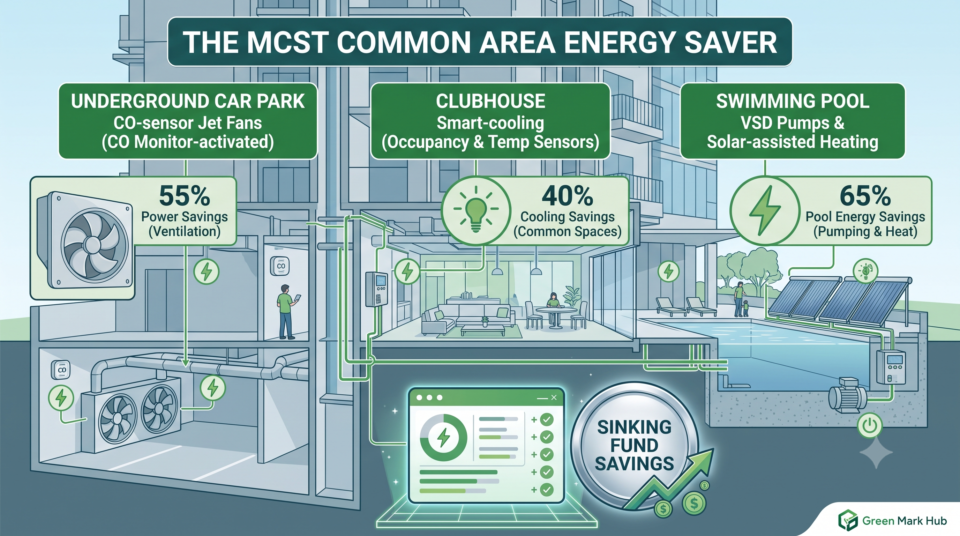
Clubhouse & Gym Cooling: Uncalibrated split-units or small central chillers running on outdated timers rather than occupancy sensors.
-
Underground Car Park Jet Fans: Ventilation fans running at 100% capacity around the clock instead of modulating based on CO (Carbon Monoxide) sensor levels.
-
Water Features & Swimming Pool Circulation: High-power pumps operating continuously without Variable Speed Drives (VSDs) or optimized filtration schedules.
The Low-CapEx Compliance Roadmap for MCSTs
Achieving Green Mark for Residential Buildings (RB) or In-Operation certification does not require a massive levy on home owners. The quickest path to compliance relies on low-CapEx, high-ROI retrofits:
-
Step 1: The Common Area Energy Audit: A targeted diagnostic to identify immediate low-hanging fruit (e.g., retrofitting car park jet fans with CO sensors and VSDs cuts fan energy consumption by up to 60%).
-
Step 2: Leveraging GMIS-EB 2.0 Grants: The Green Mark Incentive Scheme for Existing Buildings (GMIS-EB 2.0) provides co-funding of up to 50% for energy efficiency retrofits, drastically reducing upfront capital outlay for the estate.
-
Step 3: Council-Ready Financial Proposals: We translate technical engineering data into a simple 1-page financial proposal showing the exact payback period (typically under 24 months), proving to residents that the audit actually saves sinking fund reserves.
The Bottom Line
Green Mark re-certification for condominiums isn’t an added expense; it is a strategic tool to lower monthly common utility bills, prevent equipment breakdowns, and preserve the long-term resale value of the estate’s private properties.