The Legal Reality of the 90-Day Window
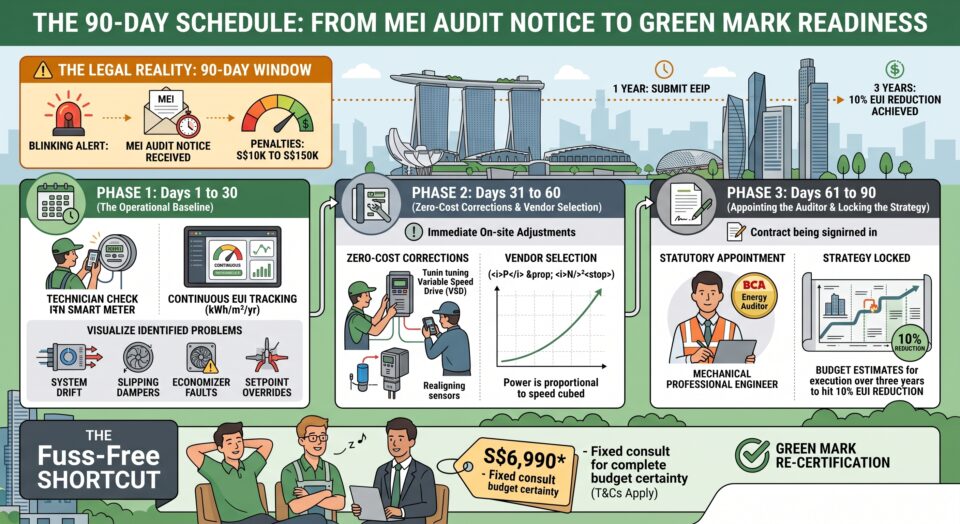
When an existing commercial or institutional building with a Gross Floor Area (GFA) of 5,000 square meters or more is flagged under Singapore’s Mandatory Energy Improvement (MEI) regime, the clock starts ticking immediately. Once you receive an audit notice from the Building and Construction Authority (BCA), you have exactly 90 days to officially appoint a qualified professional, such as a BCA-registered Energy Auditor or a Mechanical Professional Engineer.
This initial window is critical because it sets the foundation for your compliance timeline. After the 90-day deadline, you have one year to submit an Energy Efficiency Improvement Plan (EEIP) and three years from that submission date to reduce your Energy Use Intensity (EUI) by 10% compared to your historical three-year average. Failing to comply with the MEI regime can result in severe penalties, ranging from a fine of S$10,000 to S$150,000, depending on the severity and continuation of the offense.
Phase 1: Days 1 to 30 (The Operational Baseline)
The first month must be dedicated to uncovering how your building is actually performing, separating design models from real-time operational truth.
-
Sub-metering Verification: Verify that your smart meters are accurately capturing continuous EUI data (measured in kWh/m²/yr) across your central chilled water plants and HVAC systems. You need to understand exactly how far above the prescribed threshold you sit, as this gap defines whether you are looking at a minor operational tune-up or a major capital project.
-
Identify System Drift: Pinpoint the invisible operational inefficiencies driving up baseline energy use. Investigate and resolve issues like slipping dampers, economizer faults, or chilled-water setpoints that have been manually overridden and left uncorrected.
Phase 2: Days 31 to 60 (Zero-Cost Corrections & Vendor Selection)
With your data centralized, the second month focuses on rapid, low-friction improvements and securing the right consultancy partner.
-
Immediate Adjustments: Before planning any high-yield capital retrofits, execute zero-cost operational corrections. Often, 5% to 8% of excess EUI is hiding in simple schedule drift or simultaneous heating and cooling conflicts. Tuning Variable Speed Drives (VSDs) and realigning sensors can immediately chip away at your mandatory 10% reduction target.
-
Evaluate Consultants: Actively vet consultants based on their ability to handle in-operation data rather than dated, static design models. Under the MEI regime, you must prove your reduction continuously; a reduction that cannot be accurately measured is a reduction BCA will not credit.
Phase 3: Days 61 to 90 (Appointing the Auditor & Locking the Strategy)
The final month of the window is strictly about compliance filing and locking in your long-term action plan.
-
Statutory Appointment: Officially engage your Professional Engineer or BCA-registered Energy Auditor before the 90-day deadline expires. This formally satisfies the initial mandate of the BCA audit notice.
-
Draft the Roadmap: Begin outlining the exact steps and capital expenditures required to hit the mandatory 10% improvement target over the subsequent three years. Ensure that your plan integrates smoothly with continuous maintenance, as the improved energy performance must be sustained and reported on for a full year after the completion of the implementation phase.
The Fuss-Free Shortcut
Navigating MEI requirements does not have to drain your engineering team’s resources or push your facility into emergency spending. ES Management is your dedicated Green Mark Re-Certification Consultant, built to manage this critical timeline.
Why risk statutory deadlines and severe fines when you can secure complete budget certainty? For a fixed fee of S$6,990* (terms and conditions apply), we offer a completely fuss-free consultation that aligns your building with BCA standards from day one. Do not wait until the clock runs out—secure your compliance roadmap t