When a building owner or facility manager receives a Mandatory Energy Improvement (MEI) audit notice or approaches a 3-year BCA Green Mark re-certification deadline, the primary immediate concern is almost always financial: How much is this going to cost our asset, and will it drain our sinking fund?
The common misconception is that hitting a 10% Energy Use Intensity (EUI) reduction (kWh/m^{2}/yr)
requires massive, multi-million-dollar capital expenditures (CAPEX) on day one. In reality, Singapore’s regulatory framework is paired with substantial government funding mechanisms designed to offset these costs.
By structuring your compliance path around active grants, energy subsidies, and operational tuning, achieving Green Mark readiness can be transformed into a net-neutral—or even cash-flow positive—project. Here is your strategic guide to funding your building’s energy upgrade.
1. Unlocking Outcome-Based Grants: GMIS-EB 2.0
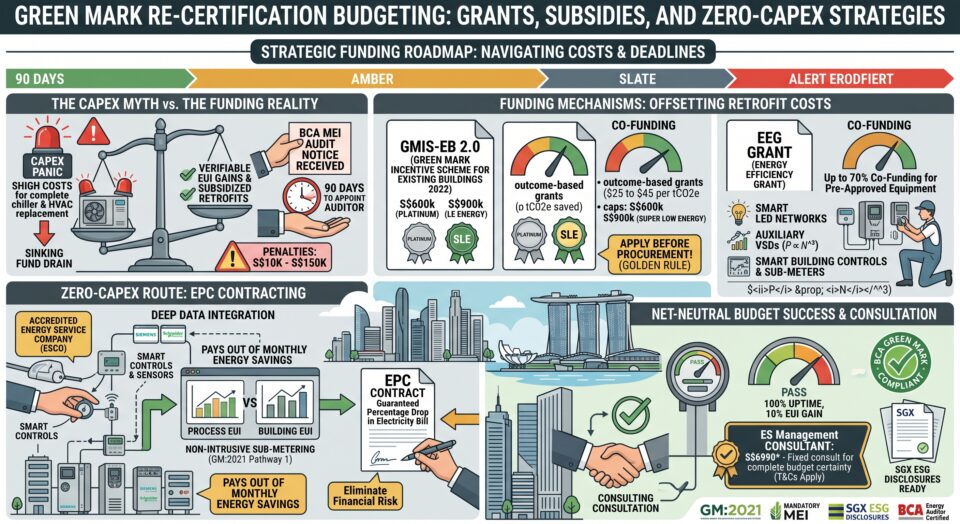
The primary government funding tool for existing buildings in Singapore is the Green Mark Incentive Scheme for Existing Buildings 2022 (GMIS-EB 2.0) administered by the Building and Construction Authority (BCA).
Unlike traditional equipment subsidies, GMIS-EB 2.0 is an outcome-based grant. It rewards asset owners based on the actual carbon emissions reduced or the higher Green Mark rating tier achieved (such as Green Mark Platinum, Super Low Energy, or Zero Energy).
Key Grant Parameters:
-
Eligible Facilities: Privately owned commercial buildings, institutional buildings, light industrial facilities, and residential common areas with a Gross Floor Area (GFA) of $5,000\text{ m}^2$ or more.
-
Funding Quantum: Grants range from S$25 to S$45 per metric ton of $CO_2$ equivalent ($tCO_2e$) saved per year, capping at significant limits based on your targeted performance badge:
-
Green Mark Platinum: Up to S$600,000 (or 50% of qualifying costs).
-
Super Low Energy (SLE): Up to S$900,000 (or 50% of qualifying costs).
-
Zero Energy (ZE): Up to S$1,200,000 (or 50% of qualifying costs).
-
The Golden Rule of GMIS-EB 2.0: Grant applications must be submitted and approved before any procurement or retrofit work begins. If you purchase equipment or sign vendor contracts before receiving BCA’s formal approval, your project forfeits grant eligibility.
2. The Energy Efficiency Grant (EEG) for Ancillary Systems
For smaller equipment upgrades, facility managers can tap into the Energy Efficiency Grant (EEG). Originally targeted at manufacturing and retail, the EEG framework provides streamlined co-funding for pre-approved energy-efficient equipment.
This scheme is ideal for targeted non-critical upgrades that yield immediate EUI drops without touching primary chiller plants:
-
Auxiliary Variable Speed Drives (VSDs): Modulating fan and pump speeds exponentially based on load demand ($P \propto N^3$).
-
Smart Building Controls & Sub-meters: Non-intrusive CT clamps and digital meters required for GM:2021 Pathway 1 EUI tracking.
-
High-Efficiency Lighting Systems: Replacing legacy warehouse or common area lighting with smart LED networks.
The EEG can co-fund up to 70% of eligible equipment costs for qualified entities, drastically lowering the upfront barrier for baseline fixes.
3. The Zero-CAPEX Route: Energy Performance Contracting (EPC)
If your asset cannot allocate upfront CAPEX despite grant availability, the Energy Performance Contracting (EPC) model offers a true zero-CAPEX alternative.
Under an EPC framework:
-
An Accredited Energy Service Company (ESCO) audits your facility, installs high-efficiency equipment (such as VSDs, smart sensors, and automated fault detection), and manages maintenance at zero upfront cost to the building owner.
-
The ESCO guarantees a specific percentage drop in your monthly electricity bill.
-
The retrofits are paid for strictly out of the verifiable monthly energy savings over a fixed period (typically 3 to 7 years).
Once the contract period ends, 100% of the ongoing energy savings revert directly to the building owner. This model completely eliminates financial risk while meeting BCA operational EUI targets.
4. A 3-Step Net-Neutral Budgeting Strategy
To optimize your re-certification budget during your 90-day audit preparation window, follow this sequence:
-
Step 1: Capture Zero-Cost Operational Fixes First (Days 1–30)
Fix sensor drift, slipping dampers, and manual setpoint overrides before applying for grants. Reducing baseline waste first ensures you don’t over-size new equipment or over-estimate your CAPEX needs.
-
Step 2: Lock in Grant Approvals (Days 31–60)
Work with a qualified Green Mark consultant to package your baseline data, energy savings modeling, and equipment scope into formal BCA grant submissions prior to procuring hardware.
-
Step 3: Execute High-ROI Retrofits with Fixed-Fee Support (Days 61–90)
Deploy grant-subsidized VSDs, smart meters, and FDD software to lock in your mandatory 10% EUI reduction.
Achieve Budget Certainty with ES Management
Navigating government grant paperwork while managing tight BCA audit deadlines shouldn’t add stress to your operations.
At ES Management, we provide a fuss-free Green Mark Re-Certification Consultancy designed to give facility leaders total financial and regulatory clarity. We assist your team in identifying eligible grant opportunities, structuring audit documentation, and executing a compliant roadmap.
-
Fixed-Fee Transparency: Get expert, end-to-end consulting starting at a flat S$6,990* (terms and conditions apply).
-
Zero Budget Surprises: No hidden administration fees or open-ended hourly billing.
Don’t let budget uncertainty delay your compliance. Contact ES Management today to evaluate your building’s grant eligibility and secure your fuss-free re-certification roadmap.