When building owners fail a BCA Green Mark re-certification audit, they rarely blame engineering failures. The chiller plant is usually tuned, the sensors are calibrated, and the LED retrofits are complete. Instead, the failure often stems from the human element: tenant plug loads, unmonitored server racks, and high-density space usage.
In Singapore’s commercial buildings, tenants typically consume 40% to 60% of total electricity. A landlord can install the most efficient chillers, but if the tenants operate on legacy behaviors, the building cannot maintain its rating.
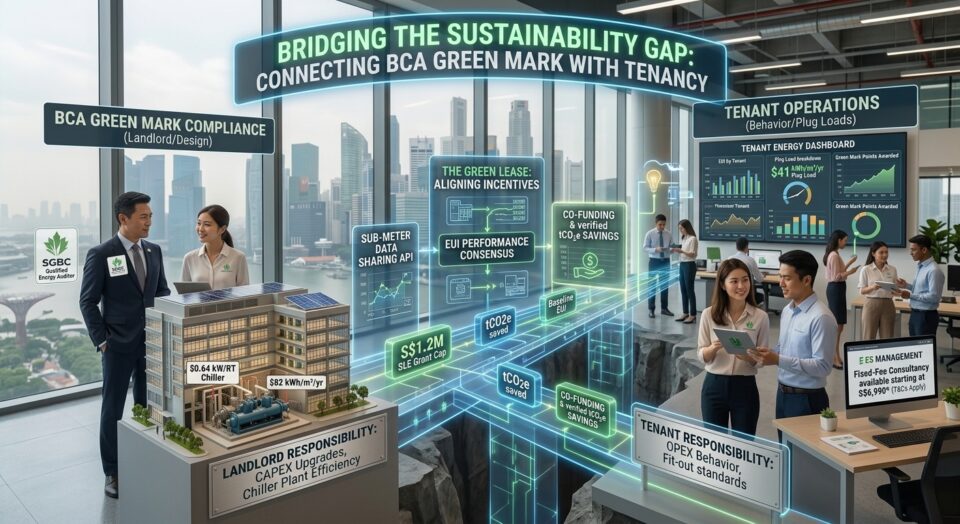
Under the latest BCA Green Mark 2.0 (GM:2021) framework, Singapore has shifted focus from “As-Built” design to “In-Operation” reality. Achieving top-tier efficiency—including whole-building Energy Use Intensity () targets—requires shifting from reactive hardware tuning to a comprehensive legal, data, and behavioral connection between Landlord and Tenant.
1. The Core Dilemma: The Split Incentive
Historically, landlords and commercial tenants suffered from a classic economic dilemma known as the Split Incentive:
The Problem: The Landlord pays for high-efficiency equipment (CAPEX), but the Tenant receives the lower utility bills (OPEX). The Landlord has no financial incentive to upgrade; the Tenant has no legal obligation to conserve.
Aligned Incentives via Connecting Frameworks
Connecting Green Mark with tenancy bridges this gap, creating a legal and behavioral framework where both parties benefit from efficiency:
2. The Legal Bridge: The Green Lease Agreement
The primary tool to connect design intent with human operation is the Green Lease Agreement (or the Green Schedule). This integrates sustainability performance directly into the legal contract between Landlord and Tenant.
Key Connected Tenancy Clauses:
A. Sub-Metering & Data Sharing Mandates
In according with Mandatory Energy Improvement (MEI) regimes and GM:2021 requirements, the landlord must have separate sub-meters for all large tenants. The lease must legally obligate both parties to share monthly energy and water consumption data (preferably automated via smart API).
B. Technical Fit-Out Standards
Tenants often build their own interiors. The Green Lease mandates that the Tenant’s initial fit-out must comply with specified Green Mark criteria:
-
Lighting Power Density (LPD): Maximum watts-per-square-meter limits during fit-outs (preventing high-draw decorative lighting).
-
Fixture Efficiency: Use only “Excellent” or “Three Tick” certified fixtures under the Water Efficiency Labelling Scheme (WELS).
C. Behavioral Logic
Lease agreements can dictate strict operational behavior to maintain shared efficiency targets:
-
Aircon Setpoints: Air-conditioning setpoints must be regulated (e.g., between 23^{\circ}\text{C} during standard partial-load conditions).
-
After-Hours Controls: Default architecture enforces automated cutoffs at 6:00 PM, requiring manual app-based overrides for overnight cooling.
3. Behavioral Science: Nudging Tenants to Conserve
A legal contract provides protection, but a landlord cannot police everyday office habits with a lawsuit. Connecting tenancy with Green Mark requires applying behavioral psychology.
Social Norming (The “Peer Benchmark” Effect)
Modern property management platforms issue monthly Tenant Energy Dashboards. Corporate ESG officers quickly intervene to adjust internal office habits to avoid ranking in the bottom percentile compared to other peer tenants in the building.
Choice Architecture (Nudge Theory)
Simple design choices drive passive savings without tenant interference:
-
Smart Lighting defaults: Sensors automatically dim perimeter lighting based on daylight harvesting, taking human memory out of the equation.
-
Friction in Extended Aircon: Requiring tenants to manually request cooling after 6:00 PM creates minor friction that discourages unnecessary overnight usage.
4. How connected tenancy earns direct Green Mark GM:2021 Points
BCA has explicitly designed GM:2021 to reward landlords who successfully bridge the landlord-tenant gap. Adopting Green Leases is no longer optional; it is a direct boost to your scorecard under the Whole Life Carbon (CN3) section:
Pro-Tip for Facility Managers: Securing just a few large anchor tenants under BCA-compliant Green Leases can instantly lock in 2 extra points toward a GoldPLUS or Platinum rating.
Regulatory & Compliance Disclaimer
Disclaimer: Information provided regarding connected tenancy strategies, Green Mark 2.0 (GM:2021) credit metrics, and Mandatory Energy Improvement (MEI) regimes is intended for educational and technical planning purposes. Grant eligibility, credit allocations, and specific EUI outcomes depend on baseline data verification, lease structure compatibility, and formal assessment by the Building and Construction Authority (BCA). ES Management provides independent engineering consultancy and does not guarantee specific application outcomes without prior technical scoping.
End Your MEI 90-Day Data Panic
Achieving predictable Green Mark re-certification requires managing both hardware performance and human behavior. Transitioning your building’s tenancy agreements to data-ready, BCA-compliant connected frameworks guarantees that your whole-building EUI remains within compliance thresholds.
At ES Management, we guide asset directors and facility teams through this exact data, legal, and operational transition:
-
Fixed-Fee Consultancy: Complete Green Mark re-certification, data auditing, and connected tenancy setup guidance starting at a fixed S$6,990 flat-fee per asset (T&Cs Apply). Total budget and technical certainty.
-
EUI Consensus & Modeling: We handle the baseline sub-metering analysis required to submit clean EUI baselines for Mandatory Energy Improvement (MEI) audits.
-
Zero Disruption Guarantee: All behavior nudges operate with safety override fallbacks to ensure uninterrupted building operations.
Avoid the 90-day data consolidation panic before your next BCA deadline. Contact ES Management today for a proactive technical audit assessment.