
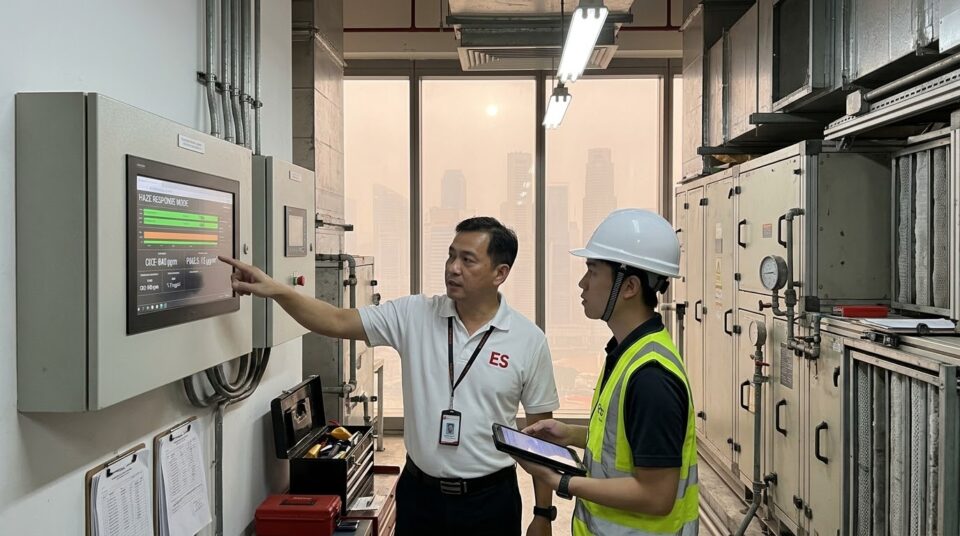
When transboundary haze alerts hit Singapore, Facility Managers (FMs) managing high-density commercial office towers face an immediate operational dilemma.
To keep outdoor smoke particulates \text{PM}_{2.5} out of office floors, the knee-jerk reaction is to manually close outdoor air dampers on Primary Air Handling Units (PAHUs) and Air Handling Units (AHUs).
While this prevents outdoor haze from infiltrating, it creates a secondary operational crisis: indoor carbon dioxide \text{CO}_2 accumulation.
During peak office occupancy hours (10:00 AM to 4:00 PM), shutting off fresh air intake causes indoor \text{CO}_2 concentrations to surge past 1200ppm within hours. This triggers occupant drowsiness, headaches, and air quality complaints—and results in an instant failure during a BCA Green Mark Health & Well-being (HWB) badge audit.
[ Traditional Haze Response ]
Fresh Air Dampers Closed ──> PM2.5 Blocked ──> Indoor CO2 Surges (>1200 ppm) ──> Failed HWB Audit & Complaints

[ Automated DCV Triage ]
Modulated Fresh Air + ePM1 60% Filtration ──> PM2.5 Filtered + CO2 Controlled (<1000 ppm) ──> HWB Compliant
The Dual Failure Traps During PSI Spikes
The\text{CO}_2Suffocation Trap: Under SS 554 (Code of Practice for Indoor Air Quality for Air-Conditioned Buildings), ambient \text{CO}_2 must stay strictly below 1000ppm. Closing outdoor air dampers completely starves the building of fresh oxygen, causing rapid air staleness.
The Fan Power Overload Trap: To filter out fine particulates, FMs often retrofit high-efficiency MERV 13/14 (ePM1 60%) filters. However, without adjusting Variable Speed Drive (VSD) fan curves, the increased static pressure drop (80–120 Pa) across dirty filter banks forces fans to consume excess energy, spiking the tower’s Energy Use Intensity (\text{kWh/m}^2/\text{yr}) and threatening Super Low Energy (SLE) benchmarks.
Step-by-Step Operational Triage Blueprint
Step 1: Implement Automated Demand Control Ventilation (DCV)
Do not rely on static damper positions or manual override during haze season. Link fresh air dampers directly to indoor \text{CO}_2 sensor clusters across office zones:
Below 800 ppm \text{CO}_2:Throttle fresh air dampers to minimum position to restrict outdoor \text{PM}_{2.5} intake
At 850–950ppm \text{CO}_2 Automatically step open dampers to flush carbon dioxide before it breaches the mandatory 1000ppm ceiling.
Step 2: Utilize Two-Stage Filtration with Differential Pressure Monitoring
Replace standard pre-filters with low-pressure-drop ePM1 filters. Install differential pressure (\Delta P) sensors across the filter banks. When \Delta P exceeds 150\text{ Pa}, trigger automated maintenance alerts to swap pre-filters before fan motors overload or slip out of efficiency windows 0.85\text{ kW/RT} central plant equivalent).
Step 3: Integrate In-Duct Air Purification
To maintain clean air without starving the building of fresh air, deploy active in-duct purification systems (e.g., bipolar ionization or ultraviolet photocatalytic oxidation). These systems actively neutralize sub-micron particulates \text{PM}_{2.5} < 15\ \mu\text{g/m}^3 within the supply air ductwork, allowing fresh air dampers to remain partially open without loading the primary filters.