The “honeymoon” period for Singapore’s existing building stock has officially ended.
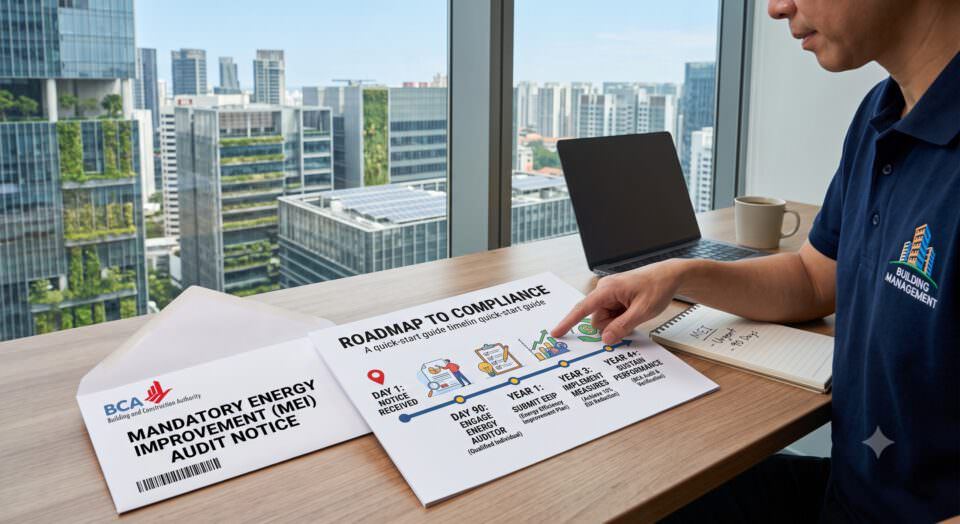
Starting in Q3 2025, the Building and Construction Authority (BCA) began issuing official Mandatory Energy Improvement (MEI) audit notices to energy-intensive existing buildings. If your asset has been flagged, you have entered a strict, legally-enforced timeline to reduce your building’s Energy Use Intensity (EUI) or face severe penalties.
This is not a voluntary “green” initiative; this is a statutory requirement under an amendment to the Building Control Act. Here is your mandatory roadmap for the next 90 days and beyond.
The MEI Regime: Who is in the Spotlight?
The MEI regime targets existing commercial buildings, healthcare facilities, and institutional buildings with a Gross Floor Area (GFA) equal to or greater than 5,000 m² that have demonstrated consistently high energy consumption.
Specifically, if your building’s EUI was within the top 25th percentile (the most inefficient) of its sub-sector for three consecutive years prior to the notice, you will have received an audit notice from the Commissioner of Building Control.
The 90-Day Priority 1: Hire a Qualified Auditor
The clock starts ticking on the date of the notice. You do not have months to plan your internal strategy.
Within 90 days of receiving the notice, a building owner must:
-
Appoint a Qualified Individual as the energy auditor. This must be a registered Professional Engineer (PE) in Mechanical Engineering or a BCA-registered Energy Auditor.
-
Formally notify BCA of the appointment.
This window is narrow. Because every flagged building in Singapore is searching for qualified auditors simultaneously, demand is extremely high. Deferred appointment until Day 89 will almost guarantee inflated consultancy costs or failure to meet the 90-day deadline.
The 1-Year Priority 2: Develop the EEIP
Once appointed, the energy auditor has one year from the audit notice date to submit a comprehensive Energy Efficiency Improvement Plan (EEIP) to BCA.
This plan is not merely a diagnostic report. It is a commitment. The EEIP must detail:
-
A quantified baseline energy consumption ($kWh/m^2/year$).
-
Proposed targeted energy efficiency improvement measures.
-
A declared reduction target of at least 10% in the building’s baseline EUI.
The 3-Year Priority 3: Implementation & Sustainment
Upon BCA’s approval of the EEIP, the building owner is legally bound to:
-
Implement all proposed measures within 3 years of the notice date.
-
Sustain the mandated 10% EUI reduction for at least another one year after implementation.
The Commercial Reality: Penalties vs. Preservation
The immediate risk of ignoring an MEI notice is legal. However, the long-term risk is commercial asset value.As SGX increasingly enforces ESG reporting, commercial tenants are refusing to occupy inefficient buildings,and banks are demanding Green Mark certifications for preferred loan rates.
The MEI regime is forcing the bottom 25% of Singapore’s assets to modernise. Do not treat this notice as a clerical issue; treat it as an urgent capital planning event.
🚨 Received an MEI Audit Notice? The Clock is Ticking.
Appointing a qualified auditor within the first 90 days is your first mandatory step. Our registered PE(Mech) auditors and GMAPs specialize in developing defensible, ROI-driven EEIPs that secure BCA approval while lowering your asset’s long-term OPEX.
[👉 Book a Free MEI Preliminary Assessment Call ]