
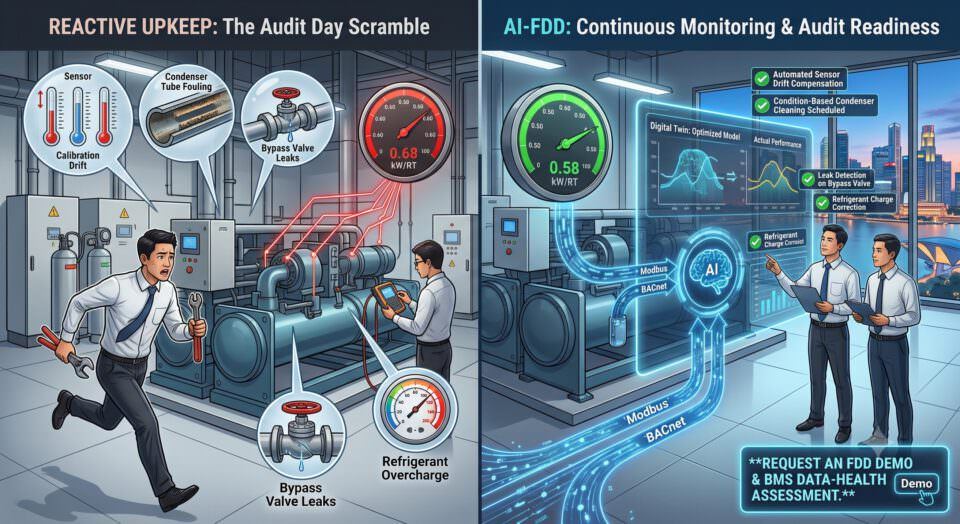
For decades, the standard operating procedure for facility maintenance has been simple: if it isn’t broken, don’t fix it. Maintenance teams rely on calendar-based preventive schedules—cleaning tubes once a year,calibrating sensors during re-certification cycles—supplemented by reactive firefighting when a critical component inevitably fails.
This traditional approach is no longer sustainable, especially in regions like Singapore where cooling accounts for up to 60% of a building’s total energy consumption. Under the current BCA Green Mark 2021 (GM:2021)framework, certification has decisive shifted from design intent to measured, verifiable operational performance. To achieve elite status like Platinum or Super Low Energy (SLE), building owners must prove their $kW/RT$ (efficiency rating) in real-time, not just on paper.
Reactive maintenance guarantees that you are losing points. The performance gap between yearly upkeep cycles is where hidden inefficiencies wreck your efficiency rating. The solution is a strategic shift to Continuous Monitoring via AI-Driven Automated Fault Detection & Diagnostics (FDD).
The Audit Day Crisis: When Reactive Upkeep Fails
Imagine the scenario: Audit day is approaching. You’ve scheduled your manual energy audit, and your facility team is working overtime to ensure the plant room looks immaculate. The auditor arrives, clamps on their calibrated flow meters, hooks up their power quality analyzers, and takes their readings.
The result comes back: 0.68 $kW/RT$. You needed 0.60 $kW/RT$ for Platinum.
Panic sets in. The plant is running, there are no alarms on the Building Management System (BMS), and tenants aren’t complaining about the temperature. Where is the inefficiency hiding?
With reactive upkeep, finding the answer is like looking for a needle in a haystack. You are forced into an expensive, chaotic scramble of retrospective troubleshooting—draining condensers, bleeding refrigerant, re-calibrating dozens of sensors—hoping to find the culprit before the assessor finalizes their report.
AI-Driven FDD eliminates this crisis.
AI-FDD: The Core Technical Advantage
AI-Driven Automated Fault Detection and Diagnostics doesn’t wait for a threshold alarm or a yearly inspection.It uses machine learning algorithms to continuously analyze thousands of concurrent data points from your existing BMS—temperatures, pressures, flow rates, motor frequencies—against a mathematically optimized “digital twin” of your plant.
When actual performance drifts from the optimized model, the AI detects the anomaly and provides automated diagnostics, pinpointing the root cause of the inefficiency before it impacts your $kW/RT$ threshold.
Here are four critical, “hidden” faults that AI-FDD catches, which traditional maintenance entirely misses:
1. Sensor Calibration Drift (The “Silent Killer”)
A chiller plant is only as smart as its sensors. If a chilled water supply temperature sensor drifts by just 0.5°C,the chiller might think it is meeting the setpoint when it is actually overcooling.
The Invisible Impact: Your chiller works harder than necessary, driving up power consumption. Traditional upkeep only catches this during standard calibration cycles, which may be years apart.
The FDD Solution: AI constantly compares the temperature relationship across all sensors (evaporator,condenser, supply, return). It mathematically identifies when one sensor’s reading is thermodynamically inconsistent with the others, alerting you to “drift” within days of it occurring.
2. Condenser Tube Fouling
The water used in cooling towers is dirty. Over time, scale, algae, and silt build up on the inside of the condenser tubes, creating a thermal barrier.
The Invisible Impact: Degrading heat transfer efficiency. To reject the required heat, the compressor must run at higher lift pressures, consuming significantly more power. Your $kW/RT$ rises gradually, often unnoticed.
The FDD Solution: Instead of waiting for a yearly tube cleaning, AI-FDD tracks parameters like approach temperature (the difference between leaving condenser water and refrigerant temperature). It alerts you the moment the approach temperature deviates from the “clean tube” baseline, allowing for targeted, condition-based cleaning exactly when needed.
3. Bypass Valve Leaks
Bypass valves are used during low-load conditions to maintain minimum flow. Sometimes, these valves get stuck partially open or develop internal seal leaks.
The Invisible Impact: Chilled water meant for the building bypasses the cooling load and returns directly to the evaporator. This forces the chiller to run at a lower, less efficient part-load ratio, and can sometimes cause unnecessary “ghost” chiller staging.
The FDD Solution: By analyzing the relationship between valve command, flow rates, and supply/return temperature differentials ($\Delta T$), AI detects when flow is moving through a bypass when it shouldn’t be.
4. Refrigerant Overcharges or Undercharges
Maintaining the precise refrigerant charge is crucial. Both overcharging and undercharging degrade the thermodynamics of the vapor compression cycle.
The Invisible Impact: Both faults reduce cooling capacity and drive up compressor workload.
The FDD Solution: AI models analyze saturation temperatures and pressures against compressor power draw. It recognizes specific parametric signatures that indicate improper charge, differentiating it from other faults like fouling or low load.
Summary: A Proactive Future for Energy Managers
AI-Driven FDD is not just a tool; it is a fundamental strategy shift. It transforms operations directors and energy managers from reactive firefighters into proactive performance guardians.
By leveraging continuous monitoring, you guarantee that your asset remains “audit-ready” every day of the year. It provides the high-fidelity data needed to justify maintainability point claims under GM:2021 Pillar In (Intelligence) modular section, and helps you avoid mandatory re-audit directives under Singapore’s increasingly strict Carbon Pricing Act.
Don’t let hidden faults wrecked your asset’s valuation on audit day. Shift your upkeep from the calendar to the cycle.
Lead Capture Hook
Do you suspect your current $kW/RT$ rating isn’t telling the whole story?
[Request an FDD Demo & BMS Data-Health Assessment.]