
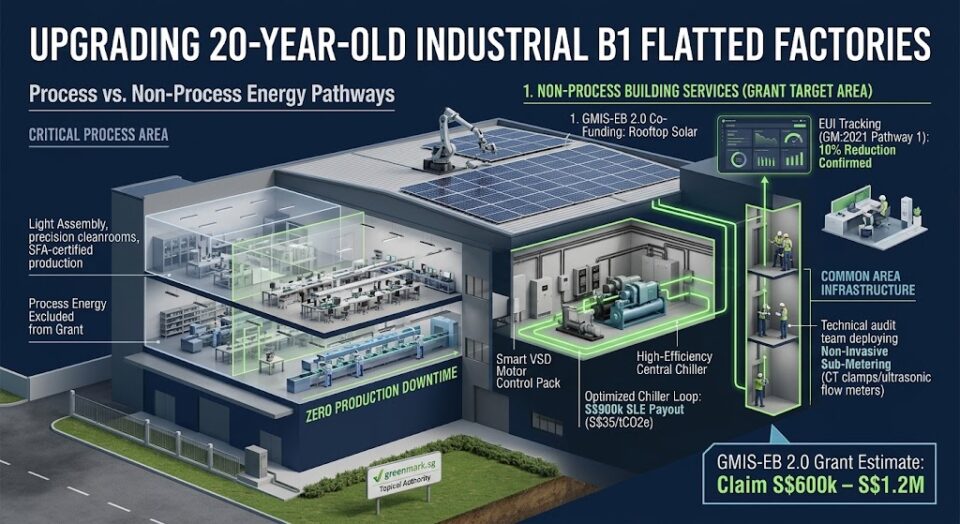
For asset managers and facilities directors operating aging B1 flatted factories in Singapore, 2026 presents a critical capital dilemma. With legacy plant hardware reaching End-of-Life (EOL), uncalibrated chiller loops, high-bay lighting inefficiencies, and aging motor drives are steadily eroding Net Operating Income (NOI). At the same time, the Building and Construction Authority (BCA) has tightened operational performance standards under Green Mark 2021 (GM:2021).
The traditional path of reactive, piecemeal hardware repairs is no longer viable. However, comprehensive plant retrofitting doesn’t have to trigger an unrecoverable CapEx shock. Under the Green Mark Incentive Scheme for Existing Buildings 2.0 (GMIS-EB 2.0), privately owned industrial facilities with a Gross Floor Area (GFA) of at least 5,000 m^2can secure up to 50% co-funding (capped between S$600,000 and S$1,200,000) for qualifying energy-efficiency upgrades.
This technical guide outlines how B1 industrial asset owners can navigate high-load plant upgrading, isolate building service energy from production processes, and secure substantial grant subsidies before hardware failure forces an emergency shutdown.
Part 1: The B1 Flatted Factory Dilemma: Process Continuity vs. EUI Targets
Upgrading B1 light industrial buildings involves a unique challenge: balancing continuous manufacturing operations with stringent Energy Use Intensity (EUI) reduction targets.
Unlike standard commercial office towers, B1 flatted factories house mixed-tenancy loads—combining corporate offices, precision light assembly, high-intensity cold rooms, and cleanrooms.
B1 INDUSTRIAL ESTATE ENERGY BREAKDOWN
CRITICAL PROCESS AREA (DO NOT TOUCH)
– Yield-sensitive cleanrooms / SFA food production | | –
Specialized process power (SSIC-defined process lines)
|
V
BUILDING SERVICES (NON-PROCESS TARGET AREA)
Central Chiller Plants & Primary/Secondary Pumps
– Common Area & Warehouse High-Bay Lighting
– Mechanical Ventilation (MV) & Office HVAC Distribution
The Process Exclusion Rule in GMIS-EB 2.0
A major misconception among industrial facility managers is that process power can be subsidised. Under BCA GMIS-EB 2.0 guidelines, energy savings derived directly from manufacturing or industrial processes are strictly excluded from grant calculations.
To qualify for co-funding, your upgrading roadmap must strategically isolate and target core building services:
-
Central Chilled Water Plants: Primary/secondary chilled water pumps, cooling towers, and variable speed drives (VSDs).
-
Mechanical Ventilation & Office HVAC: Air Handling Units (AHUs) serving common spaces and tenant office blocks.
-
Common Area Infrastructure: High-bay LED conversions, sensor-driven basement ventilation, and rooftop solar Photovoltaic (PV) installations.
By isolating non-process energy paths, B1 factory owners can achieve a 10% to 25%+ EUI reduction without risking production downtime or yield losses on the manufacturing floor.
Part 2: Demystifying GMIS-EB 2.0: Grant Mechanics & Carbon Abatement
The GMIS-EB 2.0 framework is an outcome-based cash incentive scheme. Rather than offering a fixed baseline subsidy, the grant payout is tied directly to the calculated lifetime carbon abated (tCO_2e) through your energy improvement works (EIWs).
Co-Funding Caps and Tiers
To participate, eligible B1 industrial estates must target at least Green Mark Platinum under the GM:2021 assessment framework.
| Targeted Certification Level | Funding Factor per Carbon Abated (/tCO_2e ) | Maximum Grant Cap (or 50% of Qualifying Cost) |
| Green Mark Platinum | S$25 / tCO_2e | Up to S$600,000 |
| Green Mark Super Low Energy (SLE) | S$35 / tCO_2e | Up to S$900,000 |
| Green Mark Zero Energy (ZE) | S$45 / tCO_2e | Up to S$1,200,000 |
Critical Rule on Timing: Energy Improvement Works (EIWs) must NOT commence prior to receiving the formal GMIS-EB 2.0 Letter of Acceptance from BCA. Retroactively claiming for works already underway will lead to immediate disqualification.
Part 3: The Non-Invasive 4-Step Upgrading Roadmap
Executing a major plant overhaul in a 20-year-old flatted factory requires a non-invasive diagnostic methodology. Building owners should follow this 4-step sequence:
+---------------------+     +---------------------+     +---------------------+     +---------------------+
| 1. REMOTE DATA SCAN | --> | 2. BASELINE RECT.   | --> | 3. BCA ACCEPTANCE   | --> | 4. HARDWARE RETROFIT|
| Non-invasive sub-   |     | Ultrasonic leak     |     | Submit GMIS-EB 2.0  |     | VSDs, Chiller Loop, |
| metering & sensors  |     | & sensor calibration|     | application to BCA  |     | Smart Controls      |
+---------------------+     +---------------------+     +---------------------+     +---------------------+
-
Step 1: Non-Invasive Sub-Metering & Energy Audit
Deploy non-intrusive current transformers (CT clamps) and ultrasonic flow meters to segregate process energy from non-process building service loads. Establish an empirical EUI baseline (kWh/m^2/yr).
-
Step 2: Baseline Leak & Sensor Rectification
Before replacing major CapEx machinery, fix low-hanging operational inefficiencies. Re-calibrate drifted BMS temperature/pressure sensors and repair compressed air or chilled water leaks.
-
Step 3: GMIS-EB 2.0 Application & Carbon Modeling
Calculate the projected lifetime carbon abatement (tCO_2e ) across 22 approved technology categories (including plant optimization, VSD retrofits, and rooftop PV). Submit the proposal via FormSG to secure BCA’s Letter of Acceptance.
-
Step 4: Plant Upgrading & Verification
Procure and install high-efficiency chillers, smart VSD motor controllers, and automated demand-side management systems. Validate energy savings post-stabilization to unlock the final grant tranche.
Estate Asset Enhancement: Protecting Valuation Against “Brown Discounting”
Beyond immediate grant subsidies, upgrading an aging B1 factory directly shields asset value. In Singapore’s evolving real estate market, uncertified, energy-inefficient industrial assets suffer from “brown discounting”—facing higher tenant turnover, elevated utility overheads, and refinancing penalties.
Achieving Green Mark Platinum or SLE transforms a 20-year-old asset into a prime industrial facility. It attracts MNC tenants with strict corporate ESG mandates, reduces tenant service charges, and qualifies the building owner for preferential commercial Green Loan financing.
At ES Management,, we specialize in navigating complex industrial asset retrofits, sub-meter isolation, and grant acquisition:
-
Fixed-Fee Transparancy: Complete Green Mark assessment, energy auditing, and GMIS-EB 2.0 grant management starting at a flat S$6,990 per asset (T&Cs Apply). Total budget certainty.
-
Process Power Isolation: We establish clear, audit-ready electrical boundaries that satisfy BCA requirements while protecting tenant operations.
-
Zero Operational Downtime: All recommended ACMV, AI control, and lighting retrofits are designed for seamless, non-disruptive installation.
Contact ES Management, today for an executive pre-assessment of your industrial asset.