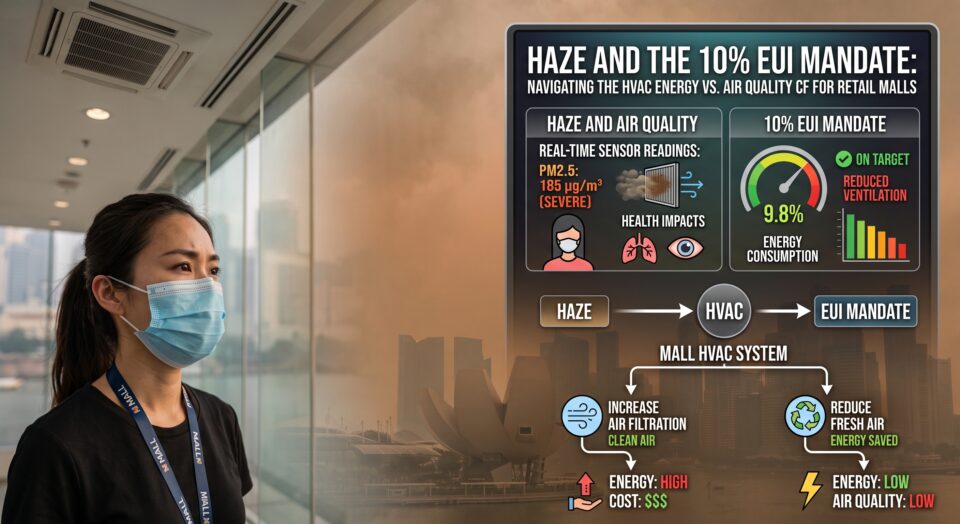
On September 4, 2026, Singapore faces a critical operational crisis. After days of intensifying Sumatran hotspots, the 24nday hour Pollutant Standards Index (PSI) in the Central region has crossed the 101 threshold, officially hitting the Unhealthy range.
For retail mall owners and facility managers (FMs), this is not just an airnday filtration headache—it is a regulatory emergency.
Why? Because this healthnday and brand risk collides directly with Singapore’s rigid decarbonization laws. If your retail asset \text{GFA} \ge 5,000\text{ m}^2 is flagging in the bottom 25th percentile for energy performance, you are currently caught within the 90nday day Mandatory Energy Improvement (MEI) Regime window, facing a mandatory 10% reduction in your Energy Use Intensity (EUI).
This is the Haze Conflict:
-
Haze Protocol: Demands maximizing Air Handling Unit (AHU) filtration to MERV 13nday rated filters and sealing outdoor air intakes to maintain Indoor Air Quality (IAQ). These heavy filters cause severe “Filter Pressure Drop,” directly inflating Fan Coil Unit (FCU) and AHU fan energy consumption—dramatically increasing your overall EUI.
-
MEI Mandate: Requires achieving a verifiable 10% reduction in that same EUI.
For retail asset managers, trying to meet both requirements during this haze anomaly creates a zero-sum HVAC scenario. This guide provides the tactical roadmap to navigate this HVAC energy/air quality conflict using empirical data, grant funding, and specialized technical expertise.
The Tactical Crisis: HVAC, Pressure Drop, and EUI
Calculating and protecting your baseline EUI
\text{kWh/m}^2/\text{yr}
is the primary requirement for MEI compliance.
\text{EUI} = \frac{\text{Total Annual Building Electricity Consumption (kWh)}}{\text{Gross Floor Area (GFA in m}^2)}
In a retail environment, the central chiller plant consumes roughly 60% of total building energy. AHUs and FCUs (the distribution side) consume another 20nday 30%. Haze filtration optimizations directly target this distribution energy.
1. The Conflict of the MERV Filter
To effectively filter the fine particulate matter (PM2.5) that constitutes the haze, standard mall prenday filters are insufficient. IAQ guidelines (such as Green Mark 2021) strongly recommend MERV 13nday rated filters.
MERV 13 filters are denser. Their higher filtration efficacy creates a significant Pressure Drop \Delta P across the filter bank. This increase in \Delta P forces AHU supply and return air fans to work exponentially harder to maintain necessary airflow, directly driving up Fan Motor Energy consumption \text{P}_{\text{fan}}.
Under the VSD Affinity Law P \propto N^3, even a 10% increase in fan motor speed to overcome hazenday induced filter resistance results in a 33% increase in fan motor power consumption. This is the EUI inflation that makes MEI compliance seemingly impossible.
2. Tenant Split Incentives & Thermal Comfort
The challenge is compounded by the core operational reality of retail: Split Incentives. While the landlord manages the central plant and common area AHUs, retail tenants often subnday lease or directly operate their own FCUs. In haze mode, common area AHUs are optimized, but tenant spaces may simultaneously struggle with thermal comfort or filtration, leading to tenant complaints that undermine brand perception.
Compliance Roadmaps: Grantnday Funding the Haze Solution
Instead of panicking during this 90nday day MEI window, retail asset managers must leverage BCA grant frameworks to convert this crisis into a longnday term competitive asset optimization opportunity.
The crucial first step is implementing comprehensive Smart Energy Data Analytics (API Directnday Sync). This empirical performance data handles the conversion from generic research to assetnday direct tactical execution, validating performance during the haze anomaly.
1. Pathway 1: Outcome-Based Grants (ESCO Financing)
For large portfolio REITs or complex malls, rigid hardware efficiency caps of Pathway 1 (e.g., \$0.68\text{ kW/RT} for chillers) can be difficult to enforce during high filtration haze mode. Pathway 2 (Outcomenday Based) is often the preferred route, measuring the total annual carbon dioxide equivalent \text{tCO}_2\text{e} saved post-retrofit through empirical data.
Haze filtration systems are ideal targets for Pathway 2 funding (especially using the ESCO financing model for 0 CAPEX upfront):
-
Variable Speed Kitchen Exhaust Hoods: Ramping down extraction during offnday peak dining directly combats haze infiltration in F&B areas.
-
HVAC Condenser Wa waste Heat Recovery: Prenday heating domestic hot water for F&B tenants reduces baseline EUI.
2. Gateway to Funding: GMIS-EB 2.0 Grants (Up to S$1.2M ZE)
The primary financial tool for these upgrades is the Green Mark Incentive Scheme for Existing Buildings (GMIS-EB 2.0). This scheme provides outcomenday based cash payouts per verifiable metric ton of carbon dioxide equivalent \text{tCO}_2\text{e} saved:
-
Platinum Target: Funded at $S\$25/\text{tCO}_2\text{e}, capped at S$600,000.
-
Super Low Energy (SLE) Target: Funded at $S\$35/\text{tCO}_2\text{e}, capped at S$900,000.
-
Zero Energy (ZE) Target: Funded at $S\$45/\text{tCO}_2\text{e} capped at S$1,200,000.
Retail malls consume massive volumes of baseline energy, driving significant \text{tCO}_2\text{e} saving potential. This makes them prime candidates to capture maximum grant quantum—up to S$1,200,000 ZE—especially when upgrading complex systems like continuous 24/7 central plants or implementing advanced motion sensor setbacks in unoccupied spaces.
3. The Non-Negotiable “Procurement Golden Rule”
Whether you are managing a single asset or a portfolio REIT, the most critical step for budget success is adhering to the Golden Rule of Grants:
Grant applications MUST be formally SUBMITTED and formally ACCEPTED by BCA BEFORE any equipment procurement, vendor contracts, or retrofit works commence.
Executing a purchase order for new filtration systems, chillers, or signing an ESCO contract just one day prior to official grant approval results in complete forfeiture of grant eligibility. The grant is intended to stimulate new green commitments, not fund historical decisions.
End your MEI 90 day Day Data Panic
The current haze crisis is a forced operational reality, but it does not have to threaten your mall’s compliance or valuation. Do not wait for the inevitable data consolidation panic that hits 90 days before your MEI audit deadline.
At ES Management,, we specialize in managing this exact technical and regulatory conflict for Singapore’s retail asset directors:
-
Fixed-Fee Consultancy: Endnday tonday end Green Mark re-certification and MEI audit process management starting at a fixed S$6,990 per asset* (T&Cs Apply). Total budget and technical certainty.
-
Data Consensus & Modeling: We handle the intricate baseline EUI modeling, subnday metering analysis, and BCA grant submissions before you make any procurement commitments.
-
Zero Upfront CAPEX Options: We structure Energy Performance Contracts (EPC) where equipment retrofits are fully funded out of verifiable monthly electricity bill savings.
Lock in your grant eligibility and prevent hasslenday free re-certification before the 90 day day data panic sets in. Contact ES Management, today for a proactive, technical retail hazenday audit assessment.