Owners and asset managers of 15-to-25-year-old B1 flatted factories across Singapore’s light industrial estates—from Kallang Way and Ubi to Jurong and Toa Payoh—face a unique operational dilemma.
On one hand, aging central air-conditioning and mechanical ventilation (ACMV) systems are driving up shared operational expenses (OPEX). On the other hand, factory managers fiercely resist energy retrofits out of fear that modifying electrical infrastructure will cause production downtime, disrupt sensitive cleanrooms, or trigger warranty issues on specialized machinery.
However, under the Building and Construction Authority (BCA) Green Mark Incentive Scheme for Existing Buildings (GMIS-EB 2.0), light industrial assets with a Gross Floor Area GFA of \ge 5, 000 \text{ m}^{2} can tap into direct co-funding.
The critical breakthrough? GMIS-EB 2.0 explicitly segregates manufacturing process power from building services.
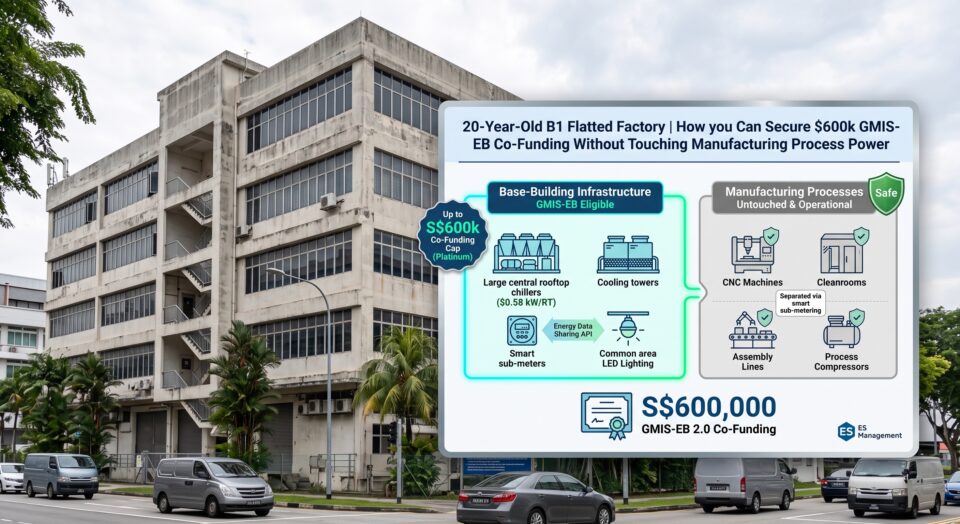
You do not need to touch a single production line, CNC machine, or cleanroom process circuit to secure up to S$600,000 (Platinum tier) or up to S$1.2 million (Zero Energy tier) in government grant funding.
1. The “Process Power” Rule: What Qualifies for Grant Support?
Many industrial property owners incorrectly assume that because their tenant mix includes light manufacturing or precision engineering, their entire building is disqualified from building-level sustainability grants.
Under GMIS-EB 2.0 guidelines, light industrial developments operating under approved Singapore Standard Industrial Classification (SSIC) codes qualify for outcome-based cash grants. The core regulatory boundary is straightforward:
The Separation Rule: Energy savings from manufacturing, industrial, and commercial processes are excluded from grant calculations. Grant co-funding applies strictly to base-building services.
┌─────────────────────────────────────────────────────────┐
│               B1 FLATTED FACTORY SITE                   │
├────────────────────────────┬────────────────────────────┤
│   ELIGIBLE FOR GMIS-EB 2.0  │   EXCLUDED FROM GRANT      │
│   (Building Services)      │   (Process Power)          │
├────────────────────────────┼────────────────────────────┤
│ • Central Chiller Plants   │ • CNC & Milling Machines   │
│ • Air Handling Units (AHUs)│ • Surface Mount Lines (SMT)│
│ • Common Area Lighting     │ • Process Cleanroom HVAC   │
│ • Car Park Ventilation     │ • Commercial Compressors   │
│ • Rooftop Solar PV Systems │ • Testing & Assembly Racks │
└────────────────────────────┴────────────────────────────┘
By establishing clean sub-metering boundaries between process power feeds and base-building utility feeds, industrial asset managers can capture substantial grant dollars while keeping tenant production lines completely untouched.
2. Unlocking the Funding Tiers: How the Math Works
GMIS-EB 2.0 is an outcome-based scheme that awards funding based on calculated lifetime carbon abatement (\text{tCO}_2\text{e}) resulting from your energy improvement works.
| Targeted Green Mark 2.0 Tier | Grant Funding Factor per tCO2e Abated | Maximum Grant Cap per Asset | Co-Funding Cap |
| Green Mark Platinum | S$25 / \text{tCO}_2\text{e} | S$600,000 | Up to 50% of qualifying cost |
| Super Low Energy (SLE) | S$35 / \text{tCO}_2\text{e} | S$900,000 | Up to 50% of qualifying cost |
| Zero Energy (ZE) | S$45 / \text{tCO}_2\text{e} | S$1,200,000 | Up to 50% of qualifying cost |
For a standard 20-year-old B1 flatted factory operating a legacy chiller plant at 0.85\text{--}1.00\text{ kW/RT}, upgrading to an optimized 0.58\text{ kW/RT} plant—combined with smart sensor controls and common area LED retrofits—easily generates thousands of tonnes of lifetime carbon savings. This typically unlocks the full S$600,000 Platinum grant ceiling.
3. Zero-Downtime Execution: Upgrading Non-Invasively
For an industrial facility operating on tight client fulfillment schedules, physical disruption is the ultimate dealbreaker. The retrofit roadmap must be entirely non-invasive:
-
AI Predictive Chiller Control Overlay: Installing a software-based predictive optimization layer on top of existing Building Management Systems (BMS). This dynamically adjusts chilled water setpoints 6.5^{\circ}\text{C} \rightarrow 8.0^{\circ}\text{C} based on weather forecasts without interrupting cooling supply.
-
Variable Speed Drive (VSD) Retrofits: Retrofitting mechanical pumps and AHU fans with VSDs during low-occupancy weekend maintenance windows.
-
Sub-Meter Data Syncing: Installing clip-on smart meters on main distribution boards (MDBs) to isolate base-building power from tenant sub-distribution without cutting main power lines.
-
Rooftop Solar PV Integration: Utilizing large, flat B1 factory roof spaces for solar panel installations, which directly count toward qualifying equipment spend under GMIS-EB 2.0.
4. The 4-Step Grant Application Roadmap
Timing is everything when applying for government co-funding. Executing contracts out of sequence will permanently invalidate your grant eligibility.
[ Step 1: Pre-Audit & Sub-Meter Isolation ]
         │ (Isolate process power from base building)
         ▼
[ Step 2: Carbon Abatement Modeling & Proposal ]
         │ (QP endorsement of projected tCO2e reduction)
         ▼
[ Step 3: BCA FormSG Submission & Letter of Acceptance (LOA) ]
         │ (CRITICAL: MUST receive LOA BEFORE signing vendor contracts)
         ▼
[ Step 4: Physical Works, Verification & Grant Disbursement ]
-
Step 1: Electrical Boundary Audit: A registered Energy Auditor maps the building’s electrical single-line diagrams (SLDs) to ensure process power circuits are cleanly excluded from the energy baseline.
-
Step 2: Carbon Abatement Proposal: The project team models the projected energy reduction (\text{kWh/m}^{2}/\text{yr}) and submits a formal retrofit proposal endorsed by a Qualified Professional (QP).
-
Step 3: Secure the BCA LOA: The application is submitted via FormSG. Physical works and vendor contracts must only commence AFTER receiving the official Letter of Acceptance (LOA) from BCA.
-
Step 4: Two-Tranche Disbursement: Grant funds are disbursed in two tranches upon proof of commencement and verified post-retrofit energy performance.
Regulatory & Compliance Disclaimer
Disclaimer: Information provided regarding B1 industrial asset retrofits, Green Mark 2.0 (GM:2021) credit metrics, and GMIS-EB 2.0 grant eligibility is intended for technical planning and educational purposes. Grant approval, qualifying cost calculations, and specific funding factor disbursements are subject to formal verification by the Building and Construction Authority (BCA) and compliance with relevant SSIC building codes. ES Management provides independent consultancy services and does not guarantee grant approval without a formal baseline audit.
Modernize Your B1 Factory with Zero Downtime
Upgrading an aging industrial asset does not mean risking production delays or swallowing massive upfront capital expenses.
At ES Management,, we specialize in navigating complex industrial asset retrofits, sub-meter isolation, and grant acquisition:
-
Fixed-Fee Transparancy: Complete Green Mark assessment, energy auditing, and GMIS-EB 2.0 grant management starting at a flat S$6,990 per asset (T&Cs Apply). Total budget certainty.
-
Process Power Isolation: We establish clear, audit-ready electrical boundaries that satisfy BCA requirements while protecting tenant operations.
-
Zero Operational Downtime: All recommended ACMV, AI control, and lighting retrofits are designed for seamless, non-disruptive installation.
Don’t leave government co-funding on the table. Contact ES Management, today for an executive pre-assessment of your industrial asset.