When a notice arrives from the Building and Construction Authority (BCA)—whether for a 3-year Green Mark re-certification or a Mandatory Energy Improvement (MEI) audit—it is easy for building owners and board members to view it as an unwelcome administrative burden.
However, viewing sustainability compliance strictly as a mechanical engineering problem misses the bigger picture.
For commercial office towers, retail malls, hotels, and industrial facilities in Singapore, energy compliance is fundamentally an asset value strategy. Managing your building’s environmental standing directly impacts your operating margins, property valuation, and regulatory risk.
Here is what decision-makers need to know about navigating BCA compliance smoothly, predictably, and cost-effectively.
1. The Real Cost of Delay: Understanding the “Brown Discount”
In Singapore’s competitive real estate landscape, institutional tenants and multinational corporations face strict corporate ESG mandates. Buildings that fail to maintain strong green certifications risk suffering from the “Brown Discount”:
-
Higher Tenant Churn: Premium corporate tenants increasingly refuse to lease space in non-certified or poorly performing buildings.
-
Depreciated Asset Valuation: Real estate valuations are tied directly to Net Operating Income (NOI). High energy overheads shrink margins and lower overall capital value.
-
Regulatory Exposure: Under mandatory compliance regimes, failing to meet BCA energy reduction targets triggers formal notices and potential financial penalties ranging from S$10,000 to S$150,000.
Keeping your building green is not just about hanging a plaque in the lobby—it is about protecting your core property value.
2. The Financial Upside: Government Subsidies & Bill Savings
Achieving compliance does not mean writing a massive blank check for expensive new equipment. In fact, most compliance pathways are designed to be cash-flow neutral or net-positive.
Government Co-Funding
The Singapore government provides substantial subsidies, such as the Green Mark Incentive Scheme for Existing Buildings (GMIS-EB 2.0) and the Energy Efficiency Grant (EEG). These schemes can co-fund up to 50% of the costs for building energy audits, smart control software, and equipment upgrades.
Lower Monthly Utility Bills
A modest 10% reduction in building energy use directly improves your monthly operational cash flow, effectively funding the compliance process through lower utility payments over time.
Crucial Rule for Board Members:
Government grants must be applied for and approved before signing contracts or purchasing equipment. Engaging vendors prematurely permanently forfeits your grant eligibility.
3. A Simple 3-Step Action Plan for Building Boards & Owners
You do not need an engineering degree to guide your property through a successful BCA audit. Decision-makers only need to follow three simple steps:
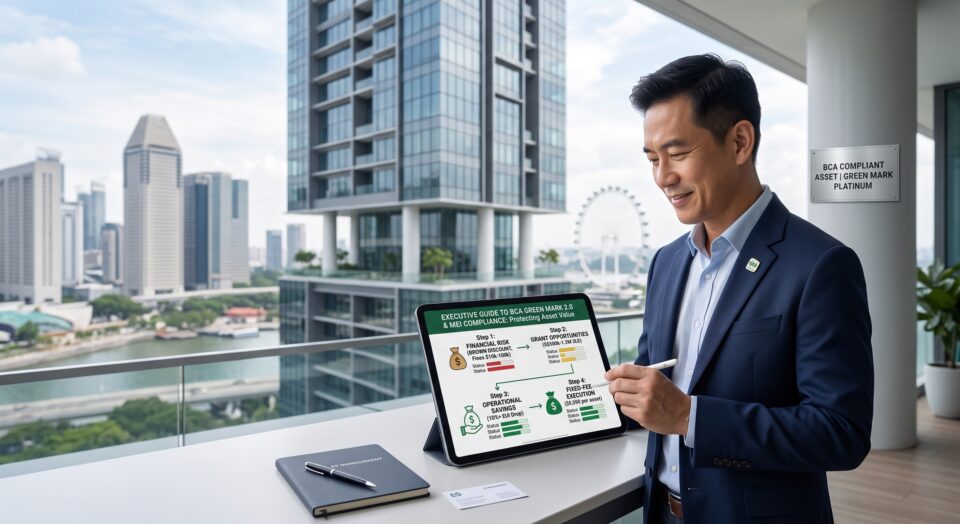
[ Step 1: Baseline Audit ] ──► [ Step 2: Grant Pre-Assessment ] ──► [ Step 3: Fixed-Fee Execution ]
  Review 12-month energy         Structure upgrades around        Lock in fixed pricing to
  data to spot quick wins.       available co-funding.            guarantee zero cost overruns.
-
Order a Pre-Audit Assessment: Have a qualified energy professional review your last 12 months of utility data. This identifies low-cost operational tweaks before committing to major equipment purchases.
-
Lock In Grant Eligibility Early: Ensure your consultancy structures your compliance roadmap around active government subsidies before any commercial commitments are signed.
-
Insist on Fixed-Fee Certainty: Avoid open-ended consulting scope fees. Choose a compliance partner that provides a clear, flat-rate pricing model so your board knows the exact cost upfront.
Protect Your Property Value with Zero Friction
Navigating BCA requirements should give your board confidence, not operational headaches or financial uncertainty.
At ES Management,, we translate complex regulatory frameworks into simple, executive-ready outcomes:
-
Fixed-Fee Clarity: Complete Green Mark re-certification and audit management starting at a flat S$6,990 per asset (T&Cs Apply). Total budget transparency with no hidden add-ons.
-
End-to-End Coordination: We manage the auditors, vendor paperwork, and regulatory submissions so your internal management team can focus on daily operations.
-
Asset-First Focus: We prioritize zero-disruption, high-ROI strategies that protect your property value and keep your tenants comfortable.
Take the panic out of your next compliance deadline. Contact ES Management, today for an executive briefing and property pre-assessment.