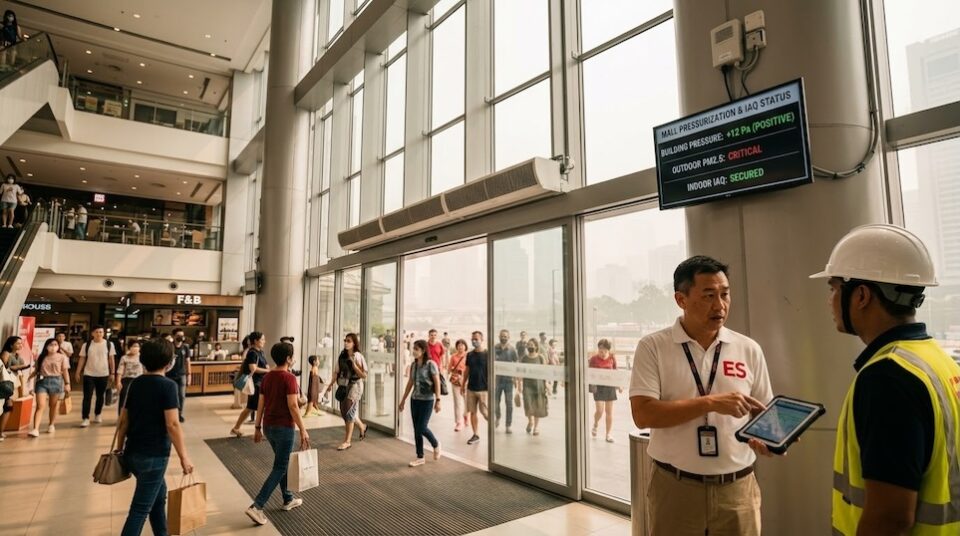
Retail malls and commercial podiums present one of the most complex Indoor Air Quality (IAQ) environments in Singapore. Unlike sealed office towers, retail assets feature high-traffic sliding entrances, multi-story atrium stack effects, and dedicated F&B kitchen exhaust systems pulling thousands of cubic meters of outdoor air into the building every hour.
During transboundary haze events, outdoor Pollutant Standards Index (PSI) spikes penetrate retail concourses within minutes. FMs who attempt to shut down outdoor air intake face immediate disruption: kitchen exhaust hoods stall due to lack of make-up air, outdoor smoke is pulled through entrance doors, and common areas experience rapid air quality decay.
                  ┌─────────────────────────────────────────┐
                  │       OUTDOOR HAZE SPIKE (PM2.5)        │
                  └────────────────────┬────────────────────┘
                                       │
            ┌──────────────────────────┴──────────────────────────┐
            ▼                                                     ▼
┌───────────────────────┐                             ┌───────────────────────┐
│ Main Entrance Sliding │                             │ F&B Kitchen Make-Up   │
│ Doors (Infiltration)  │                             │ Air (MAU Intake)      │
└───────────┬───────────┘                             └───────────┬───────────┘
            │                                                     │
            └──────────────────────────┬──────────────────────────┘
                                       │
                                       ▼
                  ┌─────────────────────────────────────────┐
                  │   Retail Concourse Contamination Risk   │
                  │   • Negative Building Pressure          │
                  │   • Dust Accumulation & Tenant Complaints │
                  └─────────────────────────────────────────┘
Why Standard Haze SOPs Fail in Retail Malls
Negative Pressure Infiltration: F&B outlets operate powerful kitchen exhaust fans that constantly draw air out of the building. If the primary make-up air units (MAUs) are throttled to block haze, the mall drops into negative static building pressure ( < 0Pa). This turns every ground-floor sliding door and loading bay into a vacuum, sucking unconditioned haze particulates (\text{PM}_{2.5} < 15\ \mu\text{g/m}^3) directly into retail corridors.
Humidity & Temperature Spikes: Over-compensating by running central air handling units at full cooling capacity to offset haze-induced heat increases chilled water demand, degrading central plant efficiency from
$0.58\text{ kW/RT}$
- up toward
$0.85\text{ kW/RT}$
- and inflating monthly utility bills.
Prescriptive Retail Haze Resiliency Playbook
1. Maintain Positive Building Pressurization
To prevent fugitive haze from entering through entrance doors, maintain a slight positive building pressure (+10\text{ to }+15\text{ Pa}) relative to the outdoors. Ensure MAUs deliver sufficient filtered outdoor air to offset F&B exhaust volumes, creating an outward airflow barrier at all building access points.
2. Multi-Stage Pre-Filtration for F&B Make-Up Air
Install high-capacity, low-resistance synthetic pre-filters alongside Electronic Air Cleaners (EACs) on all dedicated F&B Make-Up Air Units. EACs capture sub-micron haze particles using electrostatic precipitation without causing severe static pressure drops across supply fans.
3. Air Curtain & Entrance Vestibule Optimization
Re-align ground-floor entrance air curtains to discharge at an angle of 15^\circ \text{ to } 20^\circ toward the exterior. This creates an invisible mechanical barrier that deflects outdoor particulates (\text{PM}_{2.5} < 15\ \mu\text{g/m}^3) away from glass vestibules while preserving indoor air-conditioning.