For privately-owned existing buildings in Singapore, the biggest hurdle to achieving Green Mark Platinum or Super Low Energy (SLE) status has always been the upfront capital expenditure (CAPEX). With current construction costs, an energy efficiency retrofit can have a daunting payback period.
The Building and Construction Authority’s Green Mark Incentive Scheme for Existing Buildings 2.0 (GMIS-EB 2.0) was launched to tackle exactly this issue, by co-funding the gap toward better outcome-based energy performance.
If you are planning an M&E upgrade or a chilled-water plant overhaul, understanding the updated 2026 GMIS-EB 2.0 parameters is critical to maximizing your return on investment (ROI).
The Updated 2026 Grant Structure
GMIS-EB 2.0 is an outcome-based cash incentive. The grant size is determined strictly by two factors: the certified Green Mark tier achieved (based on GM:2021 standards) and the verifiable carbon emissions reduction.
As of early 2026, the updated funding levels provide enhanced support for higher ambition targets:
| Targeted Certification Rating | Funding Quantum (per tCO2e reduced) | Maximum Funding Cap |
| Green Mark Platinum | S$25 | S$600,000 |
| Super Low Energy (SLE) | S$35 | S$900,000 |
| Zero Energy (ZE) | S$45 | S$1,200,000 |
Note: All funding is capped at 50% of qualifying costs for energy improvement works.
The Catch: Why You Need Early Planning
You cannot simply complete a retrofit and apply for the grant retroactively. GMIS-EB 2.0 requires meticulous pre-retrofit planning to pass BCA’s stringent verification processes.
-
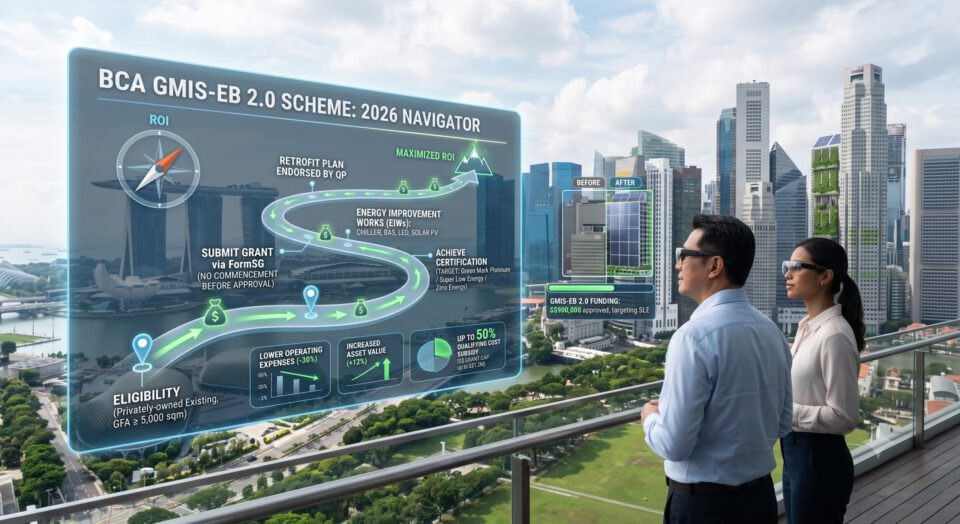
Work Must Not Commence: Your retrofit works proposed for co-funding shall only commence AFTERyour application has been approved by BCA. Commencing works before approval will disqualify you.
-
Outcome-Based Verification: The scheme is outcome-based. Disbursements occur in two tranches: the first upon approval and commencement, and the final (bulk) upon achieving the targeted certification and verifying actual energy savings in operation.
-
Minimum EUI/Performance: You must demonstrate that your existing building baseline (e.g., kW/ton) and your new design targets meet minimum prerequisite energy use intensity (EUI) requirements.
Our Strategy: Turning Compliance into CAPEX Funding
At ES.SG, we don’t just provide engineering designs; we map your energy savings directly to BCA funding computations.
We manage the entire grant submission lifecycle: conducting the baseline energy audit, developing the retrofit proposal endorsed by our registered professional engineer (PE), managing BCA review, and facilitating final verification. By choosing a Super Low Energy (SLE) target, you can unlock an additional S$300,000 in funding compared to standard Platinum—effectively subsidizing your deeper engineering upgrades.
🚨 received an MEI audit notice? received an MEI notice? received an MEI? received received received received Received Received Received BCA MEI Audit Notice?
If your building is mandated under the Mandatory Energy Improvement (MEI) regime to reduce EUI by 10%, you have entered an urgent planning window. Our consultants can integrate your mandatory compliance requirements with a voluntary upgrade toward GM Platinum or SLE to unlock GMIS-EB 2.0 co-funding, maximizing your regulatory ROI.
[👉 Book a Grant Feasibility & ROI Study Call ]
Achieve Budget Certainty with ES Management
Navigating government grant paperwork while managing tight BCA audit deadlines shouldn’t add stress to your operations.
At ES Management, we provide a fuss-free Green Mark Re-Certification Consultancy designed to give facility leaders total financial and regulatory clarity. We assist your team in identifying eligible grant opportunities, structuring audit documentation, and executing a compliant roadmap.
-
Fixed-Fee Transparency: Get expert, end-to-end consulting starting at a flat S$6,990* (terms and conditions apply).
-
Zero Budget Surprises: No hidden administration fees or open-ended hourly billing.
Don’t let budget uncertainty delay your compliance. Contact ES Management today to evaluate your building’s grant eligibility and secure your fuss-free re-certification roadmap.