
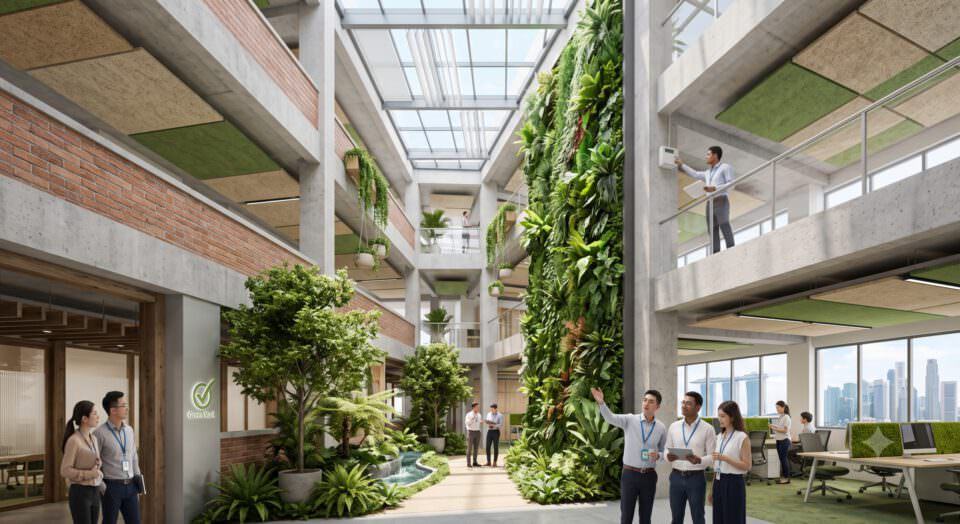
When we discuss the BCA Green Mark scheme in Singapore, the conversation quickly turns to chiller efficiencies and solar PV deployment. While crucial, these technical aspects address the building’s metabolism, not its soul. Under GM:2021, the modular section Health and Wellbeing (Hw) focuses squarely on the psychological and physiological experience of the occupants.
For owners of existing buildings, achieving SLE (Super Low Energy) status is difficult, but achieving Platinum via the Hw pillar through strategic retrofits is a powerful avenue for asset asset optimization. By focusing on lighting (daylighting and harvesting), acoustic comfort, and biophilic design, older buildings can achieve modern wellness standards.
The Daylight Harvesting Retrofit
Human physiology is governed by circadian rhythms—internal clocks set by natural light. Traditional deep-plan offices in Singapore, illuminated by uniform, static fluorescent lighting, often disrupt these rhythms, leading to fatigue and reduced productivity.
Green Mark Hw rewards designs that maximize access to natural daylight. For existing buildings, this requires clever retrofitting. While you cannot easily change the building’s orientation or window-to-wall ratio, you can implement Daylight Harvesting strategies.
A typical retrofit involves installing photosensors near the building perimeter. These sensors measure the amount of natural light entering the space and automatically dim the artificial LED lighting accordingly. This not only saves significant energy but ensures that occupants near windows are not over-lit, while creating a smoother visual transition across the floor plate.
Furthermore, GM:2021 emphasizes views to the outside. A healthy interior environmental quality (IEQ) means providing workers with a visual connection to the outdoor environment, which has been proven to lower stress levels.
The Silent Killer of Productivity: Acoustic Comfort
Acoustic comfort is often the lowest-scoring IEQ category in occupant satisfaction surveys, yet it is highly actionable under Green Mark Hw. The shift toward open-plan offices, while good for collaboration, has created noise pollution chaos.
In Singapore, the external noise from traffic and construction adds another layer of complexity. Green Mark Hw guides developers to address this through:
-
Zoning: Separating noisy focused work areas from quiet zones.
-
Sound Absorption: Retrofitting spaces with high-performance acoustic ceiling tiles, wall panels, and carpet to reduce reverberation times.
-
Sound Insulation: Ensuring partition walls between meeting rooms and private offices meet specified Sound Transmission Class (STC) ratings.
Biophilic Design: The Singapore Paradigm
Singapore brands itself as a “City in Nature.” Green Mark GM:2021 Hw codified this ambition through criteria on biophilic design. This goes far beyond placing a few potted plants in a corner.
True biophilic design integrates nature into the architectural fabric to create a physiological connection. In a Green Mark context, this is achieved through:
-
Direct Nature: Incorporating green walls, indoor water features, or potted plants throughout the office.
-
Indirect Nature: Using natural materials like wood and stone, or patterns and colors that evoke nature.
-
Space and Place: Creating architectural spaces that provide both a sense of refuge (cozy nooks) and prospect (wide, open views), mimicking natural environments.
For existing building retrofits, introducing biophilia is one of the most cost-effective ways to boost Hw scores and tenant appeal simultaneously.
Conclusion
The Hw modular section modular Section modular section Health Wellbeing modular section criteria Modular section Health Wellbeing badging Modular modular Modular Modular modular modular section Hw module Hw criteria. is the ultimate recognition that buildings are for people. By mastering the syllabus of acoustic comfort, biophilic design, and daylight harvesting retrofits, Singapore’s building owners are shifting the Green Mark narrative from how much energy a building saves, to how much vitality it gives back to its occupants.