
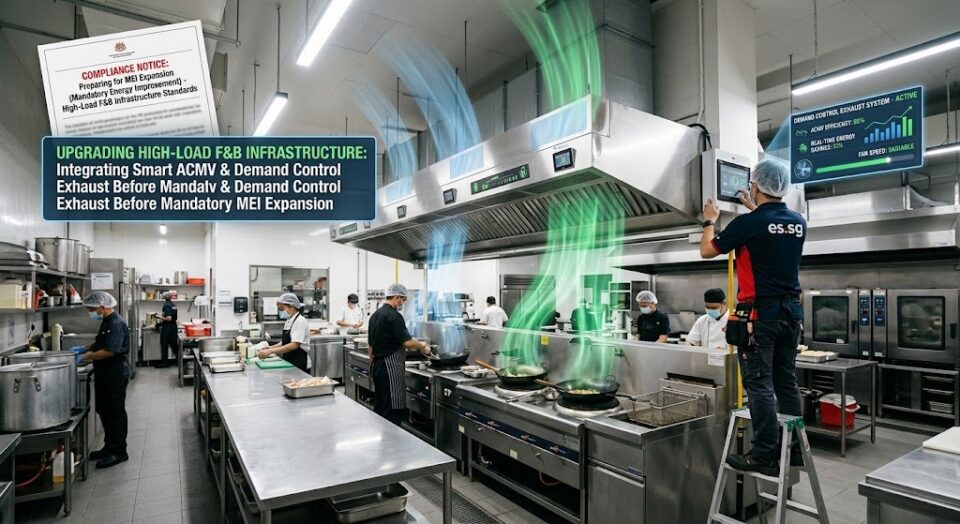
Upgrading High-Load F&B Infrastructure: Integrating Smart ACMV & Demand Control Exhaust Before Mandatory MEI Expansion
In Singapore’s competitive food production landscape, central kitchens, food hubs, and mall F&B clusters face an acute operational dilemma: managing thermal loads and heavy exhaust requirements while adhering to tightening energy efficiency benchmarks. Under the Building and Construction Authority’s Green Mark 2021 (GM:2021) framework and the expansion of Mandatory Energy Improvement (MEI) notices, high-energy F&B facilities are under intense scrutiny to optimize their Air Conditioning and Mechanical Ventilation (ACMV) performance.
Uncalibrated kitchen exhaust hoods running at fixed 100% fan speeds consume excessive electricity and draw large volumes of conditioned air out of adjacent spaces, forcing primary central cooling plants to overwork.
This guide outlines a non-disruptive infrastructure upgrading strategy—combining Demand Control Ventilation (DCV), variable-speed exhaust controls, and heat recovery systems—that cuts baseline utility spend while maintaining strict Singapore Food Agency (SFA) hygiene and environmental standards.
Part 1: The F&B Exhaust Dilemma: Air Balance vs. Energy Bleed
F&B infrastructure presents unique ACMV challenges due to intense heat, moisture, and grease generation from commercial cooking equipment.
+-------------------------------------------------------------------+
|               HIGH-LOAD F&B EXHAUST ENERGY BLEED                  |
+-------------------------------------------------------------------+
|  TRADITIONAL KITCHEN EXHAUST SYSTEM (FIXED SPEED)                 |
|  - Fans run at 100% capacity regardless of cooking activity       |
|  - Continuous loss of conditioned makeup air from dining/hall areas|
|  - High baseline utility costs & uncalibrated air balance         |
+-------------------------------------------------------------------+
                                  |
                                  v
+-------------------------------------------------------------------+
|  SMART DCV & VARIABLE SPEED EXHAUST (UPGRADED STATE)               |
|  - Optical & thermal sensors dynamically adjust fan speed          |
|  - Makeup air matched to real-time thermal load                   |
|  - 30% to 55% reduction in exhaust fan power consumption          |
+-------------------------------------------------------------------+
The Hidden Cost of Unconditioned Makeup Air
When kitchen exhaust fans run continuously at full capacity during off-peak prep hours, they create negative pressure zones. To equalize pressure, untreated ambient outdoor air or conditioned hall air is pulled into the kitchen.
This increases the sensible and latent cooling loads on the building’s chilled water plant, driving up Overall Thermal Transfer Value (OTTV) and Energy Use Intensity (EUI).
Part 2: Smart ACMV Retrofitting: Demand Control Ventilation (DCV)
Upgrading F&B exhaust infrastructure does not require replacing entire duct networks. Installing Demand Control Ventilation (DCV) retrofits smart sensor arrays directly into existing hood hoods.
Key Technological Components
-
Optical Smoke & Infrared Temperature Sensors: Detect real-time cooking activity, heat plumes, and effluent production inside the hood.
-
Variable Speed Drives (VSDs): Modulate exhaust and dedicated makeup air fan speeds automatically from 30% to 100% based on sensor signals.
-
Smart Air Balancing Dampers: Maintain correct static pressure differentials between kitchen prep areas and service corridors to prevent odor cross-contamination.
Calculated Energy & Financial Savings
| Upgrade Measure | Typical Energy Reduction | Impact on Green Mark EUI Target |
| Smart Kitchen DCV Retrofit | 30% – 55% fan power savings | Directly lowers process-adjacent building EUI |
| VSD Installation on ACMV Motors | 20% – 35% motor load efficiency | Improves overall plant $kW/RT$ efficiency rating |
| Heat Recovery Run-Around Coils | 15% – 25% reheat energy offset | Contributes to GM:2021 Super Low Energy (SLE) points |
Part 3: The Non-Disruptive 4-Step Upgrading Roadmap
For central kitchen operators and mall asset managers, maintaining zero production downtime during upgrading is critical. The following 4-step execution model ensures seamless installation:
+---------------------+     +---------------------+     +---------------------+     +---------------------+
| 1. AIRFLOW AUDIT    | --> | 2. SENSOR RETROFIT  | --> | 3. VSD INTEGRATION  | --> | 4. BALANCING VERIF. |
| Measure capture     |     | Install hood-level  |     | Link fan motors to  |     | Validate static     |
| velocities & EUI    |     | temp & optical nodes|     | smart DCV controller|     | pressure & air balance|
+---------------------+     +---------------------+     +---------------------+     +---------------------+
-
Step 1: Non-Invasive Airflow & Pressure Audit
Measure face velocity at exhaust hoods and evaluate current fan power draw (kW). Determine baseline building EUI kWh/m^2/yr.
-
Step 2: Hood-Level Sensor & DCV Mounting
Install non-intrusive optical and thermal sensors inside hood plenums during non-operating hours (e.g., overnight shifts) to prevent SFA hygiene disruption.
-
Step 3: VSD Integration & BMS Handshake
Retrofit existing exhaust fan motors with smart VSDs. Connect controllers to the central Building Management System (BMS) for real-time energy logging and alert monitoring.
-
Step 4: Air Balance Commissioning & Verification
Perform air balance testing to confirm proper capture velocity at cooking stations, ensuring strict compliance with SFA ventilation rules and BCA Green Mark airflow standards.
Estate Asset Protection: Avoiding MEI Non-Compliance Penalties
As BCA expands Mandatory Energy Improvement (MEI) notices to cover energy-intensive commercial and light industrial building types, unoptimized ACMV and exhaust systems pose a direct compliance risk.
Implementing DCV and ACMV upgrades lowers operational overheads while providing verified data logs required during 3-year Green Mark re-certification audits.
At ES Management, we specialize in transforming distressed legacy Singapore properties into competitive, high-performance green assets:
-
Fixed-Fee Certainty: Complete Green Mark assessment, energy auditing, and MEI compliance roadmaps starting at a flat S$6,990 per asset (T&Cs Apply). Budget predictability.
-
Grant Maximization: We structure retrofit roadmaps and baseline analyses specifically to maximize capital recovery through GMIS-EB 2.0.
-
Data-Driven Triage: We prioritize non-invasive AI controls and targeted retrofits that extend asset life and maximize ROI, rather than defaulting to generic, expensive demolition.
Contact ES Management today for an executive pre-assessment of your property.