
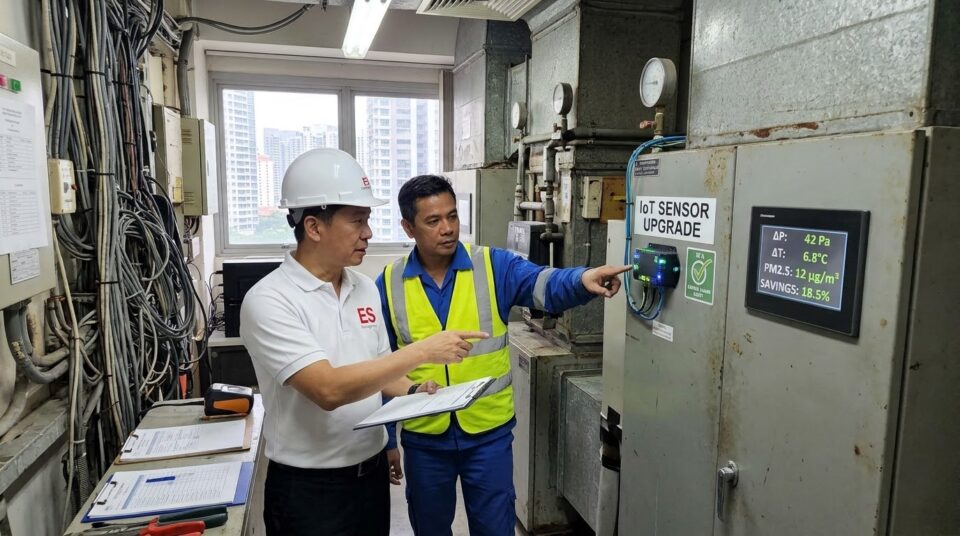
Most commercial and industrial facilities in Singapore operate on legacy Building Management Systems (BMS) that are essentially “blind and reactive.” Proprietary direct digital controllers (DDC) monitor only high-level chiller headers and major AHU supply air temperatures, relying on quarterly manual maintenance to detect issues.
By the time a tenant complains of a stuffy corner office or an uncalibrated chilled water valve gets stuck at 100% open, thousands of dollars in excess energy have already burned through the building’s operating expenditure (OpEx).
Deploying an Internet of Things (IoT) sensor layer fundamentally shifts building management from reactive fire-fighting to predictive continuous commissioning. Under Singapore’s BCA Green Mark: 2021 (GM:2021) framework, this transformation directly unlocks points under the Maintainability (MT) and Health & Well-being (HWB) sections while driving the asset toward Super Low Energy (SLE) status.
[ Legacy Reactive BMS ]
Hardwired DDC ──> High Installation Cost ──> Sparse Data Points ──> Reactive Tenant Complaints
                                                                            │
                                                                            ▼
                                                              [ Energy Penalty & Drift ]

[ Modern IoT-Driven Strategy ]
LoRaWAN / BACnet IoT Layer ──> Dense Wireless Telemetry ──> Continuous Commissioning & FDD
                                                                            │
                                                                            ▼
                                                [ Green Mark MT / HWB Badges + EUI Reduction ]
4 Ways IoT Rewrites Your Building Management Strategy
1. Decoupling Telemetry from Expensive DDC Wiring
Traditional BMS expansion requires pulling physical conduit, running shielded cabling, and adding proprietary expansion cards—often costing upwards of $1,500 to $2,500 per monitored point.
Adopting open-protocol wireless IoT networks (such as long-range LoRaWAN or mesh BLE) allows facility managers to deploy non-invasive sensors across tenant sub-zones, electrical risers, and valve actuators at a fraction of the cost. The BMS stops being a monolithic black box and becomes an agile, scalable diagnostic network.
2. Eliminating Sensor Drift with Automated Fault Detection (FDD)
Temperature and differential pressure (\Delta P) sensors naturally drift over time. A chilled water supply temperature sensor reading just 1^\circ\text{C} warmer than actual conditions forces the central chiller to over-cool the entire building loop, degrading plant efficiency by 3%–5% IoT-driven continuous commissioning layers utilize automated Fault Detection and Diagnostics (FDD) algorithms. By cross-referencing thousands of micro-readings, the system flags erratic actuator hunting or drifting calibration curves instantly, fulfilling GM:2021 Maintainability criteria for smart maintenance alert workflows.
3. Moving to True Demand-Controlled Ventilation (DCV)
Under standard operation, Fresh Air Handling Units (PAHUs) run on fixed schedules regardless of actual occupant loading. Integrating real-time IoT indoor air quality pods measuring fine particulates (\text{PM}_{2.5}), carbon dioxide (\text{CO}_2), and total volatile organic compounds (TVOCs) enables dynamic damper modulation.
During low-occupancy hours, outdoor air intake is automatically dialed back to minimize latent cooling loads. When occupancy or \text{CO}_2surges past 900ppm, fresh air dampers modulate open proportionally—safeguarding tenant cognitive health without wasting fan power.
4. Automated Energy Sub-Metering for EUI Verification
BCA Green Mark SLE and Platinum re-certification requires continuous verification of Energy Use Intensity (\text{kWh/m}^2/\text{yr}). Split-core current transformer (CT) IoT meters install directly over existing distribution boards without power shutdowns, delivering sub-circuit visibility across:
Central chiller plant vs. air-side fan power (\text{kW/RT})
Tenant plug loads vs. common-area lighting
Renewable solar PV production vs. grid import
Strategic IoT Deployment Matrix for Facility Managers
| Strategy Pillar | Legacy BMS Approach | IoT-Driven Approach | Operational Impact |
|---|---|---|---|
| Maintenance | Scheduled quarterly servicing | Continuous vibration &\Delta P
condition monitoring |
Eliminates catastrophic motor failures |
| Chilled Water | Fixed setpoint cooling | Dynamic delta-T (\Delta T) valve optimization |
Prevents Low\Delta T
Syndrome ( |
| Ventilation | Fixed timer fresh air intake | Dynamic \text{CO}_2/ \text{PM}_{2.5} |
Trims 15%–25% off ventilation energy |
| Compliance | Annual manual audit panic | Real-time automated EUI & Green Mark reporting | Guarantees audit-ready data year-round |