When building owners and facility managers in Singapore receive a Green Mark re-certification or BCA Mandatory Energy Improvement (MEI) notice, their first impulse is often to treat it as a generic compliance checklist.
However, applying a “one-size-fits-all” engineering audit to different asset classes is one of the fastest ways to blow your budget or fail your point targets.
Under the BCA GM:2021 framework, the baseline principles of energy efficiency remain constant, but the operational constraints, occupant dynamics, and point-scoring mechanics change drastically depending on your facility type.
Here is how Green Mark compliance actually works across five core Singapore real estate demographics—and how to navigate the unique traps of each.
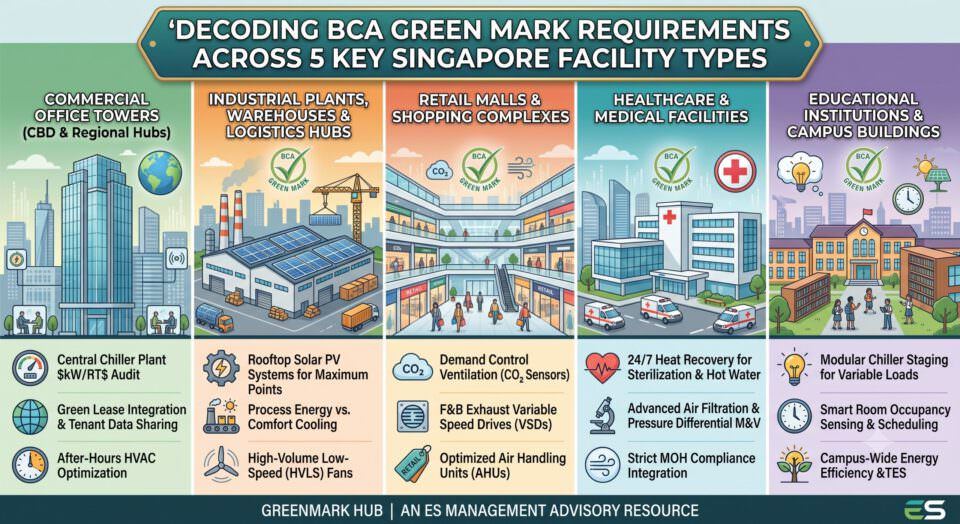
1. Commercial Office Towers (CBD & Regional Hubs)
-
The Demographic: Asset managers, REIT directors, and corporate FMs in Grade-A/B office buildings (e.g., Raffles Place, Marina Bay, Jurong Gateway).
-
The Core Reality: High tenant turnover, mixed multi-tenant operations, and strict tenant comfort SLAs (Service Level Agreements).
The Operational Challenge
In office towers, central chiller plants account for up to 60% of total building energy consumption. However, the biggest compliance hurdle isn’t just the physical plant—it’s tenant behavior and split incentives. Landlords pay for the central cooling, but tenants control internal lighting, server rooms, and plug loads.
The Green Mark Strategy
-
Green Lease Integration: Secure points under the Maintainability & Health badges by enforcing Green Leases (power density caps, mandatory energy data sharing).
-
After-Hours HVAC Optimization: Focus on tenant air-con override logic. Automated, sub-metered tenant billing for after-hours cooling prevents chilled water wastage during off-peak hours.
2. Industrial Plants, Warehouses & Logistics Hubs
-
The Demographic: Plant engineers, operations directors, and industrial park managers (e.g., JTC estates, Tuas, Changi South).
-
The Core Reality: High base loads, 24/7 process-driven operations, large footprint, and significant heat loads.
The Operational Challenge
Industrial facilities often operate heavy process machinery, compressed air systems, or cold-chain refrigeration alongside standard comfort cooling. Disentangling comfort HVAC from process energy during an M&V (Measurement & Verification) audit is complex. Furthermore, warehouses often lack centralized BMS automation.
The Green Mark Strategy
-
On-Site Renewable Energy (Solar PV): Industrial roof space is a massive asset under GM:2021. Installing solar panels yields significant points under the Energy Efficiency (EE) badge, often offsetting higher operational energy intensity.
-
Passive Design & High-Volume Low-Speed (HVLS) Fans: For non-air-conditioned logistics hubs, leveraging natural ventilation, thermal insulation, and HVLS fan integration secures low-CapEx points without expensive chiller upgrades.
3. Retail Malls & Shopping Complexes
-
The Demographic: Mall management teams, retail REIT asset managers, and property directors (e.g., Orchard Road, suburban heartland malls).
-
The Core Reality: Extremely high, fluctuating foot traffic, open-door retail concepts, high lighting power density, and extensive F&B exhaust requirements.
The Operational Challenge
Retail malls suffer massive cooling loss at entrances and open atrium spaces. F&B tenants introduce heavy latent heat and grease loads through kitchen exhaust systems, heavily straining indoor environmental quality (IEQ) and air handling units (AHUs).
The Green Mark Strategy
-
Demand Control Ventilation (DCV): Install CO₂ sensor-driven fresh air controls in AHUs. During low-traffic weekday hours, the system automatically dials back fresh air intake, saving massive amounts of cooling energy.
-
Kitchen Exhaust Air Handling: Leverage variable speed drives (VSDs) on kitchen exhaust hoods and high-efficiency filtration to secure Maintainability & Health points while curbing energy spikes.
4. Healthcare & Medical Facilities
-
The Demographic: Hospital facility directors, clinic cluster managers, and medical lab operations teams.
-
The Core Reality: Non-negotiable 24/7/365 uptime, strict infection control, precise pressure/humidity tolerances, and heavy fresh air intake requirements.
The Operational Challenge
You cannot compromise air exchange rates or filter pressure drops in a healthcare environment without risking patient safety. Standard energy-saving tactics—like raising chilled water supply temperatures or reducing air change rates—are strictly regulated by MOH codes and cannot be blindly implemented.
The Green Mark Strategy
-
Heat Recovery Systems: Hospitals generate massive waste heat from chillers while simultaneously requiring continuous hot water for sterilization and laundry. Installing desuperheaters or heat-recovery chillers creates a dual benefit that scores maximum efficiency points.
-
Advanced Filtration & Sensor Calibration: Focus heavy M&V efforts on verifying clean room pressure differentials and automated VAV (Variable Air Volume) control to prove precision efficiency without violating clinical safety parameters.
5. Educational Institutions & Campus Buildings
-
The Demographic: Estate managers, university facility heads, and international school operations leads.
-
The Core Reality: Highly intermittent occupancy (seasonal semester breaks, exam periods, weekend downtime) spread across multi-building campuses.
The Operational Challenge
Campus facilities suffer from “partial load inefficiency.” Operating a central chilled-water plant at 15% capacity during school holidays results in terrible $kW/RT$ performance unless the plant is specifically engineered for high turn-down ratios.
The Green Mark Strategy
-
Decentralized Modular Cooling: Use thermal energy storage (TES) or multi-chiller staging (combining small magnetic-bearing chillers with larger units) to efficiently handle low-occupancy periods.
-
Smart Occupancy Sensing: Leverage smart lighting and AC scheduling integrated with room booking systems to ensure vacant lecture halls automatically shut down services.
Comparison: Green Mark Priorities by Demographic
| Facility Type | Primary Green Mark Focus | Key Operational Trap to Avoid | Quickest Win for Re-Certification |
| Commercial Office | Chiller Plant $kW/RT$ & Green Leases | Unmonitored server rooms & tenant overrides | BMS trend log audit & sensor calibration |
| Industrial / Logistics | Solar PV & Process vs. Comfort separation | Ignoring compressed air & high process heat | Roof Solar Installation & HVLS fan conversion |
| Retail Malls | Demand Control Ventilation (CO₂) & Entrances | Unregulated F&B kitchen exhaust loads | Installing VSDs on AHUs and fresh air dampers |
| Healthcare | Heat Recovery & Clean Air M&V | Cutting air exchange rates (MOH violation) | Waste heat recovery for hot water systems |
| Educational Campus | Turn-down efficiency & Smart scheduling | Running large chillers during holiday low-loads | Modular chiller staging & TES integration |
The Bottom Line: Your Demographic Dictates Your Audit Path
Whether you manage an industrial plant in Tuas or a retail mall in Orchard, the secret to a fast, low-cost Green Mark re-certification is knowing where your specific building type bleeds energy and data.
What Strategy Does Your Specific Building Type Need?
Don’t guess your compliance path. ES Management provides specialized, facility-specific BCA Green Mark re-certification advisory starting from S$6,990, executed in as little as 3 months.