For plant managers, operations directors, and logistics heads in Singapore’s industrial hubs (from JTC estates in Tuas and Jurong to logistics corridors in Changi South), energy compliance is often viewed with acute anxiety.
When a BCA Green Mark re-certification notice or Mandatory Energy Improvement (MEI) trigger arrives, the primary fear isn’t the cost of the audit—it’s operational disruption.
In a 24/7 manufacturing line, cold-chain warehouse, or high-tech assembly facility, shutting down cooling systems or interfering with electrical main switchboards during an Measurement & Verification (M&V) audit can cause millions in lost yield, product spoilage, or missed delivery SLAs.
Furthermore, industrial asset owners face a technical hurdle unique to their property type: disentangling process energy from comfort HVAC cooling.
The Core Challenge: Process Energy vs. Comfort HVAC
Under the BCA GM:2021 framework, energy performance calculations for comfort air conditioning must be strictly isolated from process energy (e.g., manufacturing machinery, compressed air systems, cleanroom pressurization, and industrial freezing).
If your facility lacks granular sub-metering, process heat loads bleed into your HVAC efficiency reports, making your central chiller plant appear horribly inefficient (kW / RT) on paper.
The Non-Invasive Compliance Strategy
To maintain compliance without risking a single second of production downtime, industrial facilities must deploy a 3-step triage strategy:
-
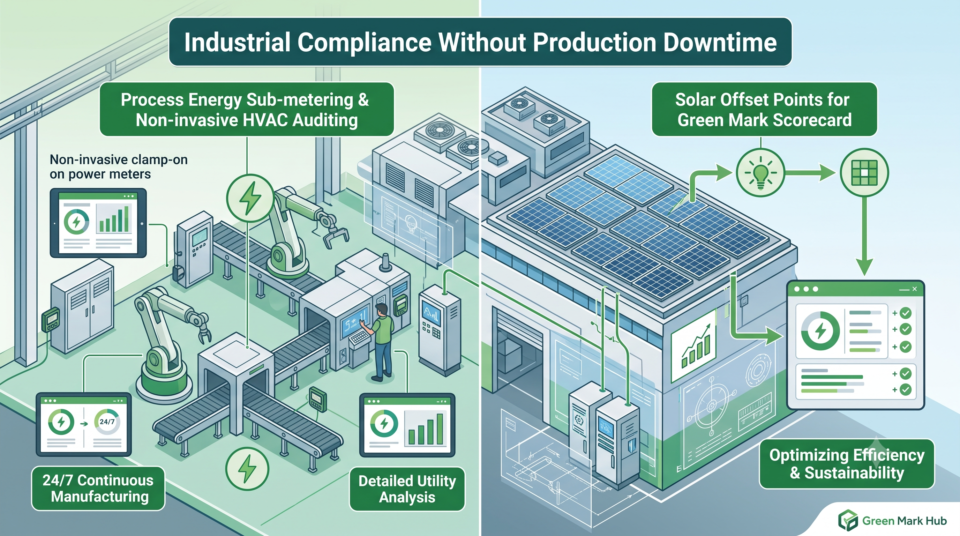
Passive Sub-Metering Isolation: Instead of rewiring main distribution boards, engineers deploy non-invasive, clamp-on CT meters and ultrasonic flow meters to digitally isolate process energy loads from comfort cooling loops.
-
Rooftop Solar PV Offsets (Pathway 2): Industrial facilities possess a massive compliance superpower—sprawling roof space. Under GM:2021 Pathway 2 (Fixed Metrics), on-site solar generation can be directly applied with a typology multiplication factor to offset HVAC efficiency shortfalls.
-
HVLS Fan & Passive Thermal Optimization: In high-ceiling logistics warehouses, integrating High-Volume Low-Speed (HVLS) fans with wall insulation drastically reduces the required air-con tonnage while maintaining required storage ambient temperatures.
The Bottom Line
A Green Mark audit for an industrial site does not require stopping a single conveyor belt or altering cleanroom pressure balances. An engineering-led, data-first approach ensures that process loads are isolated, compliance is proven, and production continues uninterrupted.
Achieve Budget Certainty with ES Management
Navigating government grant paperwork while managing tight BCA audit deadlines shouldn’t add stress to your operations.
At ES Management, we provide a fuss-free Green Mark Re-Certification Consultancy designed to give facility leaders total financial and regulatory clarity. We assist your team in identifying eligible grant opportunities, structuring audit documentation, and executing a compliant roadmap.
-
Fixed-Fee Transparency: Get expert, end-to-end consulting starting at a flat S$6,990* (terms and conditions apply).
-
Zero Budget Surprises: No hidden administration fees or open-ended hourly billing.
Don’t let budget uncertainty delay your compliance. Contact ES Management today to evaluate your building’s grant eligibility and secure your fuss-free re-certification roadmap.