
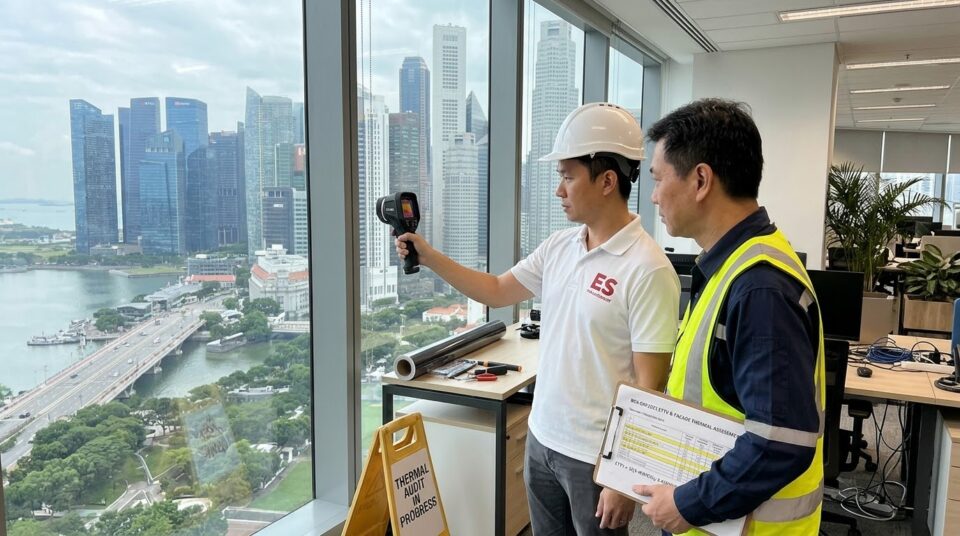
For aging commercial towers and institutional facilities built between 1990 and 2015 across Singapore, the building envelope represents an invisible operational drain. While Facility Managers prioritize central chiller plant retrofits, perimeter office zones continue to absorb intense equatorial solar radiation throughout the day.
Under the Building and Construction Authority’s BCA Green Mark: 2021 (GM:2021) framework, Envelope Thermal Transfer Value (ETTV) is a fundamental compliance pillar. Mid-life commercial buildings often register legacy ETTV figures exceeding 50\text{W/m}^2, far beyond modern Green Mark Platinum and Super Low Energy (SLE) benchmarks (< 38 \text{W/m}^2).
Replacing an entire structural curtain wall or double-glazing system requires astronomical capital expenditure (>$3,000,000) and forces disruptive tenant decanting.
By executing targeted, non-invasive fenestration retrofits—coupling advanced spectrally selective ceramic nanofilms, dynamic low-E retrofits, and internal thermal breaks—facility managers can cut the Solar Heat Gain Coefficient (\text{SHGC}) below 0.35, slash perimeter cooling loads, and bridge compliance baselines without altering the building’s external architectural facade.
┌────────────────────────────────────────────────────────────────────────┐
│                   THE PERIMETER COOLING PENALTY                        │
└───────────────────────────────────┬────────────────────────────────────┘
                                    │
    ┌───────────────────────────────┴───────────────────────────────┐
    ▼                                                               ▼
[ Legacy Single / Tinted Glazing ]                       [ The Non-Invasive Nanofilm Retrofit ]
High ETTV (> 50 W/m²)                                    Liquid Ceramic / Low-E Nanofilm (< 0.35 SHGC)
Perimeter Solar Heat Dump (Zone ΔT Spikes)               Preserves High Visible Light Transmission (VLT > 60%)
                                                                    │
    ▼                                                               ▼
[ Chiller Over-Pumping & High EUI ]                      [ Perimeter AHU Load Cut by 18% to 25% ]
Chilled Water Valves Hunt at 100%                        Chiller Sizing Reduced by 50–120 RT
Tenant Hot-Cold Discomfort Complaints                    BCA Green Mark Platinum / SLE Envelope Compliance
The Physics of ETTV in Singapore’s Equatorial Climate
Under the Singapore Standard SS 530 and BCA GM:2021 envelope calculation methodologies, Envelope Thermal Transfer Value integrates three distinct thermal transfer components:
\text{ETTV} = 12(1 - \text{WWR})U_w + 3.4(\text{WWR})U_f + 211(\text{WWR})(\text{CF})(\text{SHGC})
Where:
\text{WWR} is the Window-to-Wall Ratio.
U_w and U_fare the thermal transmittances (U-values) of the opaque wall and fenestration system respectively (\text{W/m}^2\cdot\text{K}).
\text{CF} is the solar Correction Factor based on facade orientation (East-West exposures face the highest penalties).
\text{SHGC} is the fenestration Solar Heat Gain Coefficient.
In typical commercial buildings where \text{WWR} 0.5$, the radiation term—governed by SHGC—accounts for over 70% of the total envelope heat gain.
Focusing solely on thermal insulation ($U$-value) yields marginal returns in Singapore’s non-heating climate. The real leverage lies in dramatically reducing $\text{SHGC}$ while preserving Visible Light Transmission (\text{VLT} \ge 60\%) to maintain natural daylighting without artificial lighting penalties.
3 Non-Invasive Envelope Retrofit Interventions
Intervention 1: Spectrally Selective Ceramic Nanofilms (SHGC drops to < 0.35, cuts IR by 95%+)

│

▼

Intervention 2: Perimeter Chilled Water Balancing (Recalibrate terminal VAV boxes & trim air-side CFM)

│

▼

Intervention 3: Downsize Chiller Plant Tonnage (Downsizing future chiller sizing by 10%–15% under GMIS-EB 2.0)
1. Interior Spectrally Selective Ceramic Nanofilms
Rather than removing glass panes, certified technicians apply multi-layer nano-ceramic or sputtering window films to the internal glass face during non-operating hours.
Infrared Rejection: Rejects upwards of 95% of near-infrared heat (78–2500nm).
SGHC Suppression: Lowers glass SHGC from legacy 0.65\text{--}0.75 down to \le 0.35
Daylight Optimization: Maintains neutral aesthetics and \text{VLT} \ge 60\% , satisfying BCA requirements for internal daylight factors without reflective exterior glare risks.
2. Perimeter Air-Side Re-Balancing & VAV Reset
When radiant heat through the facade drops, the sensible cooling demand in perimeter zones decreases by 18% — 25%.
Without air-side recalibration, variable air volume (VAV) terminal boxes and fan coil units (FCUs) will over-cool the space, causing chilled water control valves to hunt and tenant sub-zones to freeze. Re-tuning the Building Management System (BMS) to reset static duct pressure and reduce supply air flow rates (CFM) locks in immediate electrical savings.
3. Chiller Tonnage Downsizing & Capital Cost Avoidance
By permanently reducing peak envelope thermal loads, the total building cooling peak drops by 50 to 120 RT (Refrigeration Tons) for a standard 20-storey commercial tower. When the central plant is scheduled for replacement, the building owner can procure a right-sized, smaller chiller plant—saving hundreds of thousands of dollars in initial equipment procurement.
Envelope Performance Comparison
| Metric / Parameter | Unmodified Single/Tinted Glazing | Interior Ceramic Nanofilm Retrofit | Operational Benefit |
|---|---|---|---|
Solar Heat Gain Coefficient (\text{SHGC}) |
0.65\text{--}0.75 |
\le 0.34 |
Cuts solar radiation entry by > 50% |
Visible Light Transmission\text{VLT} |
45% — 55% | 60% — 68% | Preserves views; prevents dark office interiors |
| Envelope ETTV Score | 52–58 \text{W/m}^2 |
|
Clears Green Mark Platinum envelope threshold |
| Tenant Discomfort Hotspots | Frequent (>26^\circ\text{C}at windows) |
Uniform (23.5{–}24.5^\circ\text{C}) |
Eliminates hot-cold tenant complaints |
| Implementation Cost & Disruption | High (Facade scaffolding required) | Low (\text{S\$}0 scaffolding; internal install) |
Zero downtime or exterior aesthetic changes |