
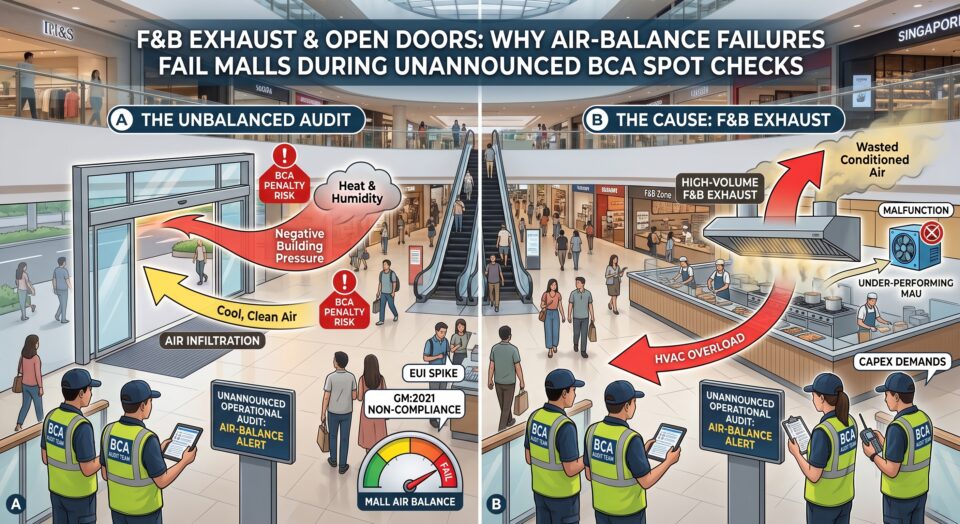
For retail mall facility managers and operations teams in Singapore, an unannounced Building and Construction Authority (BCA) spot check can turn a quiet weekday into a compliance nightmare. While central plant efficiency and baseline equipment ratings are routinely monitored, one of the most common reasons commercial shopping centers fail unexpected operational audits comes down to an invisible, ongoing operational tug-of-war: unbalanced airflow between F&B tenants and main retail concourses.
Under the GM:2021 (Green Mark 2021) framework and continuous performance monitoring expectations, keeping your mall’s energy rating intact requires managing the delicate pressure balance across open entrances, kitchen hoods, and communal cooling zones.
The Dual Threat: Kitchen Exhaust vs. Enticing Entrances
Modern retail spaces depend on open, welcoming storefronts and high-density dining precincts to maximize foot traffic. However, these architectural choices create severe HVAC vulnerabilities:
-
The F&B Exhaust Vacuum: High-volume kitchen exhaust hoods pull massive amounts of conditioned air out of the building envelope. If dedicated Make-Up Air (MAU) systems are under-performing, improperly balanced, or turned off by tenants to cut utility costs, the dining zone acts as a massive vacuum—drawing cooled air directly out of the adjacent mall corridors.
-
The Open-Door Infiltration Loop: Open-concept mall entrances and perpetually open street-level doors create an immediate pressure differential. When F&B exhaust creates negative building pressure, warm, humid outdoor air is actively sucked inside through entrance doors, dramatically spiking the sensible and latent cooling loads on Air Handling Units (AHUs).
-
Sensor Drift & Unmonitored Set-Points: Over time, airflow dampers slip, VAV (Variable Air Volume) controllers drift, and tenant fit-outs disrupt original air-balance designs. During an unannounced BCA audit, real-time Energy Use Intensity (EUI) ($kWh/m^2/yr$) measurements quickly reflect this wasted cooling energy.
The Spot-Check Penalty: Where Malls Get Caught
When BCA auditors inspect operational assets, they don’t just review static design submissions—they evaluate real-time performance indicators and maintainability metrics:
-
Fan Power Limitation Violations: As AHUs work overtime to overcome warm air infiltration, fan speeds ramp up past their maximum allowable Fan Power Density Limits ($W/CMH$), triggering immediate non-compliance warnings.
-
Loss of Maintainability & Intelligence Badges: Malls targeting specific GM:2021 Badges risk losing their Maintainability (Mt) and Intelligence (In) standings if building management systems (BMS) fail to detect and automatically correct major pressure imbalances.
-
Unplanned CAPEX Demands: Remedying major airflow failures after a failed audit often forces emergency air-balancing overhauls, duct modifications, or costly air-curtain retrofits during peak operating hours.
3 Steps to Secure Your Air Balance Before Audit Day
1. Enforce Tenant Fit-Out & MAU Interlocks
Ensure lease agreements and operational rules strictly regulate F&B tenant ventilation. Interlock kitchen exhaust hoods with dedicated make-up air fans so exhaust cannot operate without proportional, dedicated fresh air supply—preventing negative pressure from pulling air out of common mall zones.
2. Deploy Smart Pressure Sensors & Automated Air Curtains
Upgrade primary building entrances with differential pressure sensors linked to smart air curtain controls and automated door-closure defaults. When internal negative pressure spikes, automated controls dynamically adjust entrance air barriers to block ambient humidity and heat gain.
3. Implement Continuous CO2 and Air-Balance Auditing
Relying on a 3-year re-certification cycle leaves too much room for operational drift. Utilizing real-time airflow monitoring and automated Fault Detection and Diagnostics (FDD) allows facilities teams to catch fan degradation, damper failures, and airflow imbalances weeks before an auditor steps foot on site.
By proactively auditing kitchen exhaust balance and entrance infiltration, retail asset managers can protect their GM:2021 rating, avoid costly emergency re-balancing, and maintain tenant comfort without sacrificing energy efficiency.
Let ES Management handle the hassle. We offer a completely fuss-free Green Mark Re-Certification Consultant service, ensuring you meet BCA’s standards without the headache.
Visit ES.SG/ +65 9107 0587/ eddie@es-mgt.com
Focus on your business while we manage the compliance. Get started today for just S$6990*.
*Terms and conditions apply.