
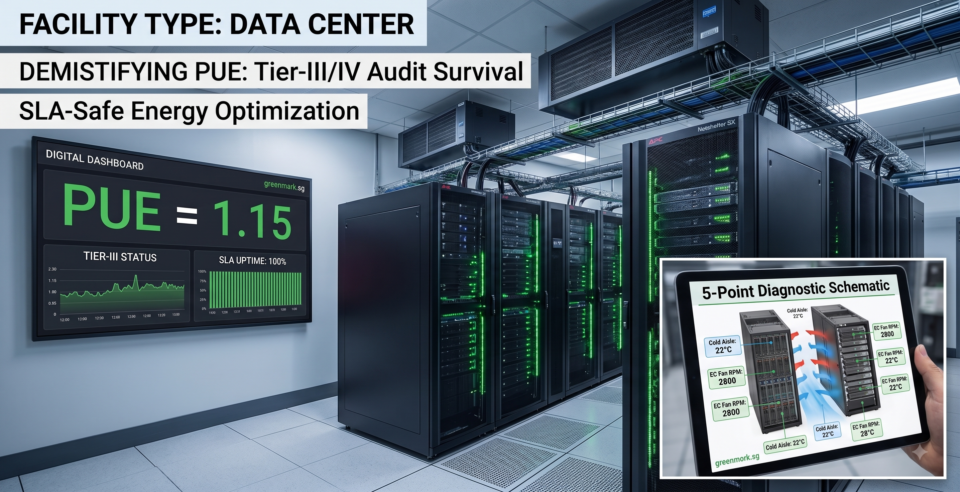
In the data center and high-tech manufacturing sector (spanning facilities across Jurong, Changi Business Park, and Loyang), one metric governs all operations: 100% Uptime.
Operating under strict Tier-III or Tier-IV Uptime Institute standards, data center facility managers handle extreme power densities and server heat loads. Service Level Agreements (SLAs) with enterprise clients enforce harsh financial penalties for any thermal excursion or power disruption.
When BCA slaps a commercial data center or enterprise server hub with an MEI notice or mandatory Green Mark requirement, the reaction is often sheer dread.
Facilities teams fear that auditors will demand aggressive chilled water set-point increases or airflow throttling that could trigger hot-spot thermal runaways and server downtime.
The Core Challenge: High Power Usage Effectiveness (PUE) vs. Risk Aversion
Singapore’s tropical climate makes achieving low Power Usage Effectiveness
PUE = \frac{\text{Total Facility Power}}{\text{IT Equipment Power}}
notoriously difficult. Cooling systems account for up to 40% of a data center’s total power consumption.
Because risk-averse engineering teams often over-cool server halls (running chillers at low temperatures and fans at maximum speed), PUE scores drift upward, triggering regulatory scrutiny under MEI thresholds.
The Uptime-Safe PUE Reduction Strategy
Lowering PUE to meet BCA standards does not require taking risks with client IT infrastructure. The path to compliance lies in precision thermal management:
-
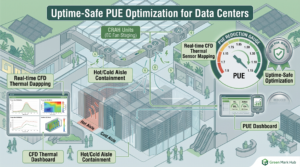
Hot/Cold Aisle Containment Optimization: Preventing the short-circuiting of supply and return air through physical containment structures dramatically increases air-handling efficiency, allowing cooling units to operate at higher return air temperatures safely.
-
Chilled Water Supply Temperature Reset (Non-Invasive Scaling): Gradually raising chilled water supply temperatures by 1^\circ\text{C} to 2^\circ\text{C}—guided by real-time computational fluid dynamics (CFD) sensor mapping—slashes chiller compressor energy by up to 6% without exceeding ASHRAE thermal guidelines for IT equipment.
-
Variable Speed Drive (VSD) Fan Staging on CRAHs: Retrofitting Computer Room Air Handler (CRAH) units with electronically commutated (EC) fans and variable speed drives allows airflow to dynamically match real-time server rack utilization rather than running at 100% constant speed.
The Bottom Line
Meeting BCA MEI targets in a data center is about eliminating wasted cooling capacity, not exposing servers to heat risk. Precision thermal containment and smart CRAH staging reduce PUE safely while preserving 100% SLA uptime guarantees.