
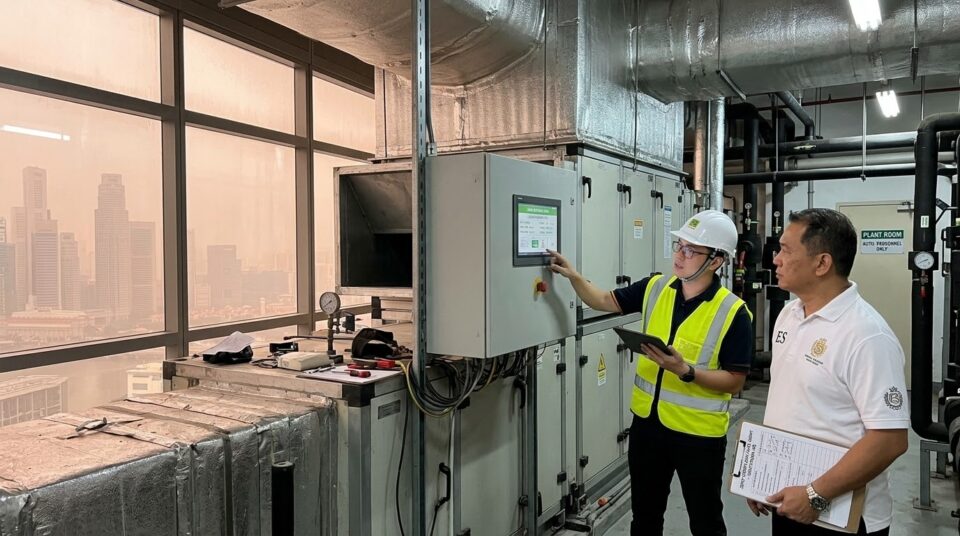
Hotel Facility Managers (FMs) and Chief Engineers face a unique operational nightmare during transboundary haze events. Unlike office tenants who leave at 6:00 PM, hotel guests remain in their rooms 24/7, demanding whisper-quiet acoustic environments, precise temperature control, and odor-free air.
When outdoor haze spikes (\text{PM}_{2.5} > 55\ \mu\text{g/m}^3), the instinctual reaction to retrofit high-efficiency MERV 13 filters into guestroom Fan Coil Units (FCUs) creates immediate guest friction:
Acoustic Noise Spikes & Airflow Failure: Guestroom FCUs are designed for low static pressure (20\text{--}30\text{ Pa}). Forcing dense physical filters into FCU filter slots increases static resistance (\Delta P > 100\text{ Pa}), causing fan motor hums, reduced supply airflow, and guest complaints.
Humidity & Mold Proliferation: Reduced airflow across FCU cooling coils impairs latent heat removal. Relative humidity inside guestrooms surges past 65%, creating a breeding ground for mold while degrading the hotel’s Green Mark Health & Well-being (HWB) audit standing.
[ FCU Filter Retrofit Trap ]
Physical MERV 13 in FCU ──> High Static Pressure (ΔP > 100 Pa) ──> Fan Hum & Low Airflow ──> Humidity > 65% & Complaints
[ PAHU Centralized Triage ]
Primary Air Unit Filtration + Active Duct Ionization ──> Clean Fresh Air ──> FCU Runs Quiet & Dry ──> HWB & Guest Approval
Step-by-Step Hospitality Haze Triage
1. Centralize Air Scrubbing at the PAHU Level
Shift the filtration burden entirely away from individual guestrooms to the primary outdoor air handling units (PAHUs). Upgrade PAHU pre-filtration to ePM1 60% with electronic air cleaners (EACs). This ensures outdoor fresh air delivered to guest corridors and rooms is pre-scrubbed of sub-micron particulates before entering local FCUs.
2. Deploy In-Duct Active Purification
Integrate non-ozone bipolar ionization or UV-PCO modules into main supply air ducts. Active ions travel through ductwork to agglomerate fine particulates ($\text{PM}_{2.5}$) and neutralize volatile organic compounds (TVOCs) inside guest rooms without imposing static pressure resistance on FCU fan motors.
3. Maintain Positive Guestroom Static Pressure
Calibrate toilet exhaust fan speeds to maintain a slight positive air balance relative to external corridors and building facades. This prevents unconditioned smoke particulates and humidity from pulling in through window seals or balcony sliding doors.
Protect Your Hotel’s Guest Experience & Green Mark HWB Badge
Don’t let seasonal haze compromise guest satisfaction or trigger mold complaints across your room inventory. ES Management provides a specialized S$6,990 Fixed-Fee Hotel IAQ & FCU Pre-Assessment:
PAHU & FCU Acoustic/Airflow Audit: Evaluate static pressure drops (Pa) and noise criteria (NC levels) across fresh air circuits.
IAQ & Dehumidification Optimization: Balance central fresh air supply to maintain room humidity below 60% without overloading FCUs.
GMIS-EB 2.0 Grant Protection: Map qualifying air-side and filtration retrofits under government co-funding schemes (up to 50% or S$600k).