
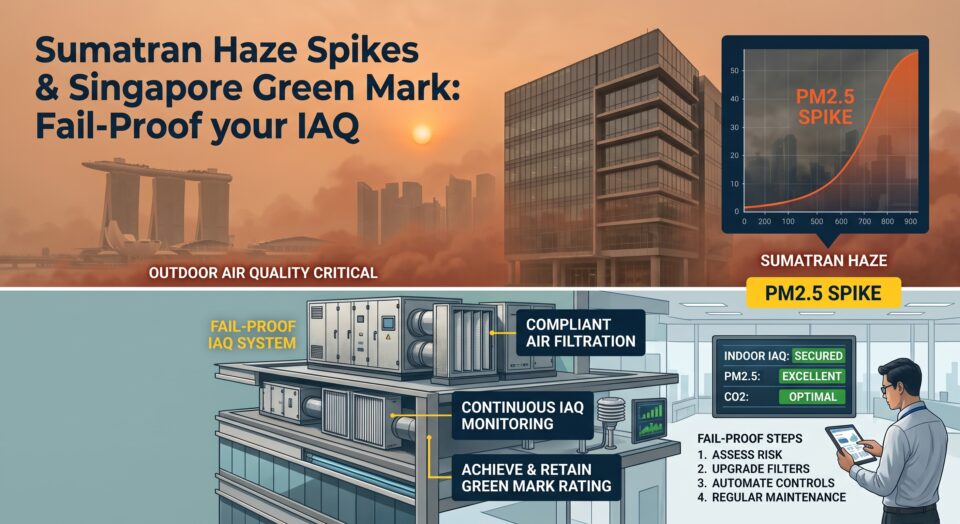
When transboundary Sumatran haze hits Singapore and 24-hour Pollutant Standards Index PSI levels cross into the Unhealthy range (>100), facility managers (FMs) of retail malls, commercial office towers, and industrial spaces face an immediate operational conflict: Air Filtration vs. Indoor Environmental Quality (IEQ) Compliance.
Under the BCA Green Mark 2.0 (GM:2021) Health and Wellbeing (HWB) and Maintainability badges, building owners are evaluated on continuous empirical indoor air quality. Simply shutting off fresh air dampers to keep out fine particulate matter \text{PM}_{2.5} without dynamic control leads to rapid carbon dioxide accumulation (\text{CO}_2 > 1000ppm), causing building occupants drowsiness and failing statutory BCA audit benchmarks.
1. The Haze Dilemma: Balancing \text{PM}_{2.5} Filtration and \text{CO}_2 Ventilation
During haze events, static HVAC controls force FMs to make an expensive trade-off between energy consumption, indoor air purity, and statutory compliance.
Plaintext
Static Damper Operation (The Haze Trap)
├── Option A: Open Dampers  --> Intakes PM2.5 haze particulates; overburdens MERV filters.
└── Option B: Close Dampers --> Traps indoor CO2 (>1000 ppm); fails BCA IEQ audit standards.

Dynamic DCV Solution (Automated Compliance)
└── Optical & CO2 Sensors  --> Modulates VSD fan speeds (30% idle to 100% load);
                              maintains positive indoor pressure and fresh air balance.
Deploying Demand Control Ventilation (DCV) integrated with real-time optical and gas sensors allows Air Handling Units (AHUs) to modulate fan speeds dynamically, maintaining positive building pressurization while keeping both $\text{PM}_{2.5}$ and $\text{CO}_2$ within compliant ranges.
2. Haze Preparedness vs. Green Mark Audit Criteria
| Operational Metric | Standard Baseline | Haze Event Impact | BCA GM:2021 Audit Benchmark |
| Fine Particulates ($\text{PM}_{2.5}$) | < 15\ \mu\text{g/m}^3 | Surges to $> 55\text{ }\mu\text{g/m}^3$ outdoor | < < 15\ \mu\text{g/m}^3 indoor continuous monitoring |
| Carbon Dioxide ($\text{CO}_2$) | < 700\text{ ppm} | Exceeds $1000\text{ ppm}$ if dampers close | Must remain $< 1000\text{ ppm}$ across all occupied zones |
| Total Volatile Organics (TVOC) | < 500\ \mu\text{g/m}^3 | Accumulates under poor air exchange | < 500\ \mu\text{g/m}^3 verified via calibrated sensors |
| Central Air-Side Draw | Baseline \text{kW/RT} | Spikes due to filter pressure drop | Maintains overall baseline EUI \text{kW/RT} |
3. Plug-and-Play Boardroom Justification Memo
FMs can customize and submit the fill-in-the-blanks template below to justify emergency IAQ monitoring and sensor calibration funding:
Plaintext
MEMORANDUM

TO:       [Management Committee / Board of Directors / CFO]
FROM:     [Facility Management Department / FM Name]
DATE:     [Date / Budget Cycle]
SUBJECT:  IAQ Sensor Calibration & Haze Resiliency Budget Proposal

PROPERTY: [Building Name / Asset Location]

1. EXECUTIVE SUMMARY
To maintain statutory BCA Green Mark Health & Wellbeing (HWB) badge compliance and safeguard indoor air quality during transboundary haze alerts, the Facility Management team requests approval for an IAQ Diagnostic Audit and Sensor Calibration exercise for an initial fee of [S$6,990 / Proposed Amount].

2. OPERATIONAL RATIONALE
- BCA Compliance Protection: Prevents indoor CO2 spikes (>1000 ppm) and PM2.5 accumulation that trigger audit non-compliance during 3-year Green Mark renewals.
- Occupant Health & Productivity: Ensures automated Demand Control Ventilation (DCV) maintains clean air filtration without over-consuming ACMV power.
- Grant Co-Funding Eligibility: Assesses eligibility for GMIS-EB 2.0 grant co-funding (covering up to 50% or S$600k–S$1.2M of qualifying smart BEMS and sensor retrofits).

3. PROPOSED BUDGET ALLOCATION
- Fixed-Fee Diagnostic Pre-Assessment & Scoping: [S$*,*** / Fixed Fee Scope]
- IAQ Sensor & Flow Meter Calibration (Est.):    [S$*,*** / Estimated OPEX]
- Total Initial Budget Requested:                [S$*,***]

4. NEXT STEPS
Upon authorization, FM will engage an accredited ESD consultancy to verify IAQ sensor accuracy, audit AHU filtration efficiencies, and finalize BCA compliance filings.
4. Key Criteria for Procuring an Accredited IAQ & Audit Partner
When selecting an external consultancy to audit your building’s indoor environmental quality and Green Mark standing, verify these baseline credentials:
-
Fixed-Fee Audit Scoping: Request transparent pre-assessment pricing capped at S$6,990 per building asset to establish clear pre-audit baselines.
-
Accredited Audit Personnel: Ensure lead auditors hold Green Mark Manager (GMM), Green Mark Facility Manager (GMFM), or ISO 50001 credentials.
-
End-to-End Grant Administration: Confirm full management of GMIS-EB 2.0 application filings directly with BCA to subsidize up to 50% of qualifying sensor and HVAC control retrofits.
-
At ES Management,, we specialize in navigating complex industrial asset retrofits, sub-meter isolation, and grant acquisition:
-
Fixed-Fee Transparancy: Complete Green Mark assessment, energy auditing, and GMIS-EB 2.0 grant management starting at a flat S$6,990 per asset (T&Cs Apply). Total budget certainty.
-
Process Power Isolation: We establish clear, audit-ready electrical boundaries that satisfy BCA requirements while protecting tenant operations.
-
Zero Operational Downtime: All recommended ACMV, AI control, and lighting retrofits are designed for seamless, non-disruptive installation.
Contact ES Management, today for an executive pre-assessment of your industrial asset.
-