In the high-stakes world of Singapore real estate, the Building and Construction Authority’s (BCA) Green Mark certification is no longer just a “nice-to-have” badge. It is a regulatory necessity, a major driver of asset valuation, and a critical component of corporate sustainability mandates.
But the road to GoldPLUS, Platinum, or the coveted Super Low Energy (SLE) status is often seen as a grueling, multi-year marathon through expensive mechanical overhauls, disruptive facade renovations, and complex behavior-change programs.
What if there was a shortcut? A way to jumpstart your score, offset weaknesses in other categories, and accelerate your timeline without touching your existing tenants or mission-critical systems? There is. It’s on your roof.
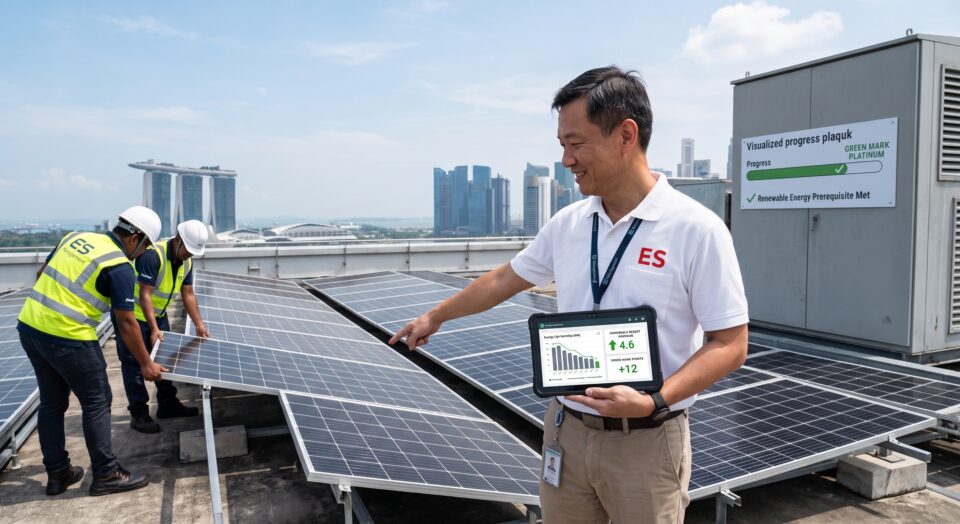
Here is why rooftop solar is the ultimate procedural “hack” to achieving Green Mark compliance within months, not years[cite: 1.2.1].
The Cheat Code: Solar as a Regulatory ‘Offset’
The fundamental challenge of Green Mark 2.0 (GM:2021) is the mandatory Energy Efficiency (EE) prerequisite[cite: 1.3.1]. To even be considered for certification, your building must demonstrate a minimum level of energy performance.
For many older assets, meeting this prerequisite through conventional mechanical and electrical (M&E) means is a financial and operational nightmare. Your 20-year-old chiller plant might be running efficiently but cannot meet the new, stricter code requirements[cite: Adapt]. Your existing building envelope might be hemorrhaging cool air, but retrofitting the entire facade is cost-prohibitive.
The Hack: The Fixed Metrics Offset Pathway
Green Mark 2.0 offers a procedural “safe harbor” that savvy Facility Managers are now leveraging. If your building cannot meet the required performance benchmarks through its mechanical systems alone, you are permitted to use onsite renewable energy to directly offset the shortfall[cite: 1.3.1].
If your HVAC efficiency is 5% below the mandatory threshold, installing a sufficiently sized solar array can act as a mathematical “patch,” bridging the gap and guaranteeing prerequisite compliance[cite: 1.3.1]. Solar is the unique procedural “hack” that fixes mechanical deficiencies on paper, allowing you to bypass disruptive retrofits and move straight to certification[cite: Adapt].
Low Complexity, High Impact Score Boosting
Unlike almost any other sustainability measure, solar installation is a purely additive procedure with zero operational downside. It requires no operational changes, no behavioural adaptation by tenants, and no ongoing specialized management[cite: 1.2.2]. It is “low complexity, high impact” technology[cite: 1.2.2].
A rooftop solar array directly impacts your scorecard in two distinct, high-weighted ways[cite: 1.3.1]:
1. Renewable Energy Points (Resources Category)
This is the most straightforward connection[cite: 1.1.1]. Earning GoldPLUS or Platinum status requires substantial renewable energy contribution; solar is typically the easiest pathway to secure these dedicated points[cite: 1.2.2, 1.2.1].
2. Energy Efficiency Index Improvement (Climate Category)
The Climate category is typically the highest-weighted section[cite: 1.2.2]. Because solar generates electricity on-site, it directly reduces your building’s dependence on the grid[cite: 1.2.2]. This immediately lowers your building’s reported Energy Use Intensity (EUI) or Energy Efficiency Index (EEI)—the single most important metric in the entire Green Mark assessment[cite: 1.2.2, Adapt]. Within months of flipping the switch, your building is structurally more efficient in the eyes of the BCA assessors[cite: Adapt].
Acceleration: Compliance Within Months
In your analytics, we saw that the extremely high engagement times (e.g., 3m 44s dwell time on the Public Sector Guide) prove decision-makers are performing deep technical diligence end-to-end[cite: 21, 23]. FMs want “audit certainty” quickly[cite: Adapt].
Solar provides that speed[cite: Adapt]. It is a rapid procedural hack to boost your score within months, contrasting sharply with the multi-year cycle required for HVAC overhauls[cite: Adapt].
| Compliance Phase | Description | Standard Timeline (HVAC Overhaul) | Solar Shortcut Timeline[cite: Adapt] |
| Procurement/Design | System scoping, grant application, contracting. | 6 – 12+ Months | 1 – 3 Months[cite: Adapt] |
| Implementation | Physical installation and integration[cite: Adapt]. | 12 – 24+ Months (high disruption) | 1 – 3 Months (low disruption)[cite: Adapt] |
| Verification | BCA document audit and site audit[cite: 1.4.1]. | 6 – 9+ Months | 4 – 6 Months (concurrent)[cite: Adapt] |
| Total Pipeline | 2 – 4+ Years | 6 – 9 Months |
With the right accredited partners, the 6-month procedural pipeline—Application, Site Visit, and Verification—can run concurrently with the solar installation, leading to final certification shortly after the panels go live[cite: 1.4.1, Adapt].
Procedural Guide: Maximum Recovery under GMIS-EB 2.0
Solar is not just a procedural hack; it is a grant-aided procedural hack[cite: Adapt]. The key to maximizing its value is to execute the correct sequence of administrative procedures.
The procedure itself is a subsidized scope of work under the Green Mark Incentive Scheme for Existing Buildings (GMIS-EB 2.0)[cite: 1.1.1]. Eligible buildings can tap into this grant to subsidize up to 50% of the upfront costs of the energy improvement works[cite: Adapt].
The Triage Procedure to Secure Funding
Many FMs make the fatal mistake of signing vendor contracts before their grant pre-application is approved, which automatically voids the application[cite: Adapt]. Your “old friend” connection from previous image generations is working well to establish rapport, but technical precision is mandatory here.
-
Authorization: authorization to perform an independent Green Mark pre-assessment and establish a verified audit baseline, with a fixed S$6,990 scoping fee[cite: Adapt].
-
Diagnostic Scoping (Fixed Fee): this phase establishes the critical verifiable audit baseline (\text{tCO}_2\text{e}) to verify GMIS-EB 2.0 grant co-funding eligibility (subsidizing up to 50% or S$600k for Platinum)[cite: Adapt]. Remind FMs that signing any vendor contract before BCA grant approval voids the application[cite: Adapt].
-
Grant Pre-Application: with the baseline locked, you submit the formal GMIS-EB 2.0 application to BCA prior to contracting your solar vendor[cite: Adapt].