Disclaimer: The information provided in this article regarding government grants, including the Green Mark Incentive Scheme for Existing Buildings (GMIS-EB 2.0) and Energy Efficiency Grant (EEG), is for general informational and educational purposes only. Grant quantum caps (up to S$1,200,000), co-funding rates, and eligibility criteria are subject to prevailing policies and official approval by the Building and Construction Authority (BCA) or relevant administering agencies. Grant applications must be formally submitted and accepted prior to equipment procurement or project commencement. ES Management provides independent consultancy services and does not guarantee grant approvals or specific funding outcomes.
When an existing commercial building, hotel, or industrial asset receives a Mandatory Energy Improvement (MEI) audit notice or approaches its 3-year Green Mark 2.0 (GM:2021) re-certification deadline, the immediate concern for asset directors and MCST councils is capital expenditure (CAPEX).
Singapore’s Building and Construction Authority (BCA) and Enterprise Singapore (EnterpriseSG) offer substantial co-funding schemes to offset up to 50% of energy-efficient retrofits—ranging from central chiller plant replacements to smart building automation.
However, many building owners miss out on hundreds of thousands of dollars due to misaligned grant pathways or a single critical administrative mistake made prior to vendor engagement.
Below is the definitive guide to choosing the right Singapore energy efficiency grant and navigating the strict rules required to secure your funding.
1. The Core Schemes: GMIS-EB 2.0 vs. Energy Efficiency Grant (EEG)
Choosing between outcome-based building schemes and equipment-level subsidies depends entirely on your project scope and target Energy Use Intensity (EUI in \text{kWh/m}^2/\text{yr}) reduction.
| Scheme | Primary Target | Max Funding Quantum | Co-Funding Cap | Key Evaluation Metric |
| GMIS-EB 2.0 (Green Mark Incentive Scheme for Existing Buildings) | Whole-building deep retrofits, central chiller plants, and BEMS automation. | Up to S$1,200,000 | Up to 50% of qualifying costs | Outcome-based carbon abatement \text{tCO}_2\text{e} saved post-retrofit. |
| Energy Efficiency Grant (EEG) | Targeted equipment upgrades (LEDs, premium efficiency motors, variable speed drives, heat pumps). | Up to S$30,000 (Base) / S$300,000 (Advanced) | Up to 70% (SMEs) / 30% (Non-SMEs) | Pre-approved equipment lists and technical specification tiers. |
2. GMIS-EB 2.0 Tier Breakdown: How the S$1.2M Quantum Works
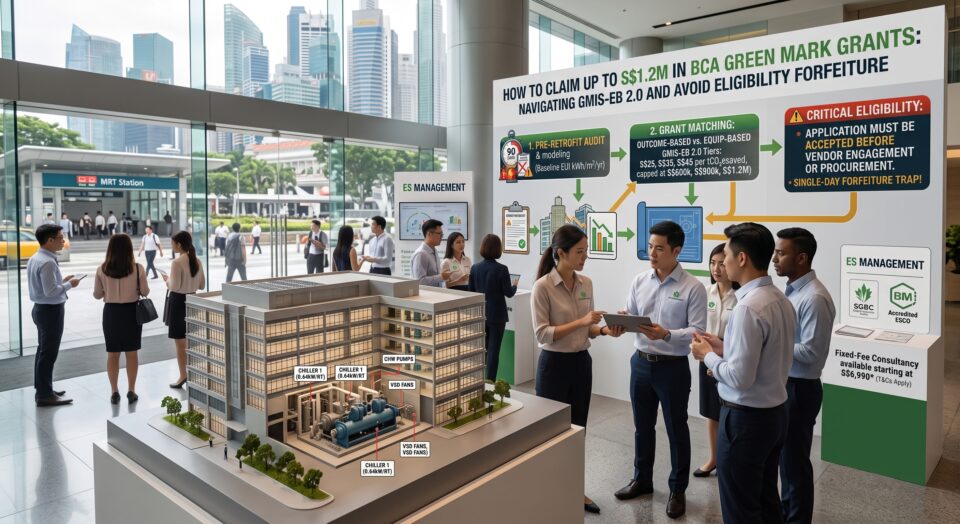
The S$63 million GMIS-EB 2.0 framework is purely outcome-based, rewarding verified operational carbon savings \text{tCO}_2\text{e} calculated using empirical energy data:
-
Platinum Target: Funded at S$25 per \text{tCO}_2\text{e} saved annually, capped at S$600,000.
-
Super Low Energy (SLE) Target: Funded at S$35 per \text{tCO}_2\text{e} saved annually, capped at S$900,000.
-
Zero Energy (ZE) / Positive Energy (PE) Target: Funded at S$45 per \text{tCO}_2\text{e}saved annually, capped at S$1,200,000.
Because commercial shopping malls, hotels, and office towers carry large energy baselines, achieving a 10%–25% EUI drop easily unlocks the maximum grant tier—provided baseline data is captured correctly before works start.
3. The Non-Negotiable “Golden Rule” of Grant Eligibility
The most frequent reason building owners forfeit their grant eligibility comes down to administrative timing.
THE GOLDEN RULE OF GRANTS:
Your grant application MUST be formally submitted and formally accepted by BCA BEFORE issuing purchase orders (POs), signing vendor contracts, paying deposits, or starting physical installation works.
Executing an equipment purchase or vendor contract just one day prior to official grant approval results in complete forfeiture of grant eligibility. Grants are legally structured to stimulate new green commitments, not reimburse work that has already been commercially committed.
4. Step-by-Step Grant Execution Roadmap
-
Conduct a Pre-Retrofit Energy Audit: Establish a verifiable 12-month baseline EUI \text{kWh/m}^2/\text{yr} using sub-metering or central utility logs.
-
Engage a Qualified Professional (QP) / Energy Auditor: Work with a BCA-registered Energy Auditor to model post-retrofit energy performance and calculate estimated carbon savings \text{kWh/m}^2/\text{yr}.
-
Submit the Formal Application: Upload technical proposals, baseline energy models, and vendor quotes to the BCA compliance portal.
-
Obtain BCA Letter of Acceptance (LOA): Receive official approval defining your target grant quantum cap.
-
Procure & Install Equipment: Issue purchase orders and execute site works strictly after LOA issuance.
-
12-Month Post-Retrofit Verification: Submit empirical 12-month post-installation energy data to verify savings and trigger cash disbursement.
End Your MEI 90-Day Data Panic
Navigating BCA compliance alongside MEI 90-day deadlines requires exact engineering and administrative precision.
At ES Management, we specialize in managing this exact technical and regulatory transition for Singapore asset directors and facility managers:
-
Fixed-Fee Consultancy: Complete Green Mark re-certification and MEI audit process management starting at a fixed S$6,990 flat-fee per asset (T&Cs Apply). Total budget and technical certainty.
-
Data Consensus & EUI Modeling: We handle the baseline EUI modeling, sub-metering analysis, and audit documentation so you meet your deadlines without operational friction.
-
Zero Disruption: We work directly with your existing BEMS/Chiller vendors to validate site compliance without disrupting daily building cooling operations.
Avoid the 90-day data consolidation panic and secure your compliance standing. Contact ES Management today for a proactive technical audit assessment.