
For most commercial and industrial buildings in tropical climates, space cooling represents a massive chunk of the monthly utility bill—typically accounting for 40% to 60% of total building energy use. When attempting to reduce this figure, the immediate response from mechanical engineers and operations maintenance teams is almost always: “Optimize the chiller plant.“
They focus on centrifugal chiller COPs, cooling tower approach temperatures, and chilled water pump $kW/RT$. Chiller plant optimization is essential, but it only addresses the production of cooling. It neglects the distribution.
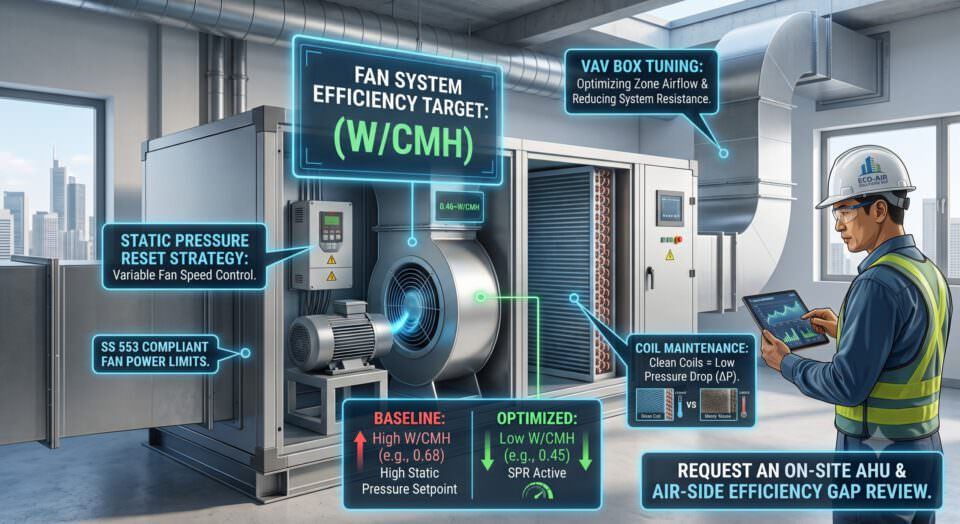
The true energy gap often lies within the building’s air-side system—the vast network of Air Handling Units (AHUs), Fan Coil Units (FCUs), ducts, and terminal boxes responsible for delivering comfort. Within these systems, the fan is king, and its power input limitations are frequently overlooked. To push your building toward Super Low Energy (SLE) standards, you must look beyond the chiller plant and aggressively trim the watts-per-cubic-meter-per-hour ($W/CMH$) consumed by your fan systems.
The Regulatory Constraint: SS 553 & Fan Power Limits
The baseline for air-side efficiency in Singapore is Singapore Standard SS 553: Code of Practice for Air-Conditioning and Mechanical Ventilation in Buildings. While standard updates are periodically issued, SS 553 consistently defines strict fan system power limitation requirements for ACMV systems.
For Mechanical Engineers, complying with SS 553 is not optional—it is a statutory requirement during design and major retrofits. The standard establishes maximum allowable fan power input limits based on the total air volume moved.
Are Your Units Complying?
During new installation, compliance is often verified through data sheets. However, operationally, aging components, altered duct configurations, and incorrect Variable Speed Drive (VSD) settings can push your units far beyond these baseline limits. Trimming $W/CMH$ means minimizing system resistance and ensuring the fan is operating within its most efficient curve at part-load.
Dynamic Optimization Strategy 1: Static Pressure Reset (SPR)
Most existing Variable Air Volume (VAV) systems are designed to deliver supply air at a fixed static pressure set point. This set point is typically determined during the balancing phase based on “worst-case scenario” (full load) conditions plus a conservative safety margin.
The result? The system operates most of its life under a pressure higher than necessary. The VAV dampers are forced to partially close to “strangle” the flow, wasting fan energy.
Minimizing Choke, Maximizing Savings
A dynamic Static Pressure Reset (SPR) strategy, often implemented via the Building Management System (BMS), minimizes this waste. The system monitors the volume control damper positions of all VAV boxes.
When SPR optimization is active, the BMS checks if all boxes are partially closed. If they are, it slows down the supply fan speed via its VSD, dynamically resetting the duct static pressure set point lower until at least one VAV box (the most open one, often representing the zone with the highest demand) is kept nearly fully open (typically 90–95% open).
By keeping at least one terminal fully open, the system resistance is minimized, and the fan operates at the lowest possible speed without compromising airflow requirements to any space.
Dynamic Optimization Strategy 2: Coil Maintenance & Pressure Drop
You can have the most advanced VSD and SPR algorithm, but if your cooling coils are dirty, your fan is guaranteed to waste power. Cooling coils act as a major flow obstruction inside the AHU. Debris, dust, pollen,and biological growth accumulation on the coil fins significantly restrict airflow.
To deliver the same required cooling capacity (BTUs/hour) across a restricted coil, the system must maintain higher airflow rates or lower supply temperatures. The Restricted airflow through the dirty coil results in a high air-side pressure drop across the coil.
The supply fan must work significantly harder to overcome this additional pressure drop, driving up $W/CMH$consumption. Routine coil cleaning and maintenance restore proper heat transfer and airflow. Industry maintenance data indicates that a clean coil can increase airflow by 10% to 46% and, critically, reduce fan and blower energy consumption by 41% to 60%.
Ops & Maintenance Gap: VAV Box Tuning
Operations teams are often reactive—fixing comfort complaints rather than proactive tuning. A frequently overlooked air-side component is the VAV terminal box itself. The performance of these boxes depends on correct sizing for each zone.
Sizing and Airflow Malpractice
A poorly tuned VAV system often suffers from sizing mismatches:
-
Installed units are too large: Small changes in damper position cause excessive changes in airflow,leading to difficult control and zone hunting.
-
Over-conservativeMargins during Commissioning: Many systems are commissioned with over-conservative static pressure margins, which SPR strategies try to eliminate.
Operations maintenance teams should review sampling trend data to ensure VAV boxes that are frequently fully open are operating correctly, motorised dampers are functioning, and minimum design air flows haven’t drifted upward over time.
Conclusion: Trimming the Air-Side Efficiency Gap
Optimizing the chiller plant is standard practice, but it is no longer sufficient to meet today’s elite building energy performance targets. True SLE performance requires focusing on the air-side distribution system,where significant efficiency gaps often go unnoticed.
By targeting fan power limitations, implementing dynamic static pressure resets, maintaining pristine cooling coils to minimize pressure drop, and tuning VAV terminals, Mechanical Engineers and Operations Teams can unlock substantial operational savings. It’s time to move beyond the production plant and start trimming the distribution system.
Lead Capture Hook
Do you suspect your building’s air distribution system is wasting fan power?
“Request an On-Site AHU & Air-Side Efficiency Gap Review.”