Securing the Building and Construction Authority’s (BCA) Green Mark certification is a prestigious accomplishment in Singapore, signaling a strong commitment to environmental sustainability. However, the path to certification can be complex, and even the most diligent teams can stumble. Avoiding common pitfalls is crucial not only for achieving certification but also for optimising your building’s long-term environmental performance and operational efficiency.
Target Audience: Project Managers and Sustainability Consultants who want to ensure success.
- Core Concept: Learn from the failures of others. A high-value, “insider knowledge” piece.
Key Mistake 1: Treating Green Mark as a Box-Ticking Exercise.
- Reality: The new GM:2021 is performance-based. Fake it and you will fail the verification stage.
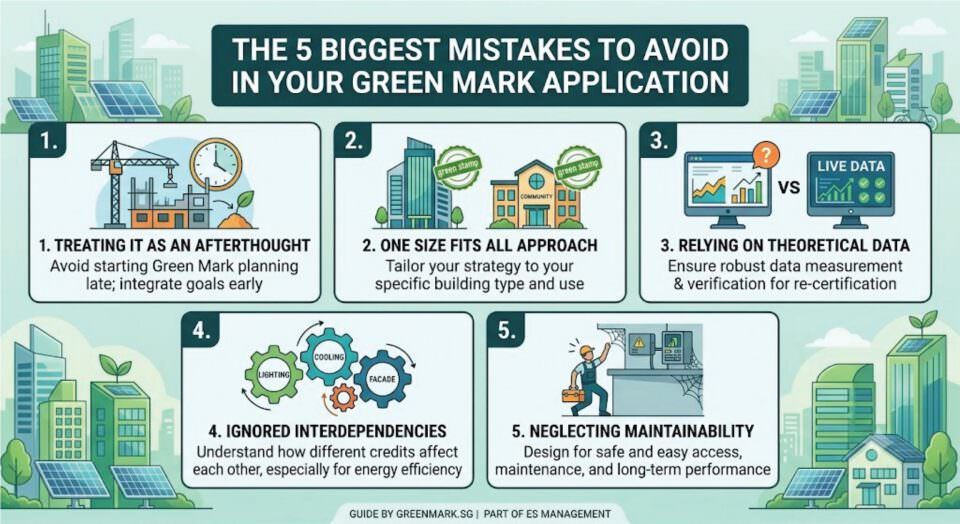
The Mistake: This is perhaps the most fundamental and costly error. Engaging Green Mark consultants or considering sustainable design features only in the late stages of design or, worse, after construction has started. This often leads to retrofitting solutions, which are significantly more expensive and less effective than integrated designs.
The Fix: Integrate Green Mark objectives from the very inception of the project (the conceptual design phase). Involve all key stakeholders—architects, engineers, and future facility managers—early on. Use the BCA Green Mark criteria as a design tool, not a post-design checklist. Early planning allows for cost-effective, passive solutions, such as optimising building orientation and maximising natural ventilation, which can significantly improve scores without exorbitant costs.
Key Mistake 2: Failing to Plan for Re-certification from Day One.
- Reality: As shown in your previous posts, the “data gap” is the silent killer. Sub-metering and long-term data logging must be prioritised immediately.
The Mistake: Attempting to apply a boilerplate “green” strategy across different projects, ignoring the unique characteristics and limitations of each building. While the Green Mark criteria are standardized, their optimal application is highly dependent on factors like building use, location, and occupant behavior.
The Fix: Each project requires a tailored approach. For an existing building recertification, for example, the focus is heavily on verifiable operational performance rather than just design intent (as discussed in the accompanying article on the Green Mark re-certification process). Understand the specific priorities of your project’s Green Mark scorecard and develop targeted strategies that maximize performance in those specific areas. What works for a high-rise commercial tower might be irrelevant or inefficient for a healthcare facility or an industrial warehouse.
Key Mistake 3: Poor Quality Documentation.
- Reality: Incomplete or disorganised submittals are the fastest way to delay an application.
The Mistake: Believing that as long as your building is designed for high efficiency, certification is guaranteed. For new developments, the “As-Built” certification is crucial. For existing buildings, the focus is even more intensely on actual, in-operation data. Relying purely on theoretical models without robust measurement and verification (M&V) plans is a critical error.
The Fix: Implement comprehensive measurement and verification (M&V) strategies from the outset. This is not just about meeting a requirement; it is essential for verifying that the designed energy-saving measures are working as intended in the real world. Ensure that adequate sub-metering is installed and integrated into a robust Building Management System (BMS). As highlighted in “The New Audit Scramble” article, the lack of 12 months of high-quality,verified operational data is a primary reason for re-certification failures. If your systems are not capturing granular performance data (like chiller plant efficiency in kW/RT or detailed indoor air quality metrics), you will be unable to prove your case to BCA auditors.
Key Mistake 4: Underestimating the “In-Operation” Prerequisites.
- Reality: For existing buildings, specific minimum standards for Chiller Efficiency and Indoor Air Quality are mandatory and must be verified by 12 months of operation.
The Mistake: Treating each Green Mark criterion as an isolated, checklist item without considering how they interact.For instance, focusing heavily on maximizing natural daylight (which earns points) without accounting for the resulting increased solar heat gain. This can inadvertently increase the cooling load, making it harder to meet the Energy Efficiency standards, which are weighted much more heavily.
The Fix: Adopt a systems-thinking approach to your application. Understand the trade-offs and synergies between different criteria. For example, a high-performance building envelope can reduce the size and energy consumption of the air-conditioning system needed. Use energy modeling software early on to simulate different scenarios and understand the complex relationships between lighting, ventilation, insulation, and the overall energy balance of the building. Your goal should be an optimized, holistic design, not a collection of fragmented features.
Key Mistake 5: Neglecting Maintainability
-
Reality: Design for safe and easy access, maintenance, and longer-term performance.
The Mistake: While energy efficiency is a major focus, Green Mark, particularly the newer GM:2021 standard, places significant emphasis on other pillars, with Maintainability often being a crucial (and overlooked) prerequisite. A building that is highly efficient but nearly impossible to maintain safely or effectively will struggle to achieve a top-tier rating (GoldPLUS or Platinum). Neglecting this means risking not just points, but the mandatory re-certification in five years.
The Fix: Prioritize the Maintainability (Mnt) criteria. This includes designing for safe and easy access to mechanical plants, standardizing components to simplify replacements, and integrating smart maintenance technologies like Fault Detection and Diagnostics (FDD). As detailed in the specialized article “Section Mnt — Maintainability: Unlocking Life Cycle Asset Value,” thinking about how the building will be operated over its entire lifecycle is not just good practice—it’s now a legalized requirement for achieving and sustaining higher Green Mark ratings in Singapore. A maintainable building is a sustainably profitable building.