
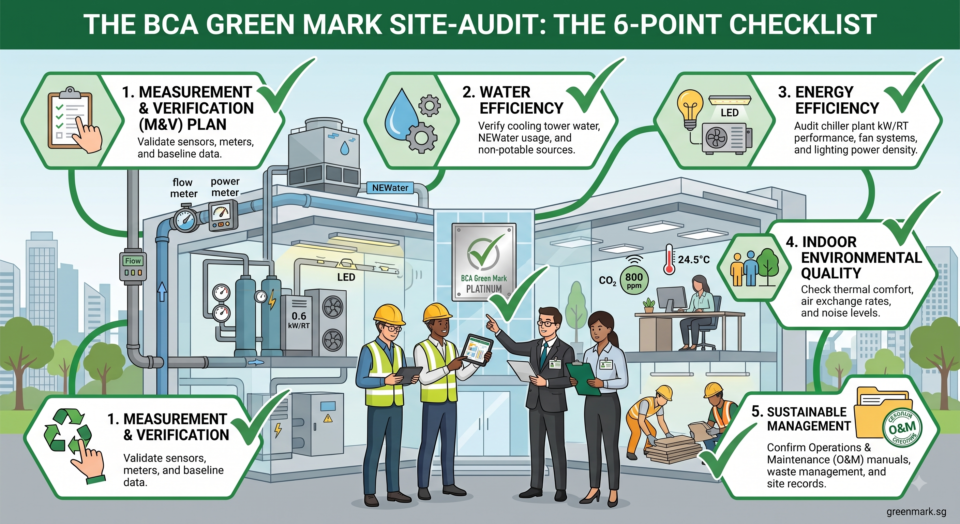
The BCA Site-Audit is the moment of truth for your Green Mark submission. You have spent months, perhaps years, compiling design documents, modelling energy data, and retrofitting systems. But during the Site-Audit (Verification Stage), BCA officers arrive to validate that your conceptual “green” commitments are a functioning, high-performance reality.
For a Facility Manager, a Site-Audit is not just a meeting—it’s a technical defense.
If the audit day goes wrong, the consequences are immediate: re-submissions that add months to Temporary Occupation Permit (TOP) timelines, expensive last-minute sensor replacements, and the potential failure of prerequisites that can derail an entire GoldPLUS or Platinum rating.
Panic is a common response, but triage is a better strategy. Based on analyzing common BCA Verification Audit failures in Singapore, you must possess an absolute, non-negotiable command of these five data fields before the auditor arrives.
The 5-Point BCA Site-Audit Checklist
1. The Sensor Calibration Trap: Valid Certificates
This is the single fastest way to fail an MEI or Green Mark M&V audit. If your chilled water plant uses a calculation pathway for efficiency, BCA mandates that you provide a comprehensive, contiguous 12-month trend of raw data.
The Triage: A trend report alone is not proof. You must possess original, valid calibration certificates(typically from an accredited laboratory or factory calibration from the manufacturer) for every single temperature sensor, flow meter, and power meter used in that efficiency calculation.
If your sensor is uncalibrated, BCA will reject that sensor’s data. Suddenly, you have a 12-month data gap, and your calculation is mathematically invalid. You are not compliant.
2. The “Contiguous Data” Disconnect: Missing trends
For Existing Buildings, Stage 2 Verification relies on 12 months of actual operation data. A common mistake is providing 12 months in theory but having large, unexplainable gaps in the contiguous BMS trend log data.
The Triage: For any projects subjected to an MEI or Stage 2 Verification, BCA requires BMS raw data in Microsoft Excel format for all relevant chiller plant operating performance parameters. They will not accept PDF “summary reports.“
Before the auditor arrives, you must manually scrub your raw data to identify missing contiguous dates,unexplainable constant readings (sensor freeze), or “noisy” data spikes. A gap in data means a gap in performance verification.
3. The M&V Plan vs. “As-Built” Reality Check
For new developments, Stage 1 Verification on-site is a physical check of the implementation of “green” features and control strategies. The auditor will be comparing your completed building with the committed design specifications and the original Measurement & Verification (M&V) plan submitted during the design stage.
The Triage: We call this “The As-Built Gap.” If your submitted design stage energy model assumed VSD (Variable Speed Drive) fan modulation on CRAH units based on hot-aisle temperature sensors, but your building is completed with constant-speed CRAH fans, you have a major non-compliance.
You must physically verify that every sensor, VSD, and control strategy in the M&V plan is physically installed,powered, networked, and successfully communicating data to the BMS.
4. Operations & Maintenance (O&M) Disconnect: Scattered records
Green Mark, particularly the newer performance-based standards like GM:2021, places immense weight on Maintainability. A building that is efficient today but unmaintainable tomorrow cannot achieve higher ratings.
The Triage: Documentation for O&M must be a consolidated compliance repository, not a collection of disconnected paper certificates and service reports. During a maintenance audit inspection, missing contractor documentation is a primary cause of audit failure.
You must consolidate a single, accessible log containing current O&M manuals for all major systems,completion certificates for recently serviced equipment, and training records proving technical competency for your O&M team. A scattered documentation trail suggests uncoordinated and high-risk maintenance.
5. Prerequisite Triage Failure: The absolute minimum standards
Under performance-based criteria, specified prerequisites are mandatory and must be verified by 12 months of operation to ensure compliance with the specific rating. In the case of Existing Buildings, these absolute minimums are often related to Chiller Plant Efficiency ($kW/RT$).
The Triage: If your GoldPLUS submission committed to a high efficiency but your 12-month contiguous raw data log proves your actual, continuous performance was hovering just above the Gold tier threshold due to unforeseen operational loads, you must declare that shortfall.
You cannot fix theoretical design stage modeling prerequisites on audit day. Your triage strategy is finding and repairing minor technical flaws (e.g., poor condenser water treatment, uncalibrated set-points) to reclaim every fraction of a $kW/RT$ efficiency point before audit day.
The Bottom Line
A BCA Site-Audit is a rigorous technical interrogation. The difference between passing and failing can be a single piece of paper, a missing 3-day data trend, or a misunderstood technical prerequisite.
You can prevent audit day panic by executing this 5-point triage roadmap. A Site-Audit doesn’t fail on a complex thermodynamic principle; it fails on an administrative detail.