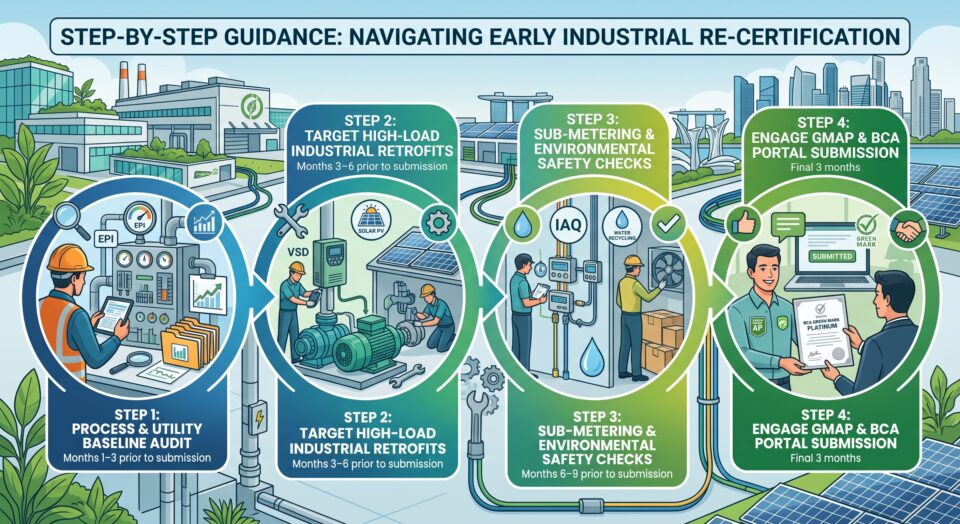
Re-certification for industrial facilities under the Singapore Building and Construction Authority (BCA) Green Mark for Existing Industrial Facilities scheme focuses on heavy baseload efficiency, process cooling, compressed air systems, and high-intensity operational continuity.
Unlike offices or F&B outlets, industrial sites face the unique challenge of decoupling energy-intensive manufacturing processes from general facility operations while maintaining stringent safety and production standards.
Key Operational Differences: Industrial vs. Office/F&B Re-Certification
-
Process vs. Comfort Cooling: Cooling systems often serve precision manufacturing environments \text{kW/100 CFM} continuous loads) rather than typical comfort cooling, demanding higher chiller plant redundancy and strict efficiency limits.
-
Compressed Air & Process Loads: Compressed air, heavy motor drives, and process heating dominate the facility’s baseline load, requiring specialized leak audits and Variable Speed Drive (VSD) integrations.
-
Rooftop Solar & High Roof Areas: Industrial sites possess large roof footprints, making on-site renewable energy (Photovoltaic/PV systems) a primary pathway to achieve Green Mark Super Low Energy (SLE) or Zero Energy status.
Industrial Facility Pre-Audit Checklist
| System Category | Checklist Focus | Required Documentation / Audit Proof | Status |
| Central Plant & Industrial Cooling | Process chiller efficiency, cooling tower water-use efficiency (cycles of concentration $\ge 6$), and chilled water pump staging. | 12–24 months of automated Chiller Management System (CMS) efficiency logs, flow meter calibration certificates. | [ ] Pass / [ ] Gap |
| Compressed Air Systems | Specific power consumption \text{kWh/m}^2/\text{year}system pressure optimization, and ultrasonic leak detection logs. | Air compressor performance test reports; regular leak audit reports and repair confirmation sheets. | [ ] Pass / [ ] Gap |
| Solar PV & Renewable Energy | Solar PV generation tracking, inverter performance monitoring, and grid feed-in records. | Annual PV maintenance logs, meter calibration reports, and monthly solar yield analysis reports. | [ ] Pass / [ ] Gap |
| Lighting & High-Bay Controls | High-efficiency LED high-bay fixtures with motion/occupancy or daylight harvesting sensors in warehouses and production floors. | Lux level report demonstrating compliance with SS 531 standards; lighting power density \text{W/m}^2 calculations. | [ ] Pass / [ ] Gap |
| Sub-metering & Energy Monitoring | Dedicated sub-metering on major process loads, heavy motors, compressed air plants, and HVAC systems. | System architecture schematic; 12 months of exported interval energy data by system category. | [ ] Pass / [ ] Gap |