The MEI Regime & The 10% EUI Mandate: What Energy-Intensive Buildings Must Do
Singapore’s Mandatory Energy Improvement (MEI) regime, enacted via amendments to the Building Control Act, transforms energy efficiency from a voluntary ESG initiative into an enforced statutory obligation.
If your asset has received a BCA Audit Notice under the MEI regime, your building has consistently exceeded prescribed Energy Use Intensity (EUI) thresholds over three consecutive years. You are now legally required to carry out dynamic operational and system-level retrofits to cut overall building energy consumption by at least 10%.
Understanding the regulatory timeline, technical obligations, and enforcement mechanisms is crucial for building owners, asset managers, and board members facing an audit notice.
Statutory Scope: Is Your Asset Subject to the MEI Regime?
The MEI regime applies to existing energy-intensive buildings with a Gross Floor Area ($\text{GFA}$) of $5,000\text{ m}^2$ or more.
Applicable Building Categories:
-
Commercial Buildings: Office towers, retail shopping centers, and hotels.
-
Healthcare Facilities: Public and private hospitals, medical centers, and polyclinics.
-
Institutional Buildings: Educational institutions, civic, community, and cultural facilities.
-
Sports & Recreation: Sports complexes and recreational centers.
-
Mixed-Use Developments: Assets combining any of the above uses.
The regime specifically targets legacy or un-retrofitted assets that haven’t undergone major building works governed by baseline Green Mark regulations, enforcing quantifiable energy reductions across the board.
The 4-Stage Compliance Process
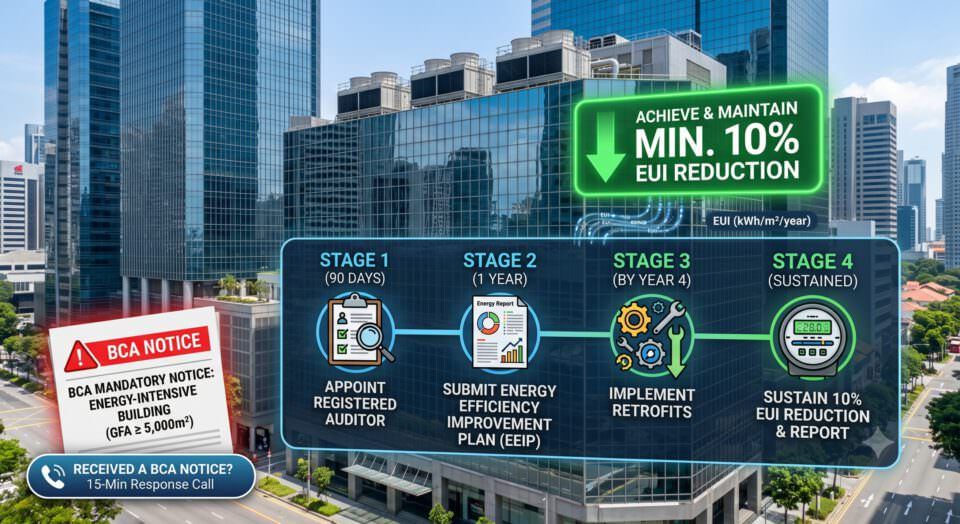
Upon receiving the Commissioner of Building Control’s written MEI Audit Notice, a strict, time-sensitive compliance clock begins. Building owners must navigate four mandatory phases:
[Stage 1: Day 0–90] ──> [Stage 2: Year 0–1] ──> [Stage 3: Year 1–4] ──> [Stage 4: Year 4–5]
 Appoint Registered      Submit Audit &          Implement EEIP &        1-Year Performance
 Qualified Auditor       EEIP to BCA             Hit 10% EUI Cut         Maintenance & Report
Stage 1: Appoint a Qualified Professional (Within 90 Days)
Building owners must formally engage a “Specified Individual”—either a BCA-registered Energy Auditor (EA) or a Professional Engineer in Mechanical Engineering [PE (Mech)]—within 90 days of receiving the notice.
Stage 2: Audit & Energy Efficiency Improvement Plan (Within 1 Year)
The appointed auditor carries out an exhaustive review of all major energy-consuming systems, including central chilled water plants, air distribution systems, lighting, and tenant sub-metering.
The auditor develops an Energy Efficiency Improvement Plan (EEIP) that outlines specific retrofits, operational tuning, or capital works capable of achieving the targeted reduction. The completed energy audit report and EEIP must be formally submitted to the BCA within 1 year from the notice date.
Stage 3: Implement Retrofits & Hit 10% EUI Cut (Within 3 Years of EEIP Submission)
The building owner has a maximum of 3 years from the date of EEIP submission to execute all proposed measures. The goal is to reduce the asset’s annual EUI by at least 10% relative to the 3-year historical average prior to the notice date:
Where:
-
$\overline{\text{EUI}}_{\text{3-Yr Baseline}}$ = Average yearly EUI ($\text{kWh/m}^2/\text{year}$) across the three consecutive years preceding the MEI notice.
-
$\text{EUI}_{\text{Post-Implementation}}$ = Operational EUI measured over a 12-month period post-retrofit.
Stage 4: Sustain Performance & Submit Maintenance Report (1-Year Maintenance + 3 Months)
Compliance does not end with achieving a temporary drop in energy consumption. Building operators must sustain the 10% EUI reduction continuously for at least 12 months following implementation.
A final Maintenance Report verified by the Specified Individual must be submitted to the BCA within 3 months after the maintenance period ends.
Financial & Regulatory Enforcement
Failing to comply with statutory directions issued under the Building Control Act carries legal and financial penalties.
| Offence Category | Statutory Enforcement / Penalty |
| Failure to Appoint Auditor / Submit EEIP | Fines ranging from SGD 10,000 to SGD 150,000 depending on offence severity. |
| Failure to Implement EEIP Measures | Court prosecution, direct statutory directions, and compounding daily fines for continuing default. |
| Failure to Maintain Improved EUI | Mandatory re-audit directions and statutory penalties. |
Beyond direct fines, non-compliance impacts asset valuation, potential green loan financing terms, and institutional tenant retention as corporate occupiers increasingly demand ESG-compliant space.
Strategic Action Items for Asset Managers & Boards
-
Avoid Reliance on High-CAPEX Overhauls Alone: Reaching a 10% EUI reduction does not always require replacing major chillers. Prioritize low-hanging fruit—such as sensor recalibration, eliminating low $\Delta T$ syndrome, optimizing airside fan power, and deploying smart BMS resets—to capture 5% to 8% savings with minimal capital expenditure.
-
Align Tenant Energy Leases: Because whole-building EUI includes tenant plug loads and lighting, board members should review green lease structures to manage high-density tenant power draw and server room usage.
-
Establish Real-Time Digital Metering: Deploy class 0.5/0.2 sub-meters on major cooling, lighting, and mechanical circuits early to prevent measurement errors during the 1-year maintenance verification phase.
Received a BCA Notice? Book an Immediate 15-Minute MEI Response Call.
Achieve Budget Certainty with ES Management
Navigating government grant paperwork while managing tight BCA audit deadlines shouldn’t add stress to your operations.
At ES Management, we provide a fuss-free Green Mark Re-Certification Consultancy designed to give facility leaders total financial and regulatory clarity. We assist your team in identifying eligible grant opportunities, structuring audit documentation, and executing a compliant roadmap.
-
Fixed-Fee Transparency: Get expert, end-to-end consulting starting at a flat S$6,990* (terms and conditions apply).
-
Zero Budget Surprises: No hidden administration fees or open-ended hourly billing.
Don’t let budget uncertainty delay your compliance. Contact ES Management today to evaluate your building’s grant eligibility and secure your fuss-free re-certification roadmap.