
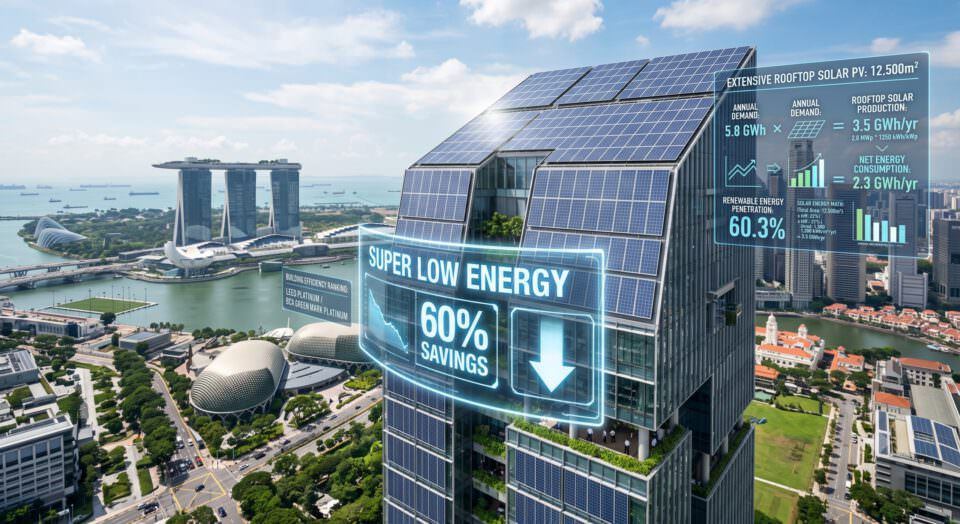
For REIT managers, property developers, and C-suite real estate executives in Singapore, achieving Super Low Energy (SLE) status is no longer just a marketing halo—it is a core asset value driver. With rising carbon taxes and institutional tenants demanding climate-aligned commercial space, transitioning a building from standard efficiency to SLE, Zero Energy (ZE), or Positive Energy (PE) directly protects net operating income (NOI) and cap rates.
Achieving these elite badges under the BCA Green Mark framework requires a calculated balance between demand-side deep retrofits and supply-side renewable integration. Here is the mathematical framework that governs the transition.
1. The Core Equation: Lowering the Baseline
Under the BCA Green Mark 2021 Super Low Energy (SLE) framework, an existing commercial asset must demonstrate at least 60% energy savings over the 2005 building code baseline (or hit strict absolute Energy Use Intensity thresholds, typically below $100\text{–}115\text{ kWh/m}^2/\text{year}$ for office assets).
Before considering solar photovoltaics (PV), deep retrofits must do the heavy lifting of reducing total building operational load. Attempting to hit SLE status through solar generation alone on a high-rise commercial asset is mathematically impossible due to roof area constraints.
Core Deep Retrofit Drivers:
-
-
-
Water-Cooled Chiller Plant Efficiency: Upgrading central cooling from 0.80 kW/RT down to ≤ 0.54 to 0.58 kW/RT.
-
Airside Optimization: Lowering fan power across AHUs and FCUs to ≤ 0.25 W/CMH using electronically commutated (EC) fans and static pressure resets.
-
Smart Lighting & Envelopes: Dropping Lighting Power Density (LPD) by > 50% via smart LED controls and applying solar-control window films to lower thermal envelope transfer.
-
-
2. The Solar Math: Maximizing On-Site Yield
Once deep retrofits suppress total annual energy demand ($\text{kWh}_{\text{building}}$), on-site solar PV is integrated to offset the remaining load.
Singapore receives an average global horizontal irradiation ($G_{\text{annual}}$) of roughly $1,150\text{ to }1,300\text{ kWh/m}^2/\text{year}$. Annual energy production from a rooftop solar system is calculated using:
Where:
-
A_{\text{PV}} = Available rooftop/facade solar array area (\text{m}^2)
-
\eta_{\text{module}} = PV panel module efficiency (typically 21.5% – 23.0% for premium N-type TOPCon or HJT panels)
-
G_{\text{annual}} = Annual solar irradiance (\text{kWh/m}^2/\text{year})
-
\text{PR} = System Performance Ratio (accounting for inverter losses, temperature degradation, and cable losses; standard benchmark is 0.75 – 0.80)
Evaluating the Badges: SLE vs. Zero Energy vs. Positive Energy
+------------------+-------------------------------------------------------------+
| Badge Status     | Mathematical Requirement                                    |
+------------------+-------------------------------------------------------------+
| Super Low Energy | >= 60% Energy Savings over 2005 Baseline                    |
| Zero Energy (ZE) | On-Site + Off-Site Renewable Generation >= Total Annual EUI |
| Positive Energy  | On-Site + Off-Site Renewable Generation > 105% Total EUI    |
+------------------+-------------------------------------------------------------+
For high-rise commercial towers where rooftop area $A_{\text{PV}}$ is limited relative to gross floor area (GFA), achieving Zero Energy requires procuring off-site renewables or Green Energy Purchases/Renewable Energy Certificates (RECs) recognised under BCA guidelines to cover the net remaining load.
3. Financial Structuring & The GBIC Grant
Executing deep energy retrofits paired with solar integration carries upfront capital expenditure, but Singapore’s regulatory ecosystem offers substantial co-funding to de-risk investments.
The Green Buildings Innovation Cluster (GBIC) Scheme, administered by the BCA, provides co-funding for building owners and developers looking to push efficiency boundaries.
GBIC Grant Advantages:
-
Up to 50% Co-Funding: Covers eligible capital expenditure, equipment cost, professional fees, and instrumentation for demonstrating super low energy technologies.
-
Accelerated Payback: Combining a 50% GBIC grant with operational electricity bill savings typically compresses deep-retrofit simple payback periods from 6–8 years down to 2.5–4 years.
-
Hedge Against Carbon Tax & Tariff Volatility: Every kWh offset on-site insulates your asset from grid price spikes and Singapore’s escalating carbon tax trajectory ($45/\text{tCO}_2\text{e}$ in 2026/2027, scaling toward $50\text{–}80/\text{tCO}_2\text{e}$ by 2030).
The Strategic Path Forward for Asset Managers
-
Conduct a Dual-Audit: Evaluate mechanical equipment efficiency (chillers, pumps, airside) in tandem with structural solar canopy feasibility rather than treating them as separate projects.
-
Model EUI Savings in Dynamic Simulation: Map hourly building load profiles against solar generation curves to optimize self-consumption rates and minimize grid export losses.
-
Structure Green Financing: Combine GBIC grant funding with green loans to achieve positive cash flow from Year 1 post-commissioning.
Schedule a GBIC Grant & Solar Integration Feasibility Study.