Ask any Singapore commercial building owner or asset manager to list their concerns regarding BCA Green Mark re-certification. Beyond the consulting fees, one answer dominates the conversation: Disruption.
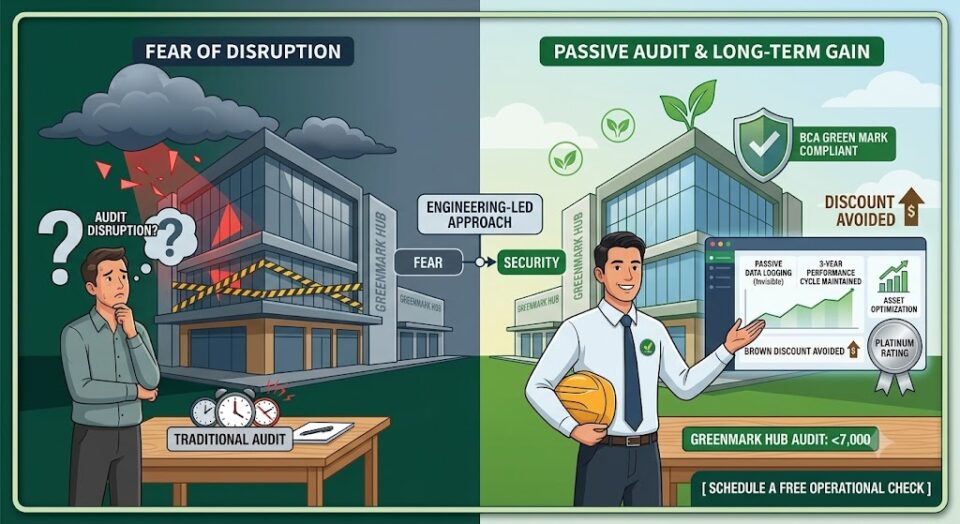
There is a powerful, persistent fear that an engineering-led audit is inherently intrusive. Decision-makers worry that Measurement & Verification (M&V) protocols require active interference with the central chilled-water plant during peak hours—leading to tenant complaints, a breakdown in indoor air quality, and operational chaos.
As an engineering-led advisory, we understand this anxiety. However, this fear is based on outdated auditing practices. A modern, professionally executed Green Mark audit is, in fact, completely passive.
The real operational and financial disruption doesn’t come from the audit itself; it comes from ignoring the underlying maintenance and data health of your high-value assets. The true disruption is asset obsolescence—the silent “brown discount” that penalizes unmaintained properties.
The Myth of the Intrusive Audit
Historically, audits often meant manually stopping equipment, opening mechanical systems during business hours, and disrupting workflow to gather data. That model is obsolete.
In a modern facility, your Building Management System (BMS) and energy meters are already generating a wealth of operational data. An engineering professional’s role is not to interfere, but to interpret.
Audit As Triage: The Passive Diagnostic Model
Think of a Green Mark audit like a high-level medical check-up. The process relies on data validation, not hardware invasive surgery.
-
BMS Trend Logging: We simply verify if your existing systems are logging the necessary parameters. If they are, the audit process is nothing more than extracting and validating a 12-month data report. No plant disruption, no shutdowns.
-
Passive Supplementary Logging: If data gaps exist, we do not shut down your systems. We use portable, non-invasive loggers—smart devices that attach silently to pipes and electrical panels—to gather data without touching your primary hardware.
A high-speed, 3-month turn-key BCA Green Mark re-certification advisory, like our starting S$6,990 baseline package, is only possible because we can leverage this data-ready, passive approach. We prove that a high-quality, professional audit can be entirely silent and invisible.
The Real Disruption: Understanding the 3-Year Lifecycle
While you may fear a temporary operational blip, the real threat to your building is the long-term, invisible decay of performance that occurs if you ignore the 3-year performance maintenance cycle.
A commercial building isn’t static; it is a complex, aging mechanical asset.
-
Year 1: Chiller plant sensors are calibrated, and your performance ($kW/RT$) is optimal. You receive your Green Mark badge.
-
Year 2-3: Maintenance becomes reactive. Temperature sensors drift. Valves stick. Heat exchange surfaces foul. Chiller operating logic falls into “override” mode to keep tenants happy.
-
Result: Performance silently degrades. By Year 4, the building that earned GoldPLUS has fallen to basic compliance, but no one knows it because the data hasn’t been validated for three years.
Ignoring this performance cycle creates a compounded operational crisis. The real disruption isn’t the audit at Year 4; it’s realizing your building needs a massive, expensive engineering recovery project just to remain compliant and avoid a formal BCA Mandatory Energy Improvement (MEI) Notice.
Fighting the “Brown Discount”: Green Mark as Valuation Security
The real goal of the Green Mark isn’t just about regulatory points. It is about asset valuation.
The global real estate market is increasingly recognizing a powerful phenomenon: The Brown Discount. This is the financial penalty applied to buildings that lag in energy performance, are difficult to maintain, or have poor indoor environmental quality (IEQ).
MNC tenants, who have set ambitious Scope 1 and Scope 2 targets, are abandoning non-compliant “brown assets.” As a result:
-
Occupancy Rates Drop.
-
CapEx Requirements Explode (emergency retrofits).
-
Property Value & Liquidity Suffer.
A Green Mark re-certification audit is your primary tool to prevent the Brown Discount. It forces you to validate your performance, verify your data health, and secure your asset’s reputation as a high-performance workspace.