You know the feeling. The ordinary flow of facility management—handling tenant complaints, scheduling cooling tower dosing, managing security rosters—is suddenly interrupted.
You open a formal email from the Building and Construction Authority (BCA).
The subject line includes the words “Notice” and “Green Mark Re-Certification.”
And then, you see the date.
Your building’s current 3-year or 5-year certification cycle is ending, and your formal submission for the new operational audit is due in precisely 90 days.
The 90-Day Panic is Real
Your first response is a spike in professional anxiety. You immediately start doing the mental math of your current operational workload:
-
When was the last time we calibrated the chiller temperature sensors?
-
Have we been keeping clean, continuous 12-month logs of the plant efficiency ($kW/RT$)?
-
Is our Building Management System (BMS) even logging data, or has it been silent for three months?
-
How am I supposed to run a full engineering audit and manage documentation while keeping the lights on?
That anxiety is legitimate. The 90-day mark is considered “critical path” territory. But panic is not a compliance strategy.
To survive the 90-day countdown, you need to transition from “fire-fighting mode” to a structured engineering triage.
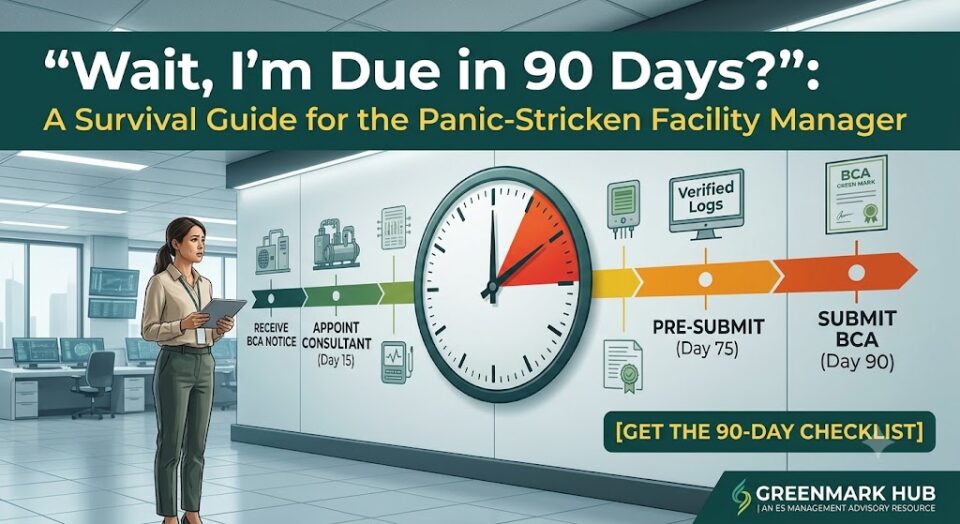
The 90-Day Triage Checklist: What Must Happen Next
Do not attempt to solve the entire audit in week one. A 90-day cycle is about ruthlessly prioritizing the elements that have the longest operational lead times.
Week 1: The Fast Audit & Diagnostic (T=90)
Before you start any data recovery, you must know what is actually working.
-
Perform a BMS Wellness Check: Can your system extract a continuous 12-month report of all mandated points? Do you have data gaps?
-
Verify Sensor Health: A GMP (Green Mark Professional) cannot submit unverified data. You must immediately cross-check your BMS sensor readings against calibrated, master reference equipment.
Week 2-4: Immediate Remediation (T=75)
This is your most crucial phase.
-
Repair/Replace Faulty Hardware: If sensors are failed or drifting, order replacements or book the calibration vendor immediately. BCA accepts short-term (e.g., 2-week to 1-month) data validation logs if you can prove your 12-month data logging plan was interrupted by hardware failure provided you remediate it now.
-
Launch Supplementary Logging: If your BMS has severe logging gaps, you must deploy portable power loggers and temperature loggers to capture the necessary operational snapshots before your submission date.
Month 2: The Audit and Documentation Synthesis (T=60)
-
Conduct the Plant Performance Audit: Your GMP and engineers must now verify your plant operating efficiency ($kW/RT$) and Indoor Environmental Quality (IEQ).
-
Compile Statutory Documentation: Assemble all required paperwork: your current PE endorsed drawings, maintenance contracts, sensor calibration certificates, and 12-month utility bills.
Month 3: Final Submission (T=30)
-
Finalize the OSE Report: Your Green Mark Professional synthesizes all data into the definitive Operating System Efficiency (OSE) report.
-
Submit to BCA: File the official Green Mark application through the BCA Online portal before your deadline.
When to Use Triage: Understanding Your Risk Profile
The strategy you deploy at 90 days out depends heavily on your current data health.
-
Risk Profile: LOW (Data Ready): Your building has an active BMS/BEMS, calibrated sensors, and continuous 12-month trend logs. Strategy: You can proceed with standard verification and synthesis.
-
Risk Profile: HIGH (Data Gaps): Your facility has uncalibrated sensors, fractured maintenance records,or significant gaps in your BMS logging. Strategy: You are in an engineering triage emergency. You must use speed, supplementary logging, and specialized expertise to recover compliance data before the clock runs out.
The Path to Compliance: No Disruption. Guaranteed.
The deepest fear managers have about a fast-track 90-day audit is operational disruption. You worry that supplementary logging means shutting down the chiller plant or blocking tenant AC during business hours.
This is a myth. Modern auditing is passive and silent. Data loggers are non-invasive. Measurement & Verification (M&V) verification happens silently via the Building Management System.
A professional, engineering-led audit means your tenants remain comfortable, your asset remains protected,and your compliance certainty is guaranteed—even on a tight 90-day deadline.
At ES Management, we provide a fuss-free Green Mark Re-Certification Consultancy designed to give facility leaders total financial and regulatory clarity. We assist your team in identifying eligible grant opportunities, structuring audit documentation, and executing a compliant roadmap.
-
Fixed-Fee Transparency: Get expert, end-to-end consulting starting at a flat S$6,990* (terms and conditions apply).
-
Zero Budget Surprises: No hidden administration fees or open-ended hourly billing.
Don’t let budget uncertainty delay your compliance. Contact ES Management today to evaluate your building’s grant eligibility and secure your fuss-free re-certification roadmap.