
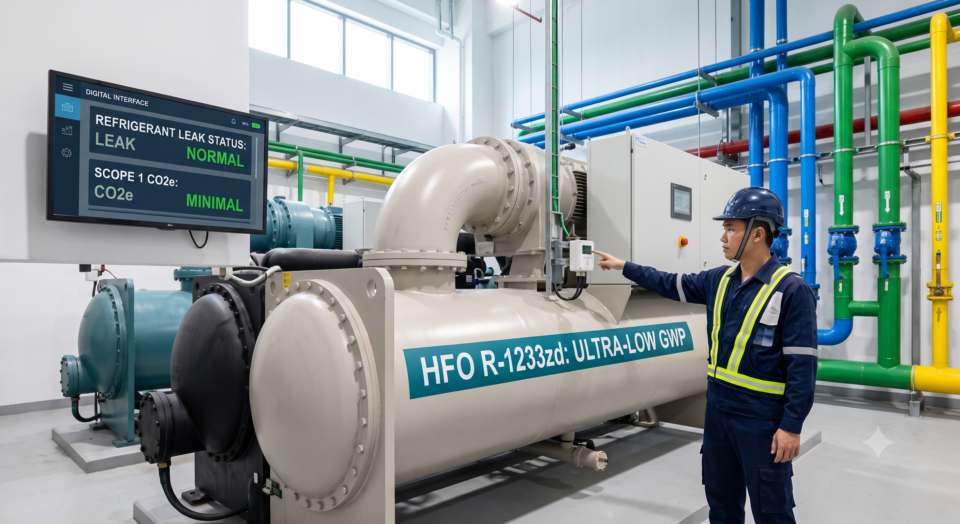
The Low-GWP Refrigerant Transition: Eliminating Scope 1 Direct Emissions in Central Chilled-Water Plants
While electricity consumption forms a building’s Scope 2 emissions, direct Scope 1 emissions from refrigerant leaks pose a severe threat to both global warming and your Green Mark Whole Life Carbon rating.
Central chiller plants rely on chemical refrigerants to transfer heat. However, common legacy refrigerants like R-134a carry a Global Warming Potential (GWP) of over 1,400—meaning just one kilogram leaked into the atmosphere has the same warming impact as 1,400 kg of carbon dioxide.
Under GM:2021, transitioning to low-GWP refrigerants and implementing leak detection infrastructure is no longer optional for top-tier ratings.
1. The Low-GWP Shift in Singapore’s HVAC Market
To align with the Kigali Amendment and Singapore’s net-zero targets, building owners upgrading their chiller plants must look beyond legacy options:
| Refrigerant Class | Common Examples | Global Warming Potential (GWP) | GM:2021 Rating Impact |
| Legacy HFCs | R-134a, R-410A | High (1,300 – 2,088) | Standard / Penalty Risk |
| HFO Blends | R-513A | Moderate (~573) | Transitional Compliance |
| Next-Gen HFOs | R-1233zd(E), R-1234ze | Ultra-Low (< 1 to 7) | Maximum Points (Cn Badge) |
Specifying ultra-low GWP Hydrofluoroolefins (HFOs) in new centrifugal or screw chillers drastically reduces your asset’s total life-cycle carbon footprint.
2. Permanent Leak Detection & Recovery Protocols
Using a low-GWP refrigerant is only half the battle. Auditors require proof that the system is sealed and monitored to prevent operational leakage.
-
Continuous Gas Monitoring Sensors: Installing permanent refrigerant leak detection sensors in the central plant room linked directly to your Building Management System (BMS).
-
Automated Containment Valves: System settings that automatically isolate refrigerant loops upon detecting pressure drops or gas concentrations above set thresholds.
-
Certified Recovery & Recycling Logs: Maintaining strict maintenance logs during servicing to ensure zero venting during compressor overhauls or system pump-downs.
3. Integrating Scope 1 Data into Corporate SGX ESG Reports
Direct refrigerant emissions tie straight into corporate sustainability disclosures. Demonstrating a structured phase-out of high-GWP refrigerants provides verifiable data for SGX Scope 1 reporting while securing credits for the Green Mark Whole Life Carbon badge.
⚡ Planning a Chiller Replacement?
Ensure your next HVAC tender specifies compliant, low-GWP refrigerants that maximize GM:2021 points while lowering long-term regulatory risk.
