In Singapore’s tropical climate, we spend roughly 90 percent of our time indoors, much of it in air-conditioned office environments. Historically, “green building” was synonymous with energy efficiency—reducing the kilowatts needed to keep a building cool. However, the BCA Green Mark 2021 (GM:2021) scheme introduced a decisive shift, elevating human health to the same level of importance as planetary health under the Health and Wellbeing (Hw) pillar.
Post-COVID-19, the definition of a healthy building has been fundamentally rewritten. It is no longer enough for a space to be comfortable; it must proactively prevent illness and promote cognitive function. For developers and facility managers aiming for Green Mark GoldPLUS or Platinum, mastering the syllabus of Indoor Environmental Quality (IEQ) and high-efficiency air filtration is now essential.
Redefining Ventilation Standards
Before 2020, ventilation standards (like SS 554) focused on minimum fresh air rates to prevent Sick Building Syndrome. In the post-COVID era, BCA Green Mark Hw encourages going beyond the minimum.
The standard now heavily rewards enhanced ventilation rates to dilute indoor contaminants and potential pathogens. This presents a unique challenge in Singapore: how do you introduce more hot, humid outside air without sending energy consumption soaring?
The solution lies in advanced technology. Developers are increasingly deploying Energy Recovery Ventilators (ERVs) that precondition incoming fresh air using the cool, dry exhaust air, maintaining the balance between IEQ and efficiency. Furthermore, GM:2021 emphasizes air tightness and leakage testing to ensure that the air entering the building is actually passing through filtration systems, rather than leaking in uncontrollably.
The Rise of High-Efficiency Filtration
The Hw section assigns significant weight to filtration. With the haze being a recurring issue in Southeast Asia,and the heightened awareness of airborne viral transmission, basic filters are no longer sufficient.
Green Mark encourages the use of MERV 13 or MERV 14 filters (or ISO equivalent) in Air Handling Units (AHUs). These high-efficiency filters can capture the fine particulate matter (PM2.5) that constitutes haze and acts as a carrier for pathogens. Crucially, the scheme requirements focus not just on the potential of the filter,but on “In-Operation” verifiability, ensuring that pressure drops are managed so energy efficiency isn’t compromised by cleaner air.
Managing What We Measure: IAQ Sensor Deployment
Perhaps the most critical editorial shift in Green Mark Hw is the move from snapshot auditing to continuous monitoring. You cannot manage what you do not measure.
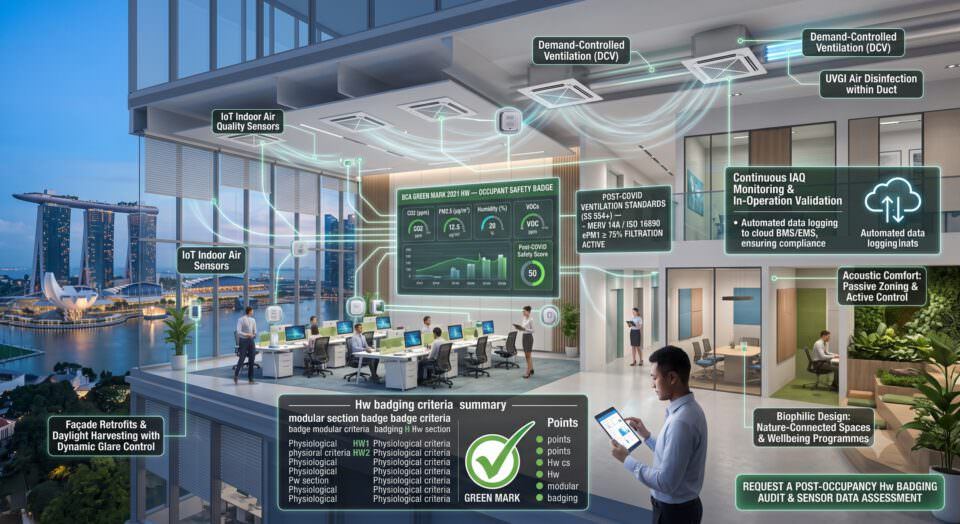
To score points under the continuous IAQ monitoring criteria, project teams must deploy a robust network of indoor air quality (IAQ) sensors. These are no longer handheld devices used once a year by consultants. They are permanently installed, Internet of Things (IoT)-enabled devices integrated into the building’s BMS (Building Management System).
Effective deployment strategies focus on:
-
Demand-Controlled Ventilation: Sensors monitoring $CO_2$ levels can modulate fresh air intake based on actual occupancy, saving energy during low-occupancy periods while guaranteeing freshness during meetings.
-
Pollutant Tracking: Modern sensor arrays in Green Mark buildings trend parameters like Total Volatile Organic Compounds (TVOCs), PM2.5, and Formaldehyde.
-
Data Transparency: Gold and Platinum buildings often display this real-time data on dashboards in lobbies to reassure occupants about the safety of their environment.
By integrating high-efficiency filtration, post-COVID ventilation strategies, and continuous sensor data,Singapore’s developers are utilizing the Green Mark Hw framework to create assets that are resilient,attractive to top-tier tenants, and fundamentally safer for people.