
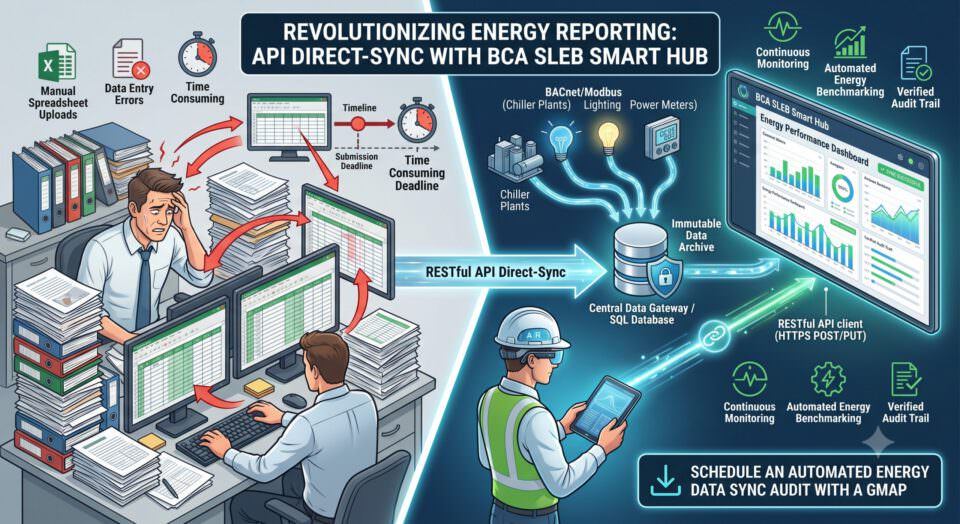
For IT/OT operations managers and sustainability reporting officers in Singapore, the annual mandatory energy submission window often triggers a chaotic scramble. Gathering consumption data from disparate Building Management Systems (BMS), normalizing it into the required formats, and manually uploading spreadsheets to the Building and Construction Authority’s (BCA) Building Energy Submission System (BESS) or the Super Low Energy Building (SLEB) Smart Hub is a time-consuming, error-prone exercise.
However, a critical technical shift is underway. Building on the intelligence pillar of BCA Green Mark 2021 (GM:2021),forward-thinking organizations are bypassing the spreadsheet entirely. They are setting up automated, dynamic data feeds directly to the SLEB Smart Hub using RESTful APIs, enabling automated energy benchmarking and transforming compliance from an annual headache into a seamless, year-round operational process.
1. The Operational Conflict: Proprietary Silos vs. Standardized Reporting
The core problem for IT/OT managers lies in the heterogeneity of building systems. A single facility might have a lighting system communicating over BACnet, a power sub-metering network over Modbus TCP, and a separate cooling plant manager operating on a proprietary protocol.
Traditionally, gathering data from these sources for statutory submission requires:
-
Manual Data Extraction: Operators logging into multiple consoles.
-
Normalize and Transcribe: Copy-pasting data into BCA-specified Microsoft Excel templates.
-
Statutory Declaration: Manually uploading and declaring the data via the BCA portal.
This process is not just resource-intensive; it’s a data integrity risk. Spreadsheet transcription errors can lead to inaccurate energy use intensity (EUI) calculations, potentially misrepresenting a building’s Green Mark performance and complicating future recertification.
2. Advanced Technical Focus:
Architecting a RESTful API Direct-Sync Loop
To achieve automation, the operational architecture must shift toward data democratization. The BCA SLEB Smart Hub now supports direct data ingestion via APIs, typically using secure RESTful (Representational State Transfer) architectures. This allows building owners to voluntarily disclose building energy performance data, enabling dynamic energy performance benchmarking and automated Green Mark reporting.
Requirements for API Sync Readiness
Implementing a RESTful API direct-sync with the SLEB Smart Hub requires several technical prerequisite layers:
-
Permanent Instrumentation: Audits and continuous monitoring for GM:2021 demand permanent measuring instruments, not one-off data loggers. The measurement system must be able to record data logging capabilities with trend intervals no greater than 5 minutes.
-
OT-to-IT Data Gateway: The data must be aggregated from the OT field level (BACnet, Modbus) into a centralized IT database (e.g., SQL, InfluxDB) or an energy monitoring system (EMS).
-
Immutable Data Archive: To pass GM:2021 validation, the data must be securely stored in an immutable archive,such as Write-Once-Read-Many (WORM) storage or secure cloud databases, preventing unauthorized modification.
-
RESTful Client Development: A client application—either built into the EMS or developed as a custom script (Python, JavaScript)—must be created to handle the API communication.
+------------------+     +------------------+     +------------------+
| OT Field Devices | --> | Data Aggregator/ | --> | IT Database/EMS  |
| (BACnet/Modbus)  |     |   Gateway/BMS    |     | (SQL/InfluxDB)   |
| 5-Min Trend Logs |     | (Modbus to MQTT) |     | Immutable Archive|
+------------------+     +------------------+     +------------------+
                                                      |
                                v                     v
+------------------+     +------------------+     +------------------+
| SLEB Smart Hub   | <-- |   BCA API Endpoint  | <-- | Automated Client |
| Energy Performance |     | (RESTful HTTPS)  |     | (API Direct Sync)|
| Dashboard        |     +------------------+     +------------------+
The API Connection Loop
The automated sync client typically follows a five-step loop:
-
Query: The client queries the internal immutable database for the required period (e.g., the last 12 months for initial disclosure or the last hour for dynamic dynamic benchmarking).
-
Normalize: It transforms the raw SQL rows into the standardized JSON or XML format required by the SLEB Smart Hub API documentation.
-
Authenticate: It authenticates with the BCA API endpoint using standard security protocols (typically HTTPS with an API key or OAuth2 token).
-
Post: It submits the normalized data via an HTTPS
POSTorPUTrequest. -
Log: It receives and logs the API status response (e.g.,
201 Createdor400 Bad Request), ensuring a complete audit trail of all submissions.
3. Summary: Enabling Automated Green Mark Benchmarking
Automation does not just eliminate manual labour; it enables the proactive maintainability strategies rewarded under the GM:2021 framework Modular Section In: Intelligence.
By establishing dynamic, verified data feeds, sustainability reporting officers can view their asset’s automated energy benchmarking against similar building typologies in Singapore in near real-time. Instead of waiting for the annual submission to discover a spike in EUI, operations managers can utilize continuous monitoring to identify operational anomalies or sensor calibration drift the moment they occur.
This verified, continuous audit trail provides the mandatory verifiability claims required during Green Mark performance audits. More importantly, it directly hedges against Singapore’s escalating carbon tax trajectory, ensuring every watt of purchased electricity is accounted for, minimized, and validated before statutory deadlines arrive.
Do you suspect your un-monitored energy data is creating a compliance gap?
[Schedule an Automated Energy Data Sync Audit with a GMAP.]