
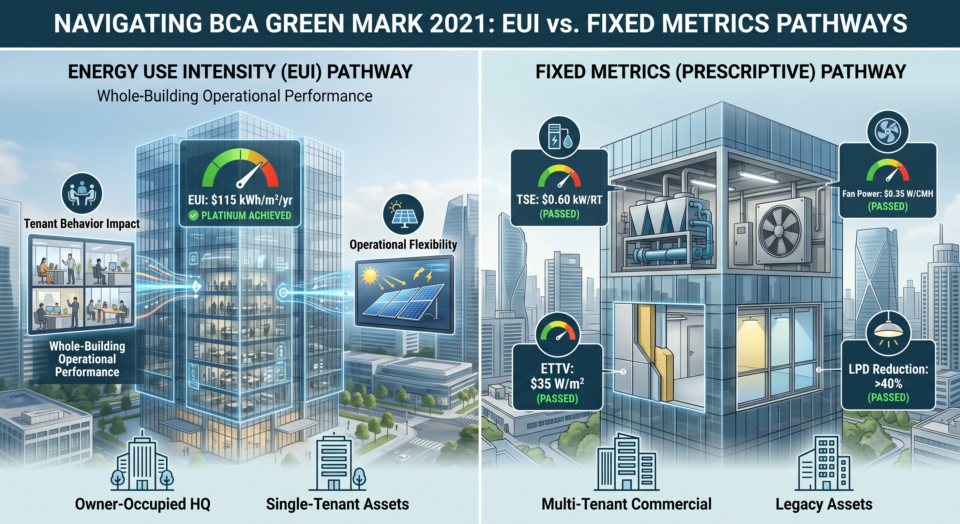
Under the Building and Construction Authority (BCA) Green Mark 2021 (GM:2021) framework, achieving energy efficiency compliance comes down to choosing between whole-building operational performance and prescriptive sub-system targets. Selecting the right pathway—Energy Use Intensity (EUI) or Fixed Metrics—can mean the difference between a smooth certification process and costly engineering overhauls.
While both pathways lead toward Green Mark certification and Super Low Energy (SLE) badges, they evaluate building efficiency through fundamentally different lenses.
1. Pathway 1: The Energy Use Intensity (EUI) Pathway
The EUI pathway evaluates a building’s total annual energy performance on an absolute scale, reflecting the shift toward outcome-based carbon accounting in Singapore’s built environment.
Instead of testing individual pieces of equipment in isolation, EUI measures total operational energy used across all building systems—including tenant power, lighting, central cooling, and plug loads—divided by the total gross floor area (GFA).
Key Characteristics:
-
Outcome-Focused: Compliance is verified through 12 months of actual utility meter data (for existing buildings) or calibrated energy models (for new designs).
-
High Operational Flexibility: Building managers can offset lower efficiency in one area (e.g., an older air-handling unit) with exceptional performance in another (e.g., smart lighting controls or aggressive passive cooling).
-
Direct Alignment with Scope 2 Disclosures: Because EUI calculates total kWh consumed, it maps directly into corporate GHG inventory reporting for SGX-listed companies using IFRS S2 standards.
Strategic Challenge:
Because EUI accounts for whole-building energy, tenant behavior heavily influences compliance. High-density tenant layouts, 24/7 server rooms, or high plug-load densities (such as trading floors or commercial kitchens) can push a building’s overall EUI above threshold limits, even if the central chilled water plant is performing flawlessly.
2. Pathway 2: The Fixed Metrics (Prescriptive) Pathway
The Fixed Metrics pathway is a “deemed-to-comply” route. It sets stringent efficiency thresholds on specific, individual sub-systems across the asset rather than assessing overall energy consumption.
To pass via Fixed Metrics, each major building component must hit a predetermined efficiency baseline.
Core Benchmark Examples:
-
Central Water-Cooled Chilled Water Plant: Total System Efficiency (TSE) $\le 0.60\text{ kW/RT}$ for Platinum standards.
-
Airside Efficiency: Fan power limitations (typically $\le 0.35\text{ W/CMH}$ or better for AHUs/FCUs).
-
Building Envelope: Envelope Thermal Transmittance Value (ETTV) targets for air-conditioned spaces.
-
Lighting Power Density (LPD): Strict percentage reductions below SS 530 base standards.
Key Characteristics:
-
Predictable Engineering Scope: Compliance relies on discrete equipment specifications and energy audits, making capital budgeting straightforward.
-
Insulated from Tenant Plug-Load Risk: High tenant power draw or long operational hours will not penalize the building’s central efficiency rating, provided the base-building systems meet their prescribed thresholds.
-
Shortfall Offset Mechanism: GM:2021 allows minor shortfalls in individual fixed metrics to be made up using on-site renewable energy generation (such as rooftop solar photovoltaics) applied with a multiplication factor.
Strategic Challenge:
Fixed Metrics offers zero internal trade-offs. If a legacy asset cannot meet a specific sub-system threshold—such as ductwork constraints preventing fan power reduction—the asset manager must either execute structural retrofits or install enough solar capacity to offset the performance shortfall.
EUI vs. Fixed Metrics: Strategic Comparison
| Comparison Dimension | Pathway 1: Energy Use Intensity (EUI) | Pathway 2: Fixed Metrics |
| Primary Focus | Whole-building operational energy consumption ($\text{kWh/m}^2/\text{year}$) | Individual sub-system performance (kW/RT, W/m², W/CMH) |
| Verification Method | 12-month utility/metering data or dynamic simulation | Component commissioning tests, sensor audits, and spec sheets |
| Tenant Dependency | High—tenant plug loads, schedules, and fit-outs impact outcome | Low—focuses primarily on base-building infrastructure |
| Design / Operational Flexibility | High—trade-offs between systems are permitted | Low—each metric must be met or offset via renewables |
| Renewable Offset Usage | Directly reduces net annual kWh to lower EUI | Used to compensate for specific sub-system benchmark shortfalls |
| Best Fit Asset Class | Owner-occupied HQ buildings, single-tenant assets, smart towers | Multi-tenant commercial offices, retail malls, legacy assets |
Selecting the Right Pathway for Your Asset
Choose the EUI Pathway if:
-
You have operational control over tenant spaces: Single-tenant buildings, institutional facilities, or assets with green lease agreements requiring strict tenant energy caps thrive under EUI.
-
You leverage advanced BMS and AI automation: Assets using predictive cooling algorithms, dynamic resets, and occupancy-based scheduling can achieve ultra-low EUI figures without replacing major machinery.
-
Your ESG priorities center on operational carbon: Assets driven by corporate sustainability targets benefit from tracking direct operational carbon reductions.
Choose the Fixed Metrics Pathway if:
-
You manage a multi-tenant commercial asset: When tenant plug loads, varied operating hours, and server room densities are outside your direct control, Fixed Metrics protects your baseline certification.
-
You are planning targeted mechanical retrofits: If your capital expenditure is focused specifically on upgrading the central chiller plant or cooling tower cells, hitting the $0.60\text{ kW/RT}$ target provides a direct route to compliance.
-
You have available roof space for solar PV: Utilizing solar energy offsets allows you to bypass structural bottlenecks in older buildings where modifying air handling systems or building envelopes is cost-prohibitive.
