
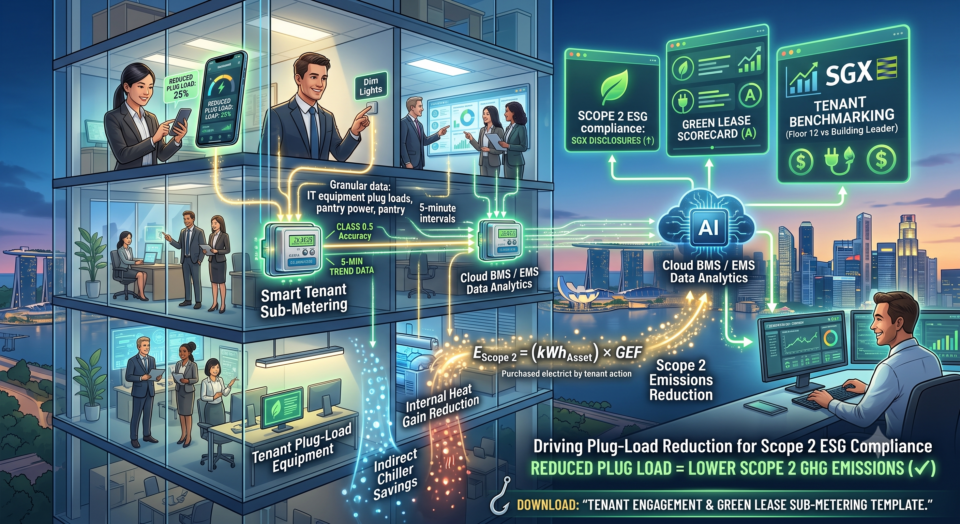
Driving Plug-Load Reduction for Scope 2 ESG Compliance
The commercial real estate landscape in Singapore is navigating a seismic shift. Passive property management is being replaced by active performance tracing, driven by a convergence of technological capability and strict regulatory mandates. For listed Real Estate Investment Trusts (REITs), developers, and corporate occupiers, “energy efficiency” is no longer a localized operational concern; it is a critical component of board-level Environment, Social, and Governance (ESG) reporting.
In multi-tenanted commercial buildings, landlords face a persistent structural barrier: the split incentive. While building owners control capital works like chiller plant upgrades or facade enhancements, a massive portion of building energy consumption—often ranging from 40% to 60%—occurs within tenant-occupied spaces. This energy draw—primarily lighting, IT equipment, and pantry plug loads—falls outside direct landlord control.
Without granular data sharing, landlords struggle to demonstrate asset-level savings, while tenants cannot benchmark their internal operations against sustainability targets. Smart tenant sub-metering, integrated with interactive engagement dashboards, provides the thermodynamic mathematical solution to bridge this gap,driving localized efficiency gains and ensuring compliance with Scope 2 emissions disclosure.
1. The Scope 2 Challenge: Decarbonizing Purchased Electricity
Under the greenhouse gas (GHG) protocol protocol, Scope 2 emissions represent indirect greenhouse gas emissions resulting from the generation of purchased electricity consumed by the reporting company. For a commercial building owner, this includes the power used for common area lighting, mechanical ventilation, and most critically, the central chilled water plant that provides air conditioning to every tenant.
Mathematical Breakdown of Scope 2 Responsibility
Total Asset Scope 2 Emissions ($E_{\text{Scope 2}}$) are calculated by multiplying the total grid-purchased electricity ($kWh_{\text{Asset}}$) by the standardized Grid Emission Factor ($GEF$) for Singapore:
The Geographically split operational boundary poses a challenge. Under the standard BCA Green Lease schedules, lighting and equipment within the tenant’s Net Lettable Area (NLA) are the tenant’s distinct Scope 2 emissions. However, the central cooling provided to them by the landlord is part of the landlord’s Scope 2.When tenants waste equipment energy, it generates additional heat gain, forcing the landlord’s cooling system to work harder, indirectly driving up the landlord’s Scope 2 profile.
Without tenant engagement on plug loads, landlords cannot meet asset-level decarbonization pathways required for GRESB (Global Real Estate Sustainability Benchmark) benchmarking.
2. Advanced Technical Focus:
Smart Metering & Interactive Engagement Loops
The days of manual meter reading or relying on non-permanent portable data loggers are over. Compliance with BCA Green Mark 2021 (GM:2021) technical guides—and passing mandatory energy audits under the MEI regime—demands permanent measuring instruments and continuous In-Operation validation.
Required Technical Specifications (SS 553 & GM:2021 Guidelines)
Passing audit validation requires installing fixed instrumentation that adheres to strict accuracy tolerances and data logging architecture:
-
Dedicated Power Meters: For individual tenant NLA spaces, meters must be Class 1 or Class 0.5 (per IEC 62053-22). Basic panel protection relays sharing CTs do not meet compliance standards.
-
Granular Measurement: Measurement systems must record data logging capabilities with the ability to trend at maximum 5-minute sampling intervals, recording values to at least one decimal place.
-
Immutable Data Archive: Data must be securely stored within the BMS (Building Management System), Energy Monitoring System (EMS), or secure cloud databases with WORM (Write-Once-Read-Many) storage.
The Interactive Tenant Dashboard: Data Democratization
Collecting granular data is useless if the results are siloed. The true optimization occurs when landlords deploy Interactive Tenant dashboards, providing occupiers with localized, real-time feedback loops.
+-------------------------------------------------------------+
|               Interactive Tenant Engagement Loop              |
+-------------------------------------------------------------+
                                |
                                v
+------------------+     +------------------+     +------------------+
|      Tenant      | --> |  Smart Sub-Meter | --> | Cloud BMS / EMS  |
| Plug Load Equipment |     |  (5-Min Trend Data) |     |  Data Analytics  |
+------------------+     +------------------+     +------------------+
                                                      |
                                v                     v
+------------------+     +------------------+     +------------------+
|   Interactive    | <-- |  Mobile/Web App  | <-- |  AI Insights &  |
|    Dashboard     |     |  User Interface  |     | Benchmarking Alg |
+------------------+     +------------------+     +------------------+
   (Shows real-time   (Shows historical   (Identifies wastage,
    kW draw, cost,   usage vs benchmarks)  sends alerts)
   alerts)
3. Operations Gap: Implementing the Strategy
Facility Managers and Tenant Relations Teams must shift their approach from reactive comfort complaint handling to proactive performance tuning. The critical barrier to smart metering is frequently an Operations Gap rather than a hardware limitation.
Dynamic Optimization Strategies:
-
Task-Ambient Lighting Design Integration: Instead of illuminating entire office floors uniformly, smart dashboards encourage occupiers to adopt task-ambient designs, dropping localized Lighting Power Density (LPD) from standard $11 \text{ W/m}^2$ levels toward $6.5 \text{ W/m}^2$ standards.
-
Static Pressure Reset Strategies (Indirect Benefit): When tenants aggressively reduce equipment use during off-peak hours, it lowers the internal latent and sensible heat gain. The BMS can monitor reduced demand at local terminal boxes and dynamically lower the central system’s duct static pressure setpointuntil at least one VAV box remainsNearly fully open (typically 90–95%). This minimizes choke and dramatically saves landlord fan energy.
-
Coil Maintenance Pressure Drop Monitoring (Indirect): A restricted, dirty coil requires higher static pressure to deliver airflow, wasting fan power limitations ($W/CMH$). When sub-metering highlights that airflow isn’t drifting upward, but cooling demand is, it alerts the Ops team that the air-side pressure drop across the coil may be restricted, demanding routine maintenance.
Conclusion: Asset Valuation Meets Global Standards
Tenant space energy tracking is no longer an optional sustainability “nice-to-have.” In Singapore, ACRA (Accounting and Corporate Regulatory Authority) and the Singapore Exchange (SGX) now mandate listed issuers and large companies to file their climate impact indicators, including Scope 1 and 2 GHG emissions, in line with ISSB (International Sustainability Standards Board) global standards.
By sharing granular operational data via interactive dashboards, landlords align themselves directly with corporate occupiers’ own disclosure requirements. More importantly, it directly hedges against Singapore’s escalating carbon tax trajectory—scaling from $45/\text{tCO}_2\text{e}$ in 2026 toward $80/\text{tCO}_2\text{e}$ by 2030—by ensuring every watt of purchased electricity is accounted for,minimized, and validated.
Do you suspect your multi-tenanted asset has an “un-monitored” energy gap in the tenant NLA?
