
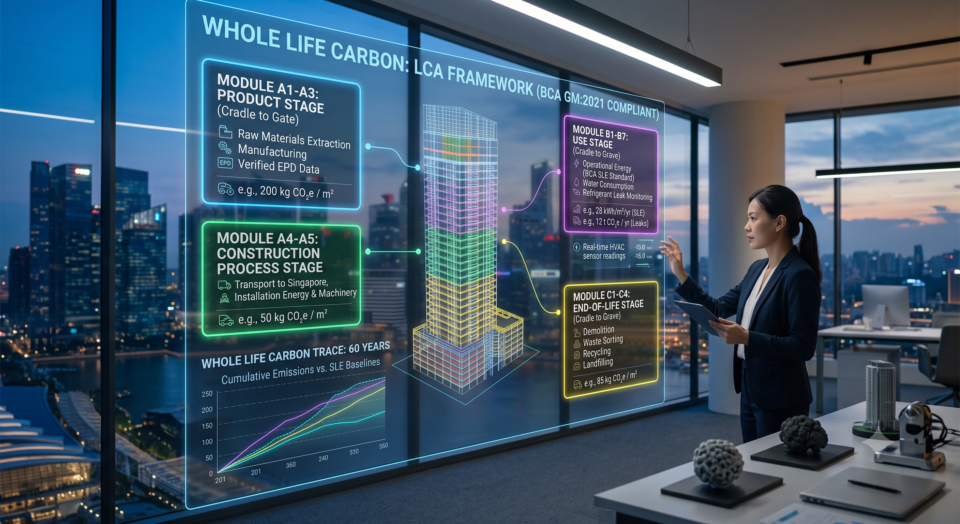
For building owners targeting Green Mark Platinum or Super Low Energy (SLE) status, conducting a formal Life Cycle Assessment (LCA) is the ultimate mechanism to evaluate and minimize whole-life environmental impacts.
An LCA evaluates an asset across its entire lifespan—from raw material extraction (Module A1) all the way through construction, operation, and eventual end-of-life deconstruction (Module C4).
Here is a breakdown of how Singapore building owners can successfully execute an LCA to satisfy GM:2021 Whole Life Carbon requirements.
      MODULE A1-A3          MODULE A4-A5             MODULE B1-B7          MODULE C1-C4
┌─────────────────────┐  ┌─────────────────┐  ┌─────────────────────┐  ┌──────────────────┐
│ Product Stage       │  │ Construction    │  │ Use Stage           │  │ End-of-Life      │
│ • Raw Materials     │─►│ • Transport     │─►│ • Operational Energy│─►│ • Demolition     │
│ • Manufacturing     │  │ • Installation  │  │ • Refrigerant Leaks │  │ • Waste Disposal │
└─────────────────────┘  └─────────────────┘  └─────────────────────┘  └──────────────────┘
1. The 4 Life Cycle Stages Evaluated in GM:2021
To compile a compliant LCA report, your consultancy team must evaluate four distinct phases using recognized carbon accounting tools:
-
Product Stage (A1–A3): Upfront carbon embedded in steel, concrete, glass, and M&E equipment.
-
Construction Process Stage (A4–A5): Transport of materials to the Singapore site and energy consumed by heavy machinery during installation.
-
Use Stage (B1–B7): Ongoing operational energy use ($kWh/m^2/yr$), water consumption, maintenance replacement cycles, and refrigerant losses.
-
End-of-Life Stage (C1–C4): Carbon cost of eventual deconstruction, sorting, recycling, or landfilling.
2. Standardized Tools for Singapore Building LCAs
Conducting an LCA requires recognized software and localized carbon emission factors. Auditors look for evaluations performed using globally accepted platforms tailored to local baselines:
-
One Click LCA / Tally: Leading software tools used to import Building Information Models (BIM) or Bill of Quantities (BOQ) to calculate baseline embodied carbon.
-
BCA Carbon Calculator: Utilizing local grid emission factors ($kg CO_2e/kWh$) and Singapore-specific material carbon coefficients to ensure regional accuracy.
3. Offsetting Residual Carbon Responsibly
Once deep energy retrofits and low-carbon materials have pushed your building’s baseline emissions as low as technically feasible, residual emissions can be addressed through approved carbon offsets.
Under GM:2021 guidelines, purchasing Renewable Energy Certificates (RECs) or high-integrity carbon credits allows assets to bridge the final gap toward Net Zero Carbon status—unlocking preferred green financing and lowering capital costs.
📊 Need a Whole Life Carbon Assessment for Your Asset?
From BIM-integrated LCA modeling to SGBC material verification, our certified Green Mark Accredited Professionals (GMAPs) handle the entire carbon accounting workflow.
[ 👉 Schedule an Initial Whole Life Carbon (LCA) Consultation ]
