
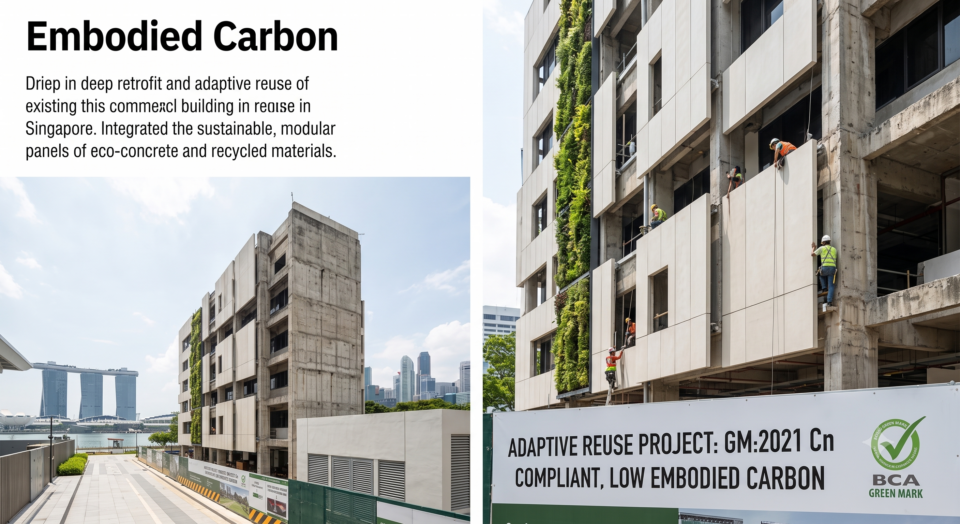
When property owners embark on building retrofits, the primary focus is almost always on reducing operational electricity consumption. However, under the BCA Green Mark 2021 (GM:2021) framework, the Whole Life Carbon (Cn) section puts a major spotlight on embodied carbon—the greenhouse gas emissions generated during the extraction, manufacturing, transportation, and installation of building materials.
For existing commercial buildings undergoing major retrofits, selecting the wrong materials can create an upfront “carbon penalty” that undermines your overall sustainability score.
Here is how facility directors and project teams can optimize material selection to maximize Whole Life Carbon points during a retrofit.
1. The Carbon Impact of Retrofit Materials
Every major asset overhaul—from replacing chiller pipework to upgrading facade glazing—introduces embodied emissions. BCA rewards projects that actively calculate and minimize these upfront emissions through carbon footprint reporting and low-carbon material procurement.
-
Low-Carbon Concrete & Cement Substitutes: When modifying structural slabs or plant room pads, utilizing eco-concrete with Ground Granulated Blast-furnace Slag (GGBS) or pulverized fly ash drastically cuts embodied carbon.
-
Recycled Content in Steel & Metals: Specifying structural steel and copper piping with high post-consumer recycled content earns points under the Singapore Green Building Product (SGBP) certification scheme.
-
Low-Embodied Carbon Finishes: Ceiling tiles, raised flooring, and drywall systems certified with 3 or 4 “Ticks” under the SGBP scheme provide instant carbon credits without complicating fit-out schedules.
2. Leveraging Adaptive Reuse Over Demolition
The greenest building is often the one that is already built. GM:2021 heavily incentivizes retaining structural components rather than replacing them.
Full Demolition & New Build        Adaptive Reuse & Deep Retrofit
┌─────────────────────────┐        ┌───────────────────────────────┐
│ High Embodied Carbon    │  ───►  │ Retained Structural Frame     │
│ Heavy Construction Waste│  ───►  │ Targeted M&E Upgrades Only    │
│ Extended Payback Window │  ───►  │ Accelerated Carbon Neutrality │
└─────────────────────────┘        └───────────────────────────────┘
By conducting a structural integrity assessment, asset owners can preserve existing concrete cores, primary facade frameworks, and major riser paths—slashing project embodied carbon by up to 60% compared to a complete teardown.
3. SGBP Certification: The Shortcut to Audit Compliance
To prove embodied carbon savings to a Green Mark auditor, product claims must be backed by verifiable documentation. Utilizing products certified under the Singapore Green Building Council (SGBC) SGBP scheme streamlines the submission process.
-
1 to 2 Ticks: Basic compliance with environmental standards.
-
3 to 4 Ticks (“Leader” / “Master”): Unlocks maximum points in the Whole Life Carbon badge by providing verified Environmental Product Declarations (EPDs).
🛠️ Is Your Retrofit Material List Compliant?
Don’t let unverified materials derail your Whole Life Carbon score. Our team helps project managers conduct embodied carbon baseline checks and source SGBP-certified alternatives.
[ 👉 Request a Pre-Retrofit Material & Carbon Baseline Review ]