
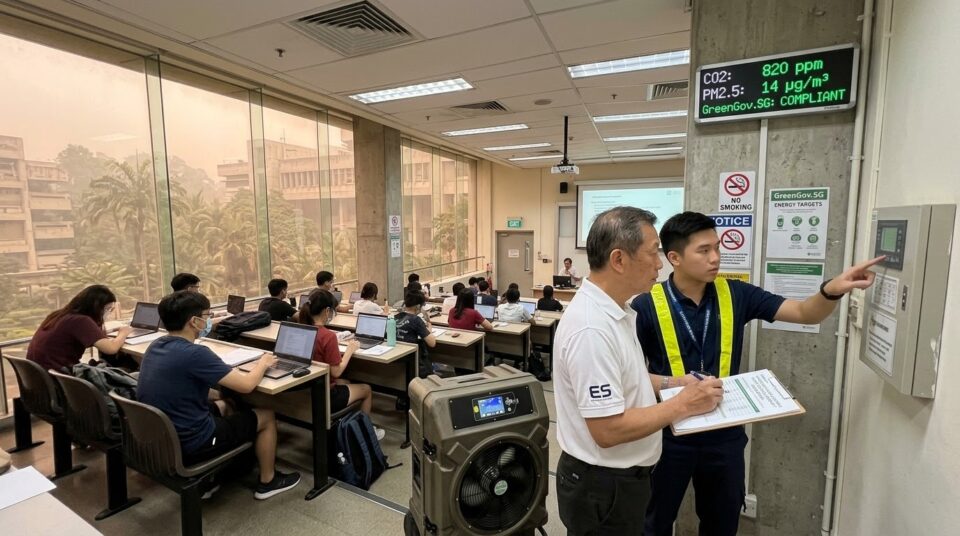
School facility directors and public sector estate managers face a tight operational tightrope during transboundary haze alerts in Singapore. Under the GreenGov.SG initiative, public sector buildings and educational institutions are bound by strict annual Energy Use Intensity (\text{kWh/m}^2/\text{yr}) reduction mandates and sustainability targets.
When 1-hour outdoor particulate concentrations surge (\text{PM}_{2.5} > 55\ \mu\text{g/m}^3), managing high-density environments like university lecture halls, school auditoriums, and government training centers becomes critical:
The Enclosed Hybrid Space \text{CO}_2 Spike:
Many educational facilities rely on hybrid (mixed-mode) or natural ventilation during standard operations. When windows are sealed and mechanical cooling is engaged without automated fresh air controls, high occupant loading causes carbon dioxide to exceed 1200ppm within 45 minutes, causing student drowsiness and violating SS 554 IAQ standards.
The Fan Power Energy Penalty: Attempting to scrub large volume spaces by running central Primary Air Handling Units (PAHUs) at 100% fan speed through high-resistance filters increases building power consumption, breaching public sector EUI targets and risking Green Mark GoldPLUS/Platinum standing.
[ Outdoor Haze Spike (PM2.5 > 55 µg/m³) ]
                  │
 ┌────────────────┴────────────────┐
 ▼                                 ▼
[ Hybrid Space Enclosed ]         [ Continuous Central Air Delivery ]
 │                                 │
 ▼                                 ▼
[ CO2 Accumulation (>1200 ppm) ]  [ Fan Power Spike (kWh/m²/yr) ]
 │                                 │
 └────────────────┬────────────────┘
                  │
                  ▼
[ GreenGov.SG Energy & IAQ Mandate Breach ]
Step-by-Step Educational Facility Haze Blueprint
1. Establish Automated Operational Triggers
Transition naturally ventilated or hybrid classrooms to full mechanical cooling only when real-time 1-hour outdoor \text{PM}_{2.5} readings exceed \ 55\ \mu\text{g/m}^3. Avoid premature central system overrides that consume unnecessary cooling energy during mild ambient conditions.
2. Deploy Localized Secondary Air Scrubbing
Instead of forcing central AHU fans to push air through high static resistance filters (\Delta P > 120\text{ Pa}), install high-CADR (Clean Air Delivery Rate) decentralized HEPA filtration units inside high-occupancy lecture halls. Localized recirculation scrubs sub-micron particulates (\text{PM}_{2.5}) effectively while keeping central fan power draw flat.
3. Implement Sensor-Driven Fresh Air Flushes
Equip high-density halls with indoor\text{CO}_2{ ppm} sensors linked to fresh air dampers. Keep outdoor air dampers at minimum positions during haze spikes to restrict particulate entry, but automatically trigger short, 5-minute fresh air “flushes” whenever indoor \text{CO}_2{ ppm} approaches 950ppm.