In Singapore’s commercial built environment, central cooling accounts for 40% to 60% of total building electricity consumption.
For decades, facility managers (FMs) and chief engineers have relied on traditional Building Energy Management Systems (BEMS) governed by static PID (Proportional-Integral-Derivative) loops, fixed schedules, and manual setpoints.
However, under the BCA Green Mark 2.0 (GM:2021) framework and the Mandatory Energy Improvement (MEI) regime, static control is no longer sufficient. Achieving top-tier efficiency—such as central plant benchmarks of 0.58 \text{ to } 0.68\text{ kW/RT}—requires shifting from reactive tuning to AI Predictive Chiller Control.
1. The Limits of Traditional BEMS
Standard BEMS controllers operate reactively. They measure return chilled water temperatures or ambient wet-bulb temperatures and adjust valve positions or compressor speeds after a thermal load change has already occurred.
Common Limitations of Legacy Controls:
-
Hunt & Overshoot: PID loops struggle with rapid weather shifts (e.g., sudden tropical rainstorms), leading to compressor hunting and wasted energy.
-
Static Setpoints: Chilled water supply temperatures \text{CHWST} and condenser water supply temperatures \text{CWST} remain locked at fixed values (e.g., 6.5^\circ\text{C} and 29.5^\circ\text{C}), ignoring real-time outdoor wet-bulb variations.
-
Sub-Optimal Staging: Multi-chiller plants often stage additional units based on fixed tonnage thresholds rather than the true system-level COP (Coefficient of Performance) curve.
2. How AI Predictive Chiller Control Works
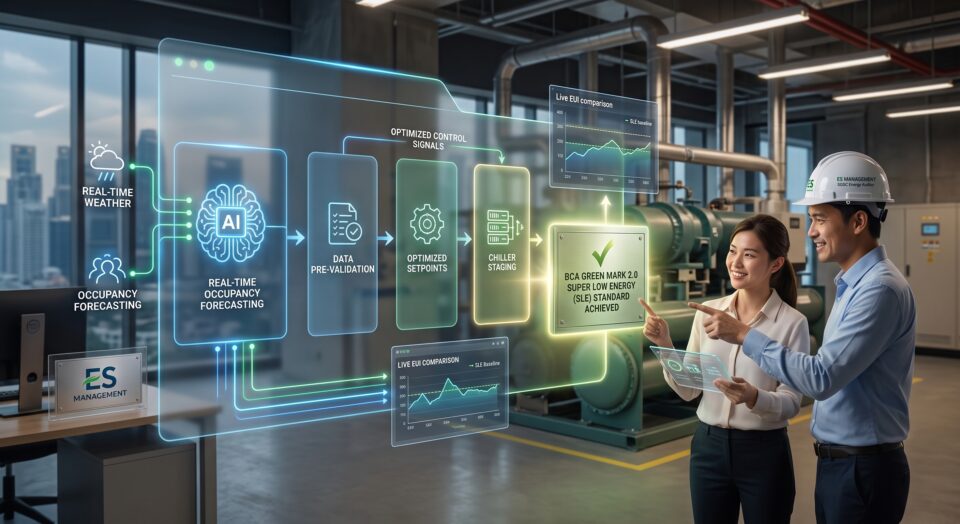
AI Predictive Control integrates machine learning (ML) models and digital twin simulations directly with your existing BEMS via BACnet or Modbus API endpoints.
Key Operational Drivers:
-
Neural Network Plant Modeling: The AI builds a mathematical digital twin of your specific central plant—mapping exact performance curves for chillers, primary/secondary pumps, and cooling tower fans across all partial-load conditions.
-
Predictive Weather & Occupancy Integration: By ingesting 24-hour weather forecasts (solar irradiance, ambient humidity, wet-bulb temperature) and tenant calendar/footfall patterns, the algorithm anticipates thermal load changes 2 to 6 hours in advance.
-
Dynamic Multi-Variable Optimization: Every 5 to 15 minutes, the AI calculates the mathematically optimal combination of parameters to minimize total system \text{kW/RT}:
-
Dynamic \text{CHWST} reset (
6.5^\circ\text{C} \rightarrow 8.0^\circ\text{C}) during partial load.
-
-
Variable primary pump flow modulation.
-
Dynamic cooling tower approach optimization.
-
Predictive chiller staging based on combined system power, not individual machine efficiency.
3. How AI Aligns Directly with BCA Green Mark 2.0 (GM:2021)
Deploying AI predictive control is one of the fastest paths to upgrading your building’s regulatory standing on greenmark.sg:
-
Unlocking the Intelligence (INT) Badge: GM:2021 explicitly rewards buildings featuring machine learning controls, real-time predictive analytics, and automated Fault Detection & Diagnostics (FDD) that prevent performance drift.
-
Accelerating EUI Reduction \text{kWh/m}^2/\text{yr}: AI optimization typically delivers an immediate 8% to 15% reduction in central plant energy consumption purely through software, helping flagged properties meet their mandatory 10% MEI EUI reduction target within months rather than years.
-
GMIS-EB 2.0 Grant Co-Funding: Because AI predictive control generates verifiable carbon abatement \text{tCO}_2\text{e}, software subscription and gateway hardware costs qualify for up to 50% co-funding under the Green Mark Incentive Scheme for Existing Buildings.
4. Software vs. Hardware CAPEX Comparison
| Strategy | Installation Time | CAPEX Investment | Typical Plant Efficiency Gain | Disruption to Building Operations |
| Physical Chiller Overhaul | 6 to 18 Months | High (S$500k – S$2M+) | $15\% – 25\%$ | High (Chilled water downtime, rigging) |
| AI Predictive Software Integration | 2 to 6 Weeks | Low to Moderate | $8\% – 15\%$ | Zero (Overlay on existing BEMS) |
Regulatory & Compliance Disclaimer
Disclaimer: Information provided regarding AI predictive control technologies, Green Mark 2.0 (GM:2021) credit metrics, and government co-funding schemes (GMIS-EB 2.0) is intended for educational and technical planning purposes. Grant eligibility, credit allocations, and specific plant efficiency outcomes depend on baseline energy audits, system compatibility, and formal assessment by the Building and Construction Authority (BCA). ES Management provides independent engineering consultancy and does not guarantee specific algorithm performance without prior technical scoping.
End Your MEI 90-Day Data Panic
Transitioning your building from reactive BEMS controls to AI predictive optimization delivers immediate energy savings without physical operational risk.
At ES Management,, we guide asset directors and facility teams through this technical transition:
-
Fixed-Fee Consultancy: Complete Green Mark re-certification, data modeling, and smart control integration starting at a fixed S$6,990 flat-fee per asset (T&Cs Apply). Total budget and technical certainty.
-
BEMS Vendor Neutrality: We interface directly with your existing controls vendors (Schneider, Johnson Controls, Honeywell, Siemens) to ensure seamless API connectivity.
-
Zero Disruption Guarantee: All AI overlays operate with safety override fallbacks to ensure uninterrupted building cooling.
Future-proof your central plant before your next BCA audit deadline. Contact ES Management, today for a zero-obligation technical assessment.