
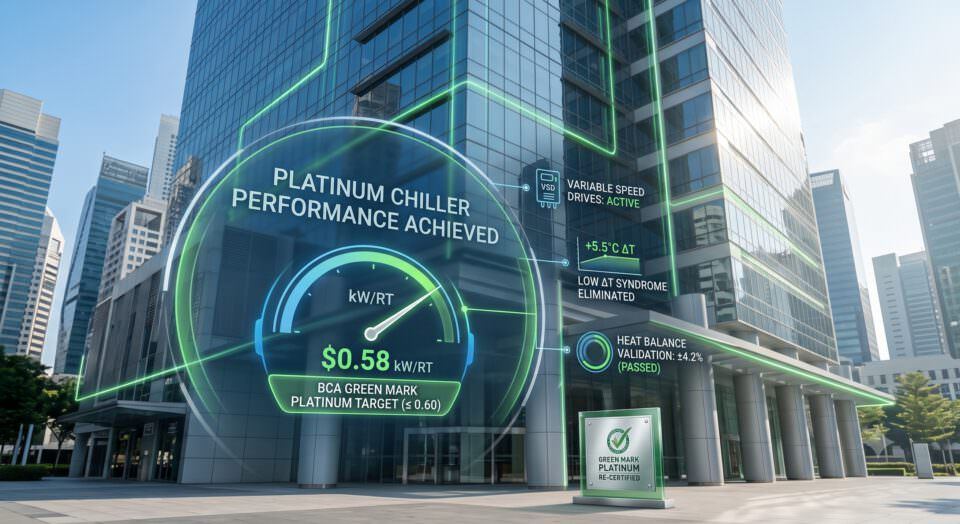
Achieving BCA Green Mark Platinum status during re-certification no longer relies on theoretical energy models. Under the Green Mark framework, Platinum designation requires verified, real-time operating data demonstrating that your central cooling system meets stringent efficiency thresholds.
For most existing commercial buildings, central HVAC systems represent 40% to 60% of total electrical consumption. Reaching the Green Mark Platinum benchmark—typically 0.60 kW/RT or better for water-cooled chilled water plants—does not necessarily require a multi-million-dollar capital replacement of your chillers.
Existing assets can bridge the performance gap through targeted system tuning, instrumentation precision, and intelligent control strategies.
1. Upgrade Instrumentation for Data Verification
Before optimizing equipment, you must prove the accuracy of your baseline data. Green Mark auditors reject certification applications supported by uncalibrated sensors or inconsistent thermal calculations.
To pass a Green Mark Platinum audit, your monitoring system must achieve a heat balance validation within ±5% for at least 80% of operating hours.
Heat Balance Error (%)=QcondenserQcondenser−(Qevaporator+Welectrical)×100≤5%
Where:
- Qcondenser = Heat rejected at the condenser (kW or RT)
- Qevaporator = Cooling load produced at the evaporator (kW or RT)
- Welectrical = Total electrical power input to the chiller compressor (kW)
Essential Sensor Upgrades:
- Temperature Sensors: Paired 4-wire RTD sensors (Pt100 or Pt1000) calibrated within ±0.05∘C to accurately capture supply and return differential temperatures (ΔT).
- Flow Meters: Inline electromagnetic flow meters or calibrated clamp-on ultrasonic meters with an uncertainty of less than ±1.0%.
- Power Meters: Class 0.5 or Class 0.2 true-RMS power quality meters dedicated to recording main chiller compressor draw, chilled water pumps, condenser water pumps, and cooling tower fans.
2. Eliminate “Low ΔT Syndrome”
A common obstacle in existing commercial plants is low temperature differential (ΔT) across the chilled water loop. When systems operate at a ΔT of 3.5∘C instead of the designed 5.5∘C, pumps must move significantly more water volume to deliver the same cooling capacity. This overworking of pumps degrades overall system efficiency.
| Parameter | Sub-Optimal Baseline | Platinum Benchmark Target |
|---|---|---|
| Chilled Water ΔT | 3.0∘C−3.8∘C | 5.0∘C−6.0∘C |
| Condenser Water ΔT | 4.0∘C−4.5∘C | 5.5∘C−6.5∘C |
| Plant Efficiency | 0.75−0.85 kW/RT | ≤0.60 kW/RT |
Quick-Win Corrective Actions:
- Fix Air Handling Unit (AHU) Bypass Lines: Balance or replace leaking 2-way and 3-way control valves across tenant spaces to prevent uncooled water from returning to the plant.
- Coil Cleaning and Flushing: Chemical cleaning of fouled AHU and Fan Coil Unit (FCU) coils restores heat transfer rates, allowing return water temperatures to rise to design levels.
- Variable Primary Flow (VPF) Conversion: Retrofitting constant-speed secondary pumps into a unified VPF loop eliminates hydraulic decoupling bypass losses.
3. Implement Dynamic BMS Control Algorithms
Static plant operation—running chillers and pumps at fixed setpoints regardless of weather or occupancy—wastes energy. Platinum-grade assets utilize Building Management Systems (BMS) with adaptive optimization software to make real-time adjustments.
+——————————————————————-+
| Real-Time Operational Inputs |
| (Ambient Wet-Bulb Temp, Tenant Cooling Load, Power Draw, Flow) |
+——————————————————————-+
|
v
+——————————————————————-+
| Dynamic AI / Advanced BMS Algorithm |
+——————————————————————-+
| | |
v v v
+—————+ +——————-+ +—————+
| CHWST Reset | | Condenser Water | | Optimal Plant |
| Optimization | | Temp Optimization | | Sequencing |
+—————+ +——————-+ +—————+
- Chilled Water Supply Temperature (CHWST) Resets: Automatically raise supply temperatures during partial-load conditions (e.g., from 6.8∘C to 8.5∘C during off-peak hours). Every 1.0∘C increase in supply temperature improves chiller efficiency by roughly 2% to 3%.
- Condenser Water Entering Temperature (CWET) Reset: Modulate cooling tower fan speeds to lower entering condenser water temperatures based on ambient wet-bulb conditions, directly reducing compressor lift work.
- Equi-Margin Equipment Sequencing: Run multiple chillers at their sweet spot (typically 60% to 80% part-load ratio) rather than running one chiller at 100% capacity and a secondary unit at 20%.
4. Target Specific Components with High-ROI Retrofits
When operational tuning is insufficient to breach the 0.60 kW/RT threshold, targeted equipment retrofits provide a cost-effective path to compliance without requiring complete chiller replacements.
Total Plant Efficiency = Chiller Power + Pump Power + Tower Fan Power
<= 0.60 kW/RT
- Variable Speed Drives (VSDs): Install VSDs on all condenser pumps, chilled water pumps, and cooling tower fans if they currently run on fixed frequencies.
- Compressor Overhauls / Variable Speed Retrofits: Upgrade existing fixed-speed centrifugal or screw chillers with VSD drives or magnetic-bearing oil-free retrofits to dramatically improve part-load EER/COP.
- High-Efficiency Cooling Tower Infills: Replace degraded drift eliminators and infills to lower approach temperatures (aiming for an approach temperature within 1.5∘C to 2.0∘C of ambient wet-bulb temperature).
- Electronically Commutated (EC) AHU Fans: Upgrading airside centrifugal fans to EC plug fans lowers air distribution power consumption, contributing directly to Total System Efficiency (TSE) requirements.
5. Prepare the Re-Certification Audit Trail
Passing the BCA Green Mark re-certification audit requires documented performance consistency over time.
- Continuous Data Logging: Ensure your Energy Management System (EMS) logs key metrics (kW, RT, flow rates, temperatures, kW/RT) at maximum 1-minute to 5-minute intervals.
- Third-Party Calibration Certificates: Maintain valid calibration certificates for all power meters, flow meters, and temperature sensors (typically calibrated within the last 3 years).
- 12-Month Operating Report: Compile a 12-month performance baseline showing both individual equipment efficiency and integrated plant efficiency across full operating schedules.
Are you preparing for an upcoming Green Mark re-certification audit, or are you looking to assess the current baseline kW/RT of your asset’s cooling system first?