
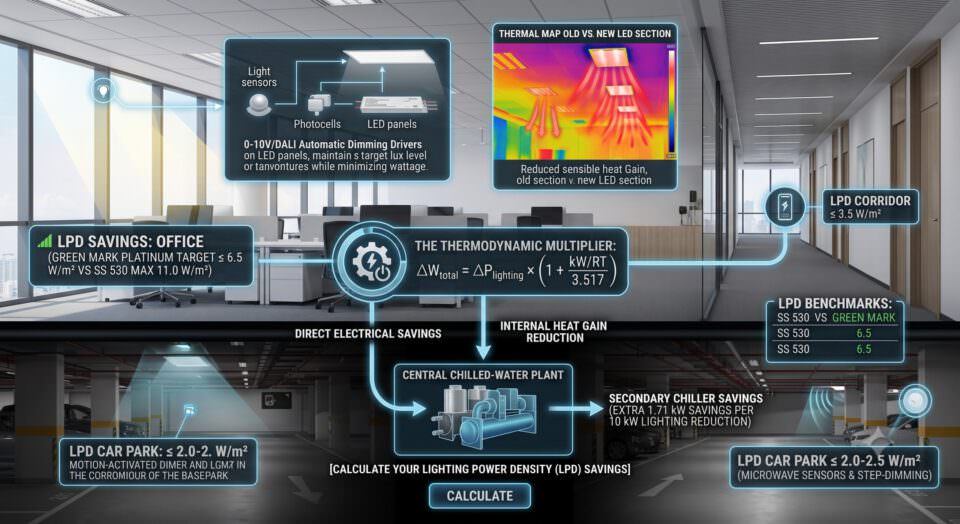
Reducing Internal Heat Gain: LED Retrofits, Lux Controls, and Lighting Power Budgets
Every watt of electricity drawn by an indoor luminaire converts into heat inside your air-conditioned space. For facility managers and fit-out contractors in Singapore, lighting upgrades are often evaluated solely on direct electrical savings. However, the thermodynamic impact on a building’s central chilled-water system is equally significant.
Lowering your space’s Lighting Power Density (LPD) in accordance with Singapore Standard 530 (SS 530)reduces internal sensible heat gains. This directly decreases the thermal load on air handling units (AHUs) and lowers the energy required by central chillers to maintain tenant comfort.
1. The Thermodynamic Multiplier: Direct vs. Indirect Energy Savings
In tropical climates like Singapore, air conditioning systems run continuously to extract heat from commercial interiors. Because luminaires operate within the building thermal envelope, 100% of the electrical energy supplied to a light fixture generates internal thermal load.
When you eliminate 1 kW of lighting power through an LED retrofit or automated dimming, you achieve two simultaneous energy reductions:
-
Direct Electrical Savings: The 1 kW drop in lighting power draw.
-
Indirect HVAC Savings: The compressor work eliminated at the chiller plant to extract that equivalent heat gain.
Calculating Combined Power Reduction
The total systemic power reduction ($\Delta W_{\text{total}}$) achieved by cutting internal lighting wattage is expressed by:
Where:
-
$\Delta P_{\text{lighting}}$ = Direct electrical power reduction from lighting (kW)
-
$\text{kW/RT}$ = Central chilled-water plant operational efficiency (e.g., $0.60\text{ kW/RT}$)
-
$3.517$ = Thermal conversion constant ($1\text{ RT} = 3.517\text{ kW}_{\text{thermal}}$)
Key Takeaway: In a building operating with a $0.60\text{ kW/RT}$ plant, every 10 kW reduced in lighting load saves an additional 1.71 kW of electrical power at the chiller plant. Over a 3,000-hour operational year, this secondary benefit adds thousands of kilowatt-hours in indirect energy savings.
2. SS 530 Benchmarks & Target Lighting Power Densities
Singapore Standard SS 530 (Code of Practice for Energy Efficiency Standard for Building Services and Equipment) establishes the statutory maximum allowable LPD for various building spaces.
To achieve high-tier BCA Green Mark certifications (such as Platinum or Super Low Energy), fit-out designs must push well below these mandatory baseline thresholds.
| Space Category | SS 530 Max Limit (W/m2) | Green Mark Platinum Target (W/m2) | Common Optimization Strategy |
| Open-Plan Offices | $11.0$ | $\le 6.5 – 7.5$ | High-efficacy LED panels ($>130\text{ lm/W}$) + Task lighting |
| Executive Offices | $13.0$ | $\le 8.0$ | Architectural recessed LEDs with occupancy sensing |
| Corridors / Restrooms | $6.0$ | $\le 3.5$ | PIR motion sensors & scheduled step-dimming |
| Basement Car Parks | $5.0$ | $\le 2.0 – 2.5$ | Microwave sensor-equipped LED battens ($100\%\rightarrow20\%$ dim) |
| Retail Spaces | $19.0$ | $\le 12.0$ | High-CRI accent LEDs with localized lux budgeting |
3. Beyond LED Chips: Implementing Smart Lux Controls
Replacing legacy fluorescent T8 tubes with LED fixtures is only step one. Achieving deep reductions in internal heat gain requires dynamic lux control strategies that reduce overall burner hours.
+-----------------------------------------------------------------------+
|                       Dynamic Lux Control Loop                        |
+-----------------------------------------------------------------------+
                                    |
            +-----------------------+-----------------------+
            |                                               |
            v                                               v
+-----------------------+                       +-----------------------+
|  Daylight Harvesting  |                       |   Occupancy Sensing   |
|   Photocell Sensors   |                       |    (PIR / Microwave)  |
+-----------------------+                       +-----------------------+
            |                                               |
            +-----------------------+-----------------------+
                                    |
                                    v
+-----------------------------------------------------------------------+
|               0-10V / DALI Automatic Dimming Driver                   |
|       (Maintains Target Lux while Minimizing Wattage & Heat)          |
+-----------------------------------------------------------------------+
Key Control Architectures:
-
Daylight Harvesting: Perimeter zones within 3 to 5 meters of window facades experience significant natural light. Integrating photocell sensors connected to 0-10V or DALI dimming drivers automatically scales down artificial lighting levels to maintain a constant 300–500 lux desk surface target.
-
Occupancy & Motion Sensing: In spaces with transient occupancy—such as stairwells, storerooms, and multi-storey car parks—microwave or PIR sensors dim lighting down to a 10% or 20% standby level when unoccupied, cutting both baseline power draw and continuous heat emission.
-
Task-Ambient Lighting Design: Instead of illuminating an entire office floor uniformly to 500 lux, design fit-outs for a 200–300 lux ambient base level paired with localized 500 lux LED task lights at workstation desks.
4. Impact on Airside System Sizing for Fit-Out Contractors
For fit-out contractors and Mechanical & Electrical (M&E) engineers, designing spaces with aggressive LPD targets directly impacts mechanical system sizing:
-
Lower Supply Air Volume Requirements: Lower sensible heat gains allow air handling units (AHUs) and variable air volume (VAV) terminal boxes to run at reduced CFM rates, trimming fan energy consumption.
-
Preventing Low $\Delta T$ at Cooling Coils: Excess internal heat loads often force chilled-water control valves wide open, which can overwhelm local AHU coils. Lowering internal heat gain maintains design supply/return water temperature differentials across local cooling loops.
-
Reduced Airside Static Pressure: Reduced airflow demands translate into lower duct static pressures, extending filter life and lowering noise levels across tenant spaces.
Ready to quantify the combined electrical and cooling load impact on your asset’s energy profile?
[Calculate Your Lighting Power Density (LPD) Savings]