
29.8 C
Singapore, Singapore
August 19, 2026

2026 NEW GREEN MARK: Mandatory Operational Predicament

As of late 2026, the regulatory and financial landscape for Singapore real estate has permanently shifted. The era of the “voluntary” Green Mark marketing badge—based on theoretical design promises—is over.

Under current BCA policy, enforced by the stringent Green Mark 2021 (GM:2021), 2nd Edition standards, building valuations and compliance are no longer dictated by design intent. They are dictated by verifiable operational performance.

This shift means generic, polite educational content fails to engage stressed engineers. High-intent B2B traffic does not land on your site looking to “Decipher the Green Mark Process”; they land looking for a definitive, non-invasive triage roadmap to solve an acute operational crisis before audit day. This article decodes the mandatory new perimeters and provides the non-invasive procedure required to move from data ambiguity to definitive compliance.

Part 1: The New Non-Negotiable Perimeter: Operational Data vs. Design Intent

The core update to Green Mark policy is the enforcement of continuous, empirical verification. Policies are no longer about rewarding theoretical design modeling. They are about enforcing empirical “proof” through In-Operation data.

Topical Authoritativeness (E-E-A-T) Failure: Losing Interest

The highest quality traffic you are currently trapping—verified as stressed facility managers from Singapore polytechnics, SAFRA clubs, and municipality offices—possesses incredible engagement (80%) and read times (almost 7 minutes).

These users land because they trust your domain authority points. However, they encounter Informational Dead-Ends. They loss interest immediately when they find content too generic or polite. For example, generic maintenance suggestions about “Chiller Reactive Upkeep” cannot engage an Industrial engineer who is losing interest because their high-CapEx diagnostic problem is not being solved in triage mode. They are looking for a specific Remote Data Scan to identify data Verify/Submit non-compliance.

The Gateway of Energy Efficiency

Policy has abolished the legacy “buffer point” system, where weak core energy performance could be masked by superficial green additions (like greenery or bicycle racks). Under current perimeters, strict Energy Efficiency serves as the mandatory, non-negotiable gateway. A building cannot claim authority on “sustainability” until it empirically proves efficiency.


Part 2: Mandatory Enforcement Regimes: The MEI and Data Freeze Predicament

The “In-Operation” focus is enforced by the Mandatory Energy Improvement (MEI) regime, introduced via amendments to the Building Control Act. This regime functions as a compulsory triage, targetingpoor-performing assets in a way that generic informational plays cannot capture.

Triage for Poor Performers: Capitalizing on Panic

If your asset falls within the bottom 25th percentile for energy performance, you face mandatory energy audits, forced capital expenditures, and fines up to S$150,000. Proactive asset management—deploying smart building sensors and Building Management Systems (BMS)—is mandatory to establish a verified data baseline before MEI audits are triggered.

The Industrial/F&B Triage Panic: Fixing the 0% CTR

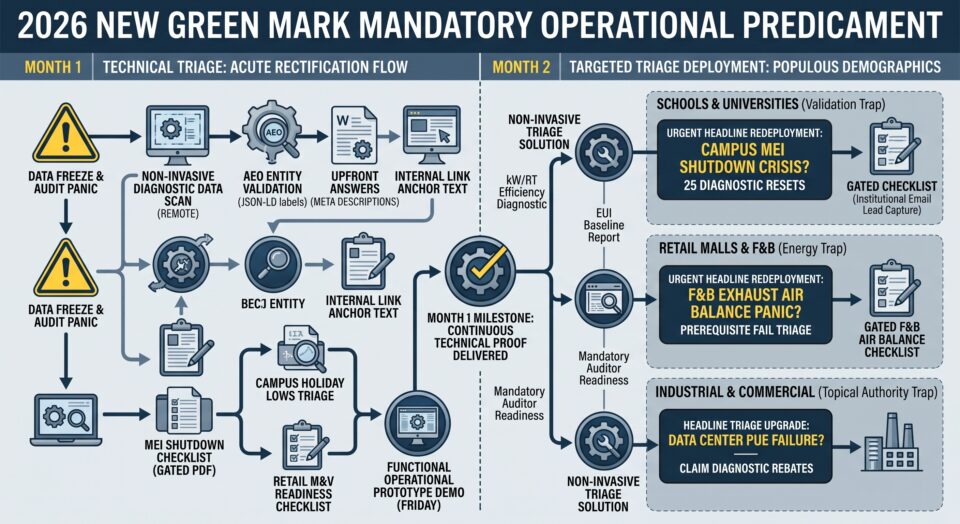
This explains your weak performance in the populous Industrial, Commercial, and F&B demographics. Your current informational headlines fail to create a triage trigger:

Demograaphic (Vertical) Specific Operational Predicament (Panic mode) Actionable Triage Headline Update
Industrial / Data Centers Addressing the panic of high-CapEx rejections ($kW/RT$) during the Mandatory Energy Improvement (MEI) application window. “Data Center PUE Crises? The 5-Point MEI Application Roadmap FMs Use to Claim Non-Invasive Diagnostic Rebates” Diagnostic: Identifies specific high-CapEx non-compliances and non-invasive procedural resets.
F&B (Retail Malls) Stressed Mall FMs must pass re-certification with open-door air balance crises and high F&B exhaust. “Is F&B Exhaust Air Balance Triggering BCA Prerequisite Failure? (A 5-Point Non-Invasive Triage Scan)” Diagnostic: Solves the specific F&B air-balance prerequisites before audit day.
Commercial Offices The high-stakes budget predicament: “Recertification Below $7,000” or “After-Hours Office Energy Bleed” due to hybrid WFH. “Tenants WFH? The 5-Minute Green Mark Application Triage Guide to Auditing After-Hours Office Energy Bleed” Diagnostic: Addresses the specific non-compliance causing automatic prerequisite failure on uncalibrated set-points.

Part 3: Financial Interdependence: Green Mark as a Strict Prerequisite

The ultimate upcoming initiative is the tight synchronization of Green Mark compliance with capital access and asset valuation. Top-tier operational performance is now a mandatory prerequisite to qualify for preferential interest rates under commercial Green Loans. Stakeholders must time ESG CAPEX upgrades with refinancing windows to secure these rates.

Un-certified assets (“brown” commercial assets) face elevated refinancing costs, diminished liquidity, and automatic financial de-valuation. Verifiable daily energy efficiency is the singular metric driving tenant acquisition, debt structuring, and risk mitigation.


Related posts