
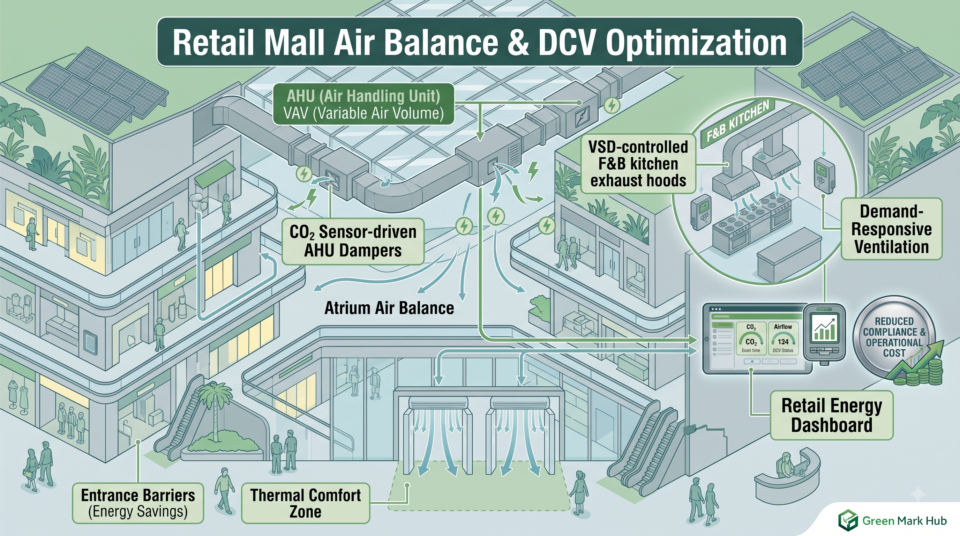
Retail mall management teams, retail REIT asset directors, and property managers face a continuous energy battle: uncontrolled air loss.
Whether managing an Orchard Road flagship mall or a suburban heartland shopping center, the property’s physical design works directly against energy efficiency.
High footfall through open-front entrances, massive atrium glass facades, and dozens of tenant F&B kitchens running heavy exhaust hoods continuously drain conditioned air out of the building.
When a BCA Green Mark re-certification or MEI trigger occurs, mall operators worry that meeting EUI reduction targets will force them to restrict tenant operations or create uncomfortable, warm shopping environments that drive foot traffic away.
The Core Challenge: Atrium Bleed & F&B Exhaust Loads
Retail complexes suffer from two primary operational energy drains:
-
Entrance & Atrium Infiltration: Open-door retail concepts and high entrance traffic cause cold air to spill out and warm, humid ambient air to rush in, forcing central chillers to work overtime on latent cooling (dehumidification).
-
Unregulated F&B Kitchen Exhaust: Tenant kitchens continuously draw thousands of cubic meters of conditioned air out of the mall mall concourse through exhaust hoods, creating negative building pressure if fresh air intake is not dynamically balanced.
The Mall Compliance Strategy
Achieving Green Mark for Existing Buildings (GM:2021) in a retail environment requires smart air balance automation rather than tenant restrictions:
-
Demand Control Ventilation (DCV) with CO₂ Sensors: Foot traffic in malls fluctuates wildly between weekday mornings and weekend peaks. Installing CO₂ sensor-driven controls on Air Handling Units (AHUs) automatically modulates fresh air intake—reducing cooling energy during low-traffic hours while keeping air crisp during weekend rushes.
-
Kitchen Exhaust Variable Speed Drives (VSDs): Equipping tenant kitchen exhaust systems with optical/temperature-sensing VSDs ensures exhaust fans scale down when cooking activity is low, preventing conditioned concourse air from being needlessly dumped outside.
-
Entrance Air Curtain & Pressure Balancing: Optimizing entrance air curtain velocity vectors and adjusting lobby supply fans maintains neutral building pressure, stopping humid outside air from penetrating the ground floor.
The Bottom Line
A retail mall can pass Green Mark re-certification with flying colors without altering tenant leasing rules or compromising shopper comfort. Dynamic ventilation controls turn footfall fluctuations into automatic energy savings.