
For hospital facility directors, clinic cluster managers, and medical lab operations heads, receiving a Mandatory Energy Improvement (MEI) notice or Green Mark re-certification deadline triggers a high-stakes operational dilemma.
In a clinical environment, indoor environmental quality (IEQ) isn’t just about occupant comfort—it is a matter of life safety.
Infection control protocols, Ministry of Health (MOH) guidelines, and international healthcare standards dictate non-negotiable parameters: strict air exchange rates, mandatory positive/negative pressure differentials for isolation rooms, precise humidity control to prevent pathogen growth, and continuous cleanroom filtration.
Facility managers frequently fear that tuning HVAC systems or lowering airflow to hit BCA’s 10% Energy Use Intensity (EUI) reduction target will violate MOH compliance or compromise patient care.
The Core Challenge: Rigid Clinical Codes vs. EUI Targets
Standard commercial energy-saving tactics—such as raising chilled water supply temperatures, throttling fresh air intake, or turning off air handling units (AHUs) during off-peak hours—cannot be blindly applied in a healthcare setting.
Doing so risks filter moisture buildup, pressure differential collapse in operating theaters, and cross-contamination in wards.
The Non-Invasive Healthcare Strategy
To achieve BCA compliance while preserving strict clinical safety, healthcare facilities must focus on non-clinical energy recovery loops and precision M&V diagnostics:
-
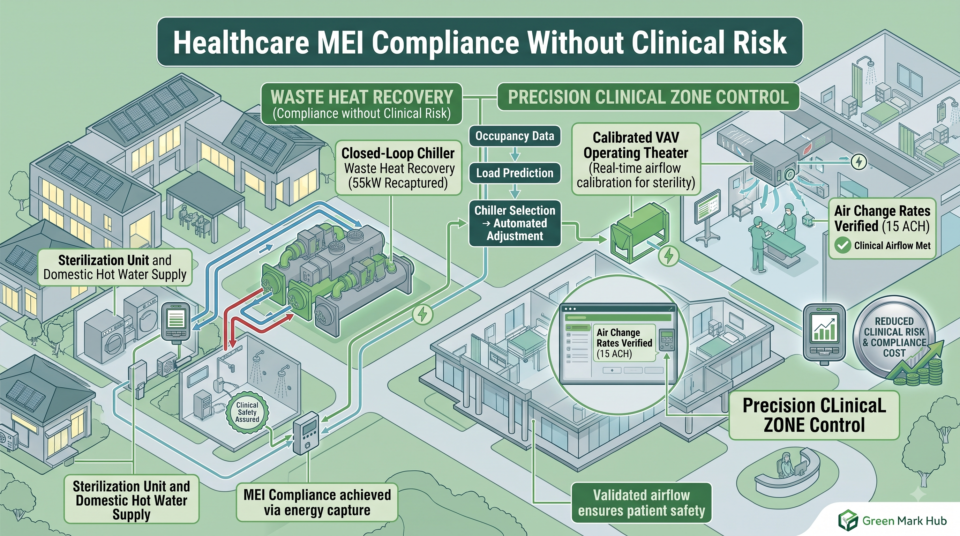
24/7 Condenser Waste Heat Recovery: Hospitals require massive volumes of domestic hot water around the clock for sterilization, laundry, and patient sanitation. By installing heat-recovery chillers or desuperheaters on central cooling plants, waste heat from the air-conditioning loop is captured to generate free hot water—cutting boiler gas/electric loads to zero while improving chiller efficiency ($kW/RT$).
-
Precision Airflow & VAV Calibration: Rather than reducing total air volume, engineers perform advanced Measurement & Verification (M&V) to calibrate Variable Air Volume (VAV) terminal boxes and static pressure sensors. This ensures cleanrooms and operating suites receive exact design air exchanges without fan over-pressurization.
-
Sub-Metered Process Isolation: Isolating heavy medical equipment (MRIs, CT scanners, lab sterilizers) from comfort cooling baselines ensures clinical process energy does not artificially inflate the building’s audited HVAC EUI score.
The Bottom Line
Healthcare energy compliance does not require risking patient safety or violating MOH codes. By focusing on 24/7 waste heat recovery and precision M&V airflow balancing, hospitals achieve Super Low Energy performance invisibly.