For industrial building owners and Management Corporation Strata Title (MCST) councils governing B1 flatted factories and B2 manufacturing estates, annual budgeting meetings often hit an impasse:
- Escalating Common Area Maintenance (CAM) Utilities: Landlords and MCSTs absorb the electricity costs for common-area central cooling, mechanical ventilation, corridor lighting, and high-volume cargo lifts. As retail electricity tariffs fluctuate around S$0.28 – S$0.35/kWh common-area utility bills drain sinking and management funds.
- The 3-Year Green Mark Re-Certification Cliff: Mandatory BCA Green Mark re-certification cycles penalize aging central mechanical plants that have degraded beyond the statutory
0.85\text{ kW/RT}benchmark. However, strata owners resist upfront special levies to overhaul central chillers.
The financial and regulatory bridge to resolve both issues is Rent-to-Own (RTO) Solar Financing tied to Energy Market Authority (EMA) Grid Buybacks.
┌────────────────────────────────────────────────────────────────────────┐
│                   RENT-TO-OWN (RTO) SOLAR CASH FLOW                    │
└───────────────────────────────────┬────────────────────────────────────┘
                                    │
    ┌───────────────────────────────┴───────────────────────────────┐
    ▼                                                               ▼
[ Self-Consumed Solar ]                                   [ Surplus Exported to Grid ]
Directly powers Common Area Chilled Water,                SP Group SCT / ECIS Scheme Credit
Pumps, Mechanical Ventilation, & Lift Risers              (Earns ~S$0.20 to S$0.25/kWh)
    │                                                               │
    └───────────────────────────────┬───────────────────────────────┘
                                    │
                                    ▼
         [ Common Area Utility Bill Drops by 25% to 45% ]
                                    │
                                    ▼
       [ Monthly Savings Exceed Fixed RTO Lease Payments ]
             Surplus Cash Poured Back into Sinking Fund
                                    │
                                    ▼
         [ Whole-Building EUI Drops by 12% to 18% ]
      Green Mark Platinum / SLE Re-Certification Secured
How Rent-to-Own (RTO) Solar Operates in Industrial Estates
Unlike a standard Power Purchase Agreement (PPA)—where a third-party vendor owns your roof for 20 to 25 years and charges you for the power generated—Rent-to-Own (Solar Leasing) is a structured lease-to-own pathway:
- S$0 Initial Outlay: The system is engineered, procured, and installed with zero capital expenditure (CapEx) drawn from your operational or sinking funds.
- Fixed Operating Expense (OpEx): The estate pays a predictable, fixed monthly equipment lease fee over a 5 to 7 year term.
- Full Asset Transfer at S$1: At the end of the term, ownership of the entire rooftop array transfers directly to the building owner or MCST for a nominal sum, yielding 15+ years of unencumbered free electricity generation.
Monetizing Surplus via EMA Energy Buyback Schemes
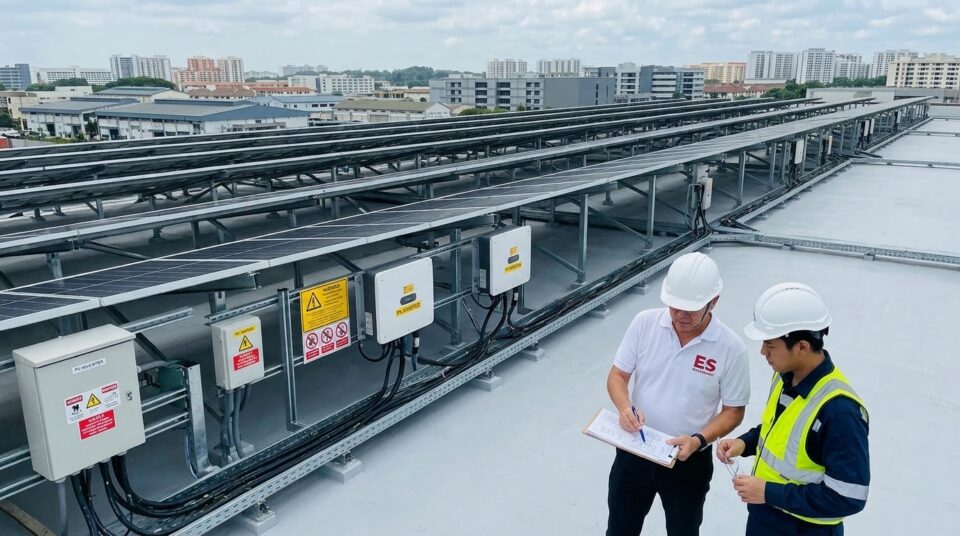
Industrial rooftops typically feature large, unobstructed slab footprints that allow for significant solar capacity (300–800kWp). On weekends, public holidays, or during off-peak shifts when tenant operations scale down, solar arrays often generate more electricity than common-area systems consume.
This surplus is not wasted; it is exported back to the national grid through Energy Market Authority (EMA) buyback frameworks:
1. Simplified Credit Treatment (SCT) Scheme
For non-contestable accounts or facilities below $1\text{ MWac}$ connected directly to SP Group, export credits are credited at the prevailing regulated tariff minus network grid charges. In 2026, this delivers a stable return of approximately\text{S\$}0.20\text{--}\text{S\$}0.25/\text{kWh}applied directly as an offset against your monthly SP Services utility statement.
2. Enhanced Central Intermediary Scheme (ECIS)
For contestable commercial consumers who procure electricity through an Open Electricity Market (OEM) retailer, surplus power exported to the grid is settled half-hourly at the Uniform Singapore Energy Price (USEP). This cash-equivalent credit directly lowers the net balance payable on the estate’s consolidated monthly power bill.
Net Common Area Utility Bill = (Grid Import × Retail Tariff) - (Exported Solar Surplus × SCT/ECIS Rate)
The resulting utility savings immediately exceed the fixed monthly RTO lease installment, creating positive net cash flow from month one.
The Re-Certification Lever: Bridging the EUI Deficit
When your building approaches its statutory 3-year BCA Green Mark re-certification audit, degraded chiller efficiency (0.85\text{ kW/RT}) poses a direct risk of rating downgrade or audit non-compliance.
Under BCA Green Mark: 2021 (GM:2021) Pathway 1, building energy performance is evaluated on Energy Use Intensity (EUI):
\text{EUI} = \frac{E_{\text{grid}} (\text{kWh/yr}) - E_{\text{solar}} (\text{kWh/yr})}{\text{GFA } (\text{m}^2)}
Because onsite solar generation is subtracted directly from gross utility consumption, an industrial RTO solar installation:
Mathematically Lowers EUI by 12%–18%: This bridges central chiller performance deficits without touching tenant manufacturing lines or requiring an immediate central plant replacement.
Protects Sinking Funds: Preserves reserve cash balances for scheduled lift, structural, or facade works while securing Green Mark Platinum or Super Low Energy (SLE) status.
Paves the Way for GMIS-EB 2.0: Pairing the solar EUI baseline with minor air-side sensor retrofits positions the building to capture up to 50% (S$600k–S$1.2M) in BCA GMIS-EB 2.0 co-funding for future chiller modernization.
Urgent Technical Triage & Pre-Assessment Callout
Slash Common Area Utility Overheads & Guarantee Green Mark Re-Certification
Stop letting rising retail power tariffs drain your MCST funds while worrying about your upcoming BCA 3-year audit.
Rent-to-Own & Buyback Feasibility Modeling: Calculate exact rooftop yields, common-area consumption offsets, and net SCT/ECIS export cash flows.
Audit-Ready EUI Modeling: Map onsite solar generation directly into your building’s GM:2021 compliance baseline to secure re-certification without plant shutdowns.
GMIS-EB 2.0 Capital Roadmap: Structure qualifying air-side and sensor upgrades to lock in up to 50% (S$600k–S$1.2M) in government co-funding.