
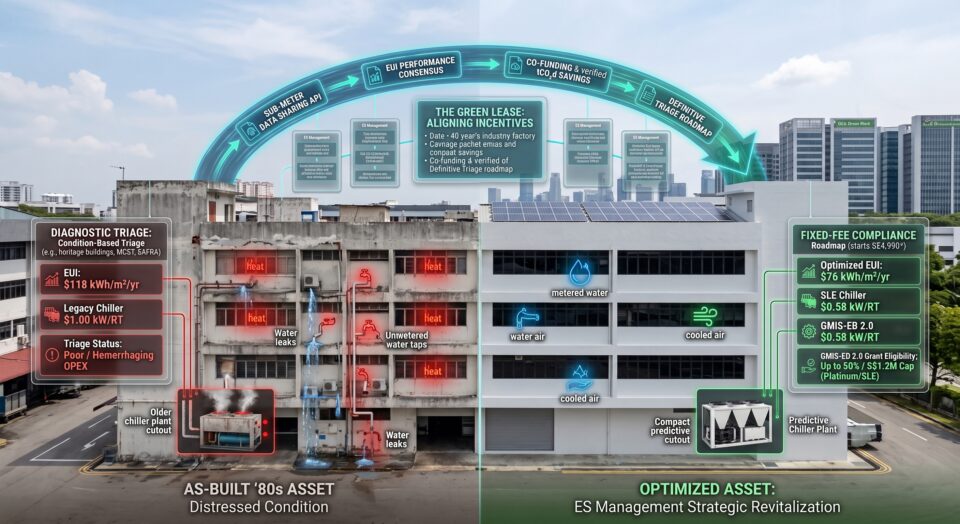
If your commercial or light industrial building was built between 1980 and 1990, you are managing an asset in distress.
For four decades, these 40-year-old existing buildings served their purpose reliably. Today, they are operational liabilities. They are hemorrhaging money in utility costs, falling into the bottom quartiles of BCA’s energy benchmarks, and face a rapidly intensifying threat of the “Brown Discount”—asset valuation decay as tenants demand compliant Green Mark space.
Under the new Mandatory Energy Improvement (MEI) regime and the BCA Green Mark 2.0 (GM:2021) framework, managing a 40-year-old asset requires transitioning from reactive maintenance to a comprehensive revitalization triage.
Demolition is not the only answer. Revitalizing an aging Singapore asset through data-driven retrofits can generate massive operational savings, secure substantial government co-funding, and extend its functional life by 20 to 30 years without the embodied carbon of new construction.
1. The 1.20 \text{ kW/RT} Barrier: Identifying the Triage Priorities
A 40-year-old building suffers from systemic efficiency gaps that a modern asset does not face. The triage begins with identifying the single biggest operational hemorrhage.
Singapore Chiller Plant Performance Triage

[ LEGACY baseline ] ───────► [ OPTIMIZED baseline ] ──────► [ SLE / PLATINUM ]
 1.10 \text{ to } 1.30 \text{ kW/RT}     $0.80 \text{ to } 0.90 \text{ kW/RT}$     0.58 \text{ kW/RT}
(Operational Hemorrhage)         (Basic Compliance)               (Market Leader)
-
Ancient Chiller Plants: While a 10-year-old building might only need variable speed drive (VSD) optimization, a 40-year-old building is often operating whole-building cooling systems with baselines exceeding 1.10 \text{ to } 1.30 \text{ kW/RT}. Moving this to a modern
0.58 \text{ kW/RT}configuration generates immediate whole-building Energy Use Intensity ($\text{EUI}$) reductions of 40% to 50%.
-
Infrastructure Obsolescence: BEMS and control protocols are outdated, making basic automation impossible. Building distribution panels lack adequate sub-metering, preventing any meaningful Energy Data Sharing needed for MEI.
-
Tenant Load Shift: The building’s original thermal load design (built pre-internet) is fundamentally incompatible with the heat density of modern digital tenant loads.
2. Demolition vs. Revitalization: The Embedded Carbon Advantage
Property owners often assume that the physical condition of a 40-year-old estate makes retrofitting impractical. This is rarely true. In Singapore’s land-scarce environment, preserving an existing asset through an operational revitalization offers superior ROI and environmental outcomes:
-
Zero Embedded Carbon: Upgrading central plants and controls avoids the massive carbon emissions associated with the demolition and construction of concrete and steel, aligning with Whole Life Carbon credits.
-
Uninterrupted Income: AI software overlays and control retrofits can often be implemented without any operational disruption to existing tenants.
-
Budget Certainty: A total revitalization through new hardware replacement is expensive. A triage-based revitalization leverages AI optimization, sub-meter data, and target hardware updates to solve 80% of the efficiency gap for 20% of the CAPEX of demolition.
3. High-ROI Triage Pathways for Aging Assets
The triage protocol focuses on high-impact, low-disruption interventions first:
A. AI Predictive Control Overlay
Installing advanced, cloud-based AI predictive control platforms to sit on top of legacy BMS. These dynamically manage chiller plant parameters (such as supply water temperatures) based on 24/7 data, forcing legacy hardware to run efficiently without requiring full replacement.
B. ACMV and AHU Fan Retrofits
Retrofitting old, constant-speed AHU fans with advanced Variable Speed Drives (VSDs) and EC motors, reducing fan power consumption by up to 50% during non-peak load conditions.
C. Smart Sub-Metering and IEQ Sensor Deployment
Installing smart sub-meters (as required for Green Mark Maintainability Badge) and Indoor Environmental Quality (IEQ) sensors to provide granular data on both energy use and tenant comfort, creating the necessary data baseline for continuous optimization and MEI compliance submissions.
4. Securing Grants for Obsolete Assets
BCA actively incentivizes the revitalization of old properties through the Green Mark Incentive Scheme for Existing Buildings (GMIS-EB 2.0).
Because 40-year-old assets have the most severe performance baselines, they often represent the highest carbon abatement potential (\text{tCO}_2\text{e}). This makes them prime candidates for maximum grant funding:
-
Up to 50% Co-Funding for ACMV replacements, smart control overlays, and auditing.
-
Capital Support Capped at S$1.2M for assets achieving Super Low Energy (SLE) standards.
-
Immediate OPEX Relief: Utility savings can reach S$10,000 to S$30,000+ per month for large, obsolete industrial/commercial sites, quickly offsetting the non-grant portions of the revitalization budget.
Regulatory & Compliance Disclaimer
Disclaimer: Information provided regarding the revitalization of aging assets, Green Mark 2.0 (GM:2021) credit metrics, and government co-funding schemes (GMIS-EB 2.0) is intended for educational and technical planning purposes. Grant eligibility, credit allocations, and specific EUI outcomes depend on a baseline energy audit, asset condition assessment, and formal evaluation by the Building and Construction Authority (BCA). ES Management provides independent engineering consultancy and does not guarantee specific grant application approvals without technical scoping.
Save Your Estate Before Obsolescence
Managing a 40-year-old building does not have to be a slow descent into financial obsolescence or regulatory penalties.
At ES Management, we specialize in transforming distressed legacy Singapore properties into competitive, high-performance green assets:
-
Fixed-Fee Certainty: Complete Green Mark assessment, energy auditing, and MEI compliance roadmaps starting at a flat S$6,990 per asset (T&Cs Apply). Budget predictability.
-
Grant Maximization: We structure retrofit roadmaps and baseline analyses specifically to maximize capital recovery through GMIS-EB 2.0.
-
Data-Driven Triage: We prioritize non-invasive AI controls and targeted retrofits that extend asset life and maximize ROI, rather than defaulting to generic, expensive demolition.
Don’t accept that your aging asset is obsolete. Contact ES Management today for an executive pre-assessment of your 40-year-old property’s revitalization potential.