
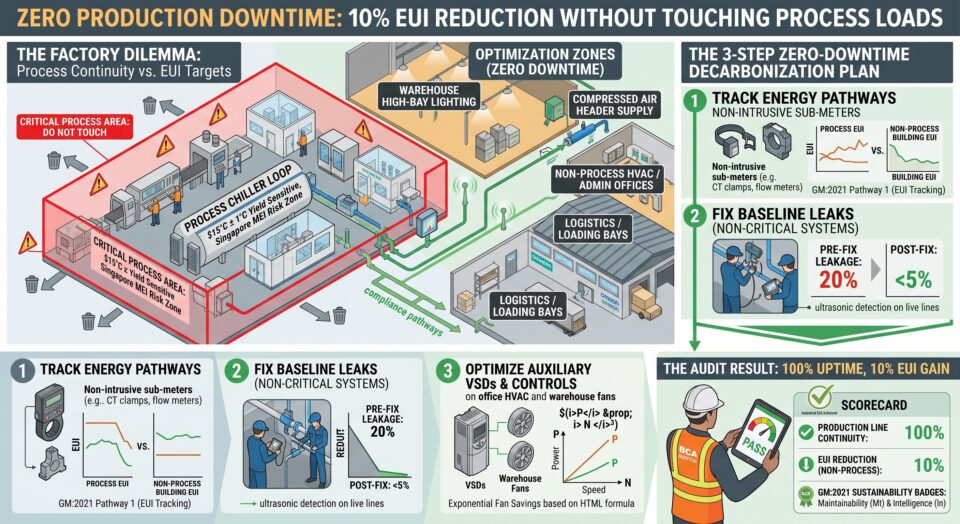
For plant directors, facility managers, and operations leads in Singapore’s industrial and logistics hubs, achieving energy efficiency targets presents a delicate balancing act. Under the GM:2021 (Green Mark 2021) scheme and mandatory Mandatory Energy Improvement (MEI) mandates, industrial facilities must achieve targeted Energy Use Intensity (EUI) (kWh/m2/yr) reductions. However, modifying process cooling loops—chillers, cleanroom HVAC, or manufacturing thermal management systems—carries unacceptable risks of production downtime, process parameter shifts, and expensive product yield losses.
Hitting a 10% EUI reduction does not require touching mission-critical manufacturing operations. By strategically isolating non-process energy sinks and optimizing ancillary systems, industrial facilities can pass BCA audits without a single second of factory line interruption.
Where Industrial Energy Drift Hides (Outside the Production Line)
In 24/7 manufacturing plants and automated logistics hubs, significant baseline energy waste occurs outside core manufacturing equipment:
-
High-Bay & Perimeter Lighting Power Density (LPD): Warehouse high-bays, loading bays, and multi-tier mezzanine racks often operate full-output metal-halide or early-gen LED fixtures 24 hours a day, inflating non-process base loads.
-
Compressed Air Line Leaks & Uncontrolled Pressure Drop: Compressed air systems frequently consume up to 20% of an industrial site’s total electricity. Unmonitored piping leaks, improper receiver sizing, and over-pressurized header distribution act as continuous baseline leaks.
-
Non-Process HVAC & Admin Space Over-Cooling: Administrative offices, packing areas, and non-classified buffer zones often share cooling circuits with high-load industrial areas, leading to severe localized over-cooling and fan power waste.
-
Un-Optimized Mechanical Ventilation in Logistics Warehouses: Large-volume warehouses running constant-speed exhaust and supply fans continuously draw unconditioned ambient heat and humidity into storage areas, forcing auxiliary cooling systems to work overtime.
The Audit Risk: Fan Power Limits & EUI Baselines
When BCA auditors inspect industrial assets for GM:2021 re-certification, operational non-compliance typically stems from secondary support systems rather than process equipment:
-
Excessive Fan Power Density ($W/CMH$): Constant-volume AHUs and general ventilation systems running without variable speed controls often exceed maximum allowable fan power density thresholds.
-
Lack of Operational Sub-Metering: Under GM:2021 Pathway 1 (EUI Tracking) and Intelligence (In) badge requirements, failure to separate process cooling energy from non-process building energy prevents facilities from proving baseline efficiency gains to auditors.
The 3-Step Zero-Downtime Decarbonization Plan
1. Isolate Process vs. Non-Process Energy via Sub-Metering
Install smart, non-intrusive sub-meters (such as wireless CT clamps and flow meters) to segregate process cooling loads from building envelope loads. By proving to BCA auditors that process loads remain distinct, you can apply EUI reduction targets strictly to non-critical auxiliary infrastructure.
2. Optimize High-Bay Lighting & Compressed Air Systems
-
Smart Motion & Lux Sensing: Retrofit warehouse high-bays and aisle lighting with daylight-harvesting and occupancy sensors to achieve instant 40–60% lighting load reductions.
-
Ultrasonic Leak Remediation: Conduct live-line ultrasonic compressed air leak detection and install demand-side storage receivers. Fixing micro-leaks restores system pressure without adjusting compressor set-points or affecting production line pressure.
3. Implement Variable Speed Drives (VSDs) on Non-Critical Fans & Pumps
Retrofit VSDs and automated schedule controls on office HVAC units, loading dock air curtains, and general warehouse ventilation loops. Modulating fan speeds based on real-time occupancy and ambient temperature cuts fan energy exponentially (P ∝ N3) while preserving stable thermal conditions inside the manufacturing plant.
By targeting non-process energy sinks, industrial facility leaders can meet GM:2021 standards, trim operational expenditure (OPEX), and pass BCA spot checks—all while maintaining 100% production uptime and process integrity
Let ES Management handle the hassle. We offer a completely fuss-free Green Mark Re-Certification Consultant service, ensuring you meet BCA’s standards without the headache.
Visit ES.SG/ +65 9107 0587/ eddie@es-mgt.com
Focus on your business while we manage the compliance. Get started today for just S$6990*.
*Terms and conditions apply.